
By David Skilling*
Global economic and geopolitical regime change from the market state to state capitalism has been underway for the past several years, and is accelerating and intensifying.
Macro policy is a core domain on which this global regime change will play out. The demands of geopolitical rivalry will lead to the accumulation of public debt: the post-Cold War peace dividend is over, and governments will need to spend more in areas such as military capability, industrial and innovation policy, and strategic autonomy.
And this will be done from a starting point of record peacetime levels of public debt in the US and other advanced economies. The fiscal situation will increasingly shape and constrain the options open to policy-makers. This represents an important reversal of the policy hierarchy of the past few decades.
Over the past 35 years of the market state, monetary policy has been the central/high-profile part of economic decision-making. Activist/strategic fiscal policy was largely retired across advanced economies in favour of fiscal discipline and fiscal rules. In its place came the central bank maestros, from Alan Greenspan onwards, who assumed outsized importance in economic management.
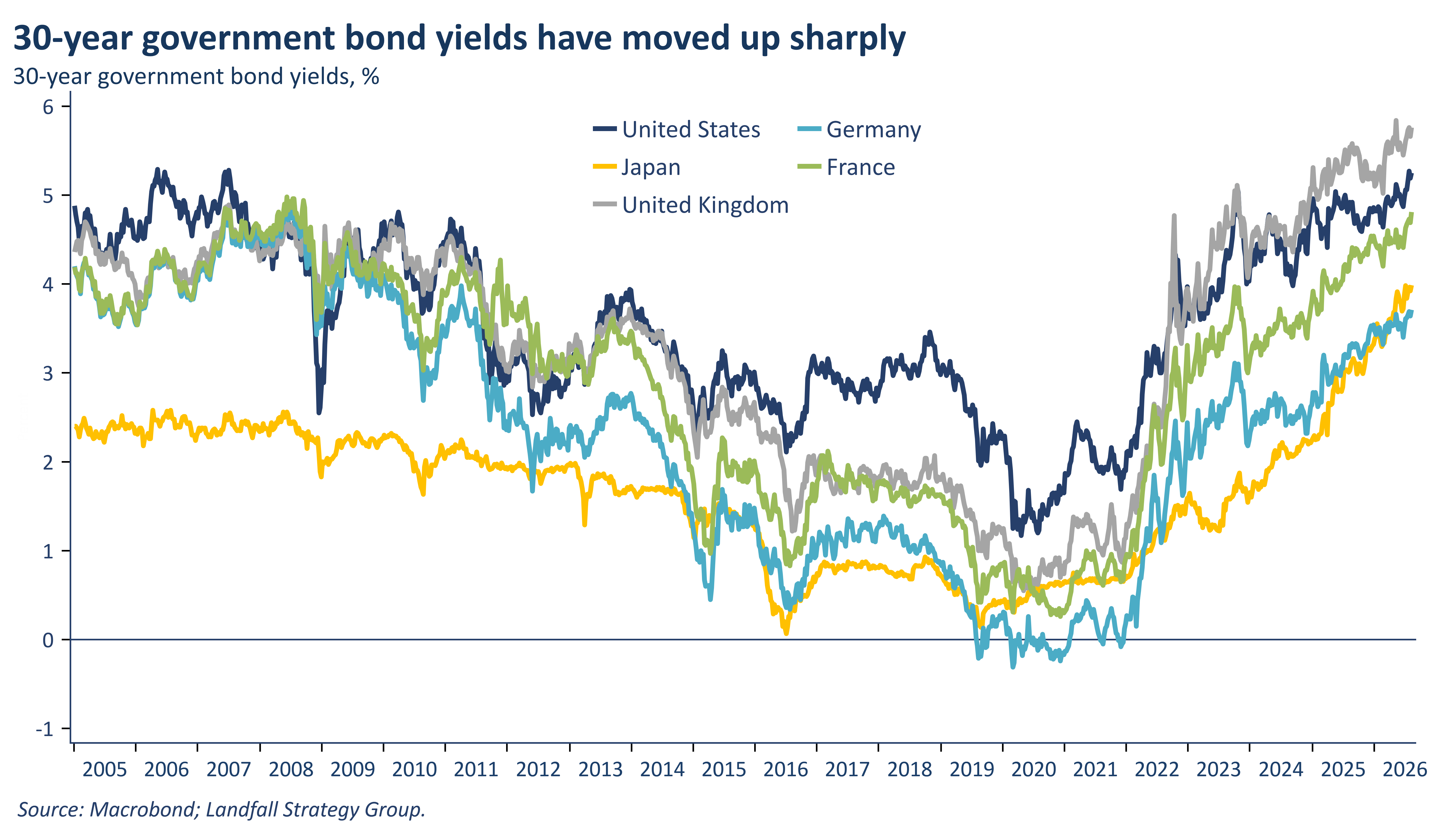
But in a regime of state capitalism, monetary policy will not be as dominant. Fiscal policy is the key policy instrument to deliver against a range of strategic policy imperatives. But markets are already signaling the challenges of financing government priorities: the 30-year bond rate has been moving up sharply across many advanced economies.
Indeed, the US fiscal position is reshaping the conduct of US economic policy and the functioning of the global economy. Consider three recent examples in which US policy can be usefully understood through the lens of fiscal primacy.
JPY intervention
The US and Japan recently undertook a rare, coordinated intervention to support the JPY, which was at almost 40-year lows against the USD. Bilateral US/Japan coordination was last seen in 1998, in the wake of the Asian financial crisis.
The explicit US motivation was to counter disorderly movements in the JPY and provide support to a friendly country. But the movements in the JPY have not obviously been disorderly, although they have been substantial.
The more persuasive motivation for US intervention relates to concern about the impact on the US of Japanese policy attempts to strengthen the JPY. Japan could intervene by selling USD assets, such as Treasuries, to buy JPY; or by allowing for higher domestic rates. Both approaches could have material implications for US yields.
Japan is the single largest holder of US Treasuries, owning ~US$1.1 trillion. A shift in Japanese demand would be material, particularly in the context of already softening foreign demand for US Treasuries and an expanding US fiscal funding requirement.
Note also the US Treasury sold euro rather than USD to purchase JPY; and Japan was given access to a Treasury facility that allowed it to sell USD without selling US Treasuries into the market. This episode is consistent with a US policy objective to manage risks to foreign demand for Treasuries and contain US borrowing costs.
The Warsh Fed
The July FOMC meeting under new Governor Warsh decided to hold rates. This was not altogether surprising, and a reasonable case can be made for holding (although I think that structural inflationary pressures are building in the US, and elsewhere).
But Mr Warsh’s commentary around the decision has raised doubts about his commitment to reducing inflation to target. There are several reasons that Mr Warsh may prefer looser policy: he has a belief in the structural disinflationary properties of AI/technology; and he is operating in a politically constrained space under Mr Trump.
But the US fiscal situation also creates substantial constraints on monetary policy. US federal government debt/GDP is at record peacetime levels, at ~100% of GDP, and is forecast to rise to 120% within the decade. Already federal debt servicing costs are ~3% of GDP, and are forecast to rise sharply.
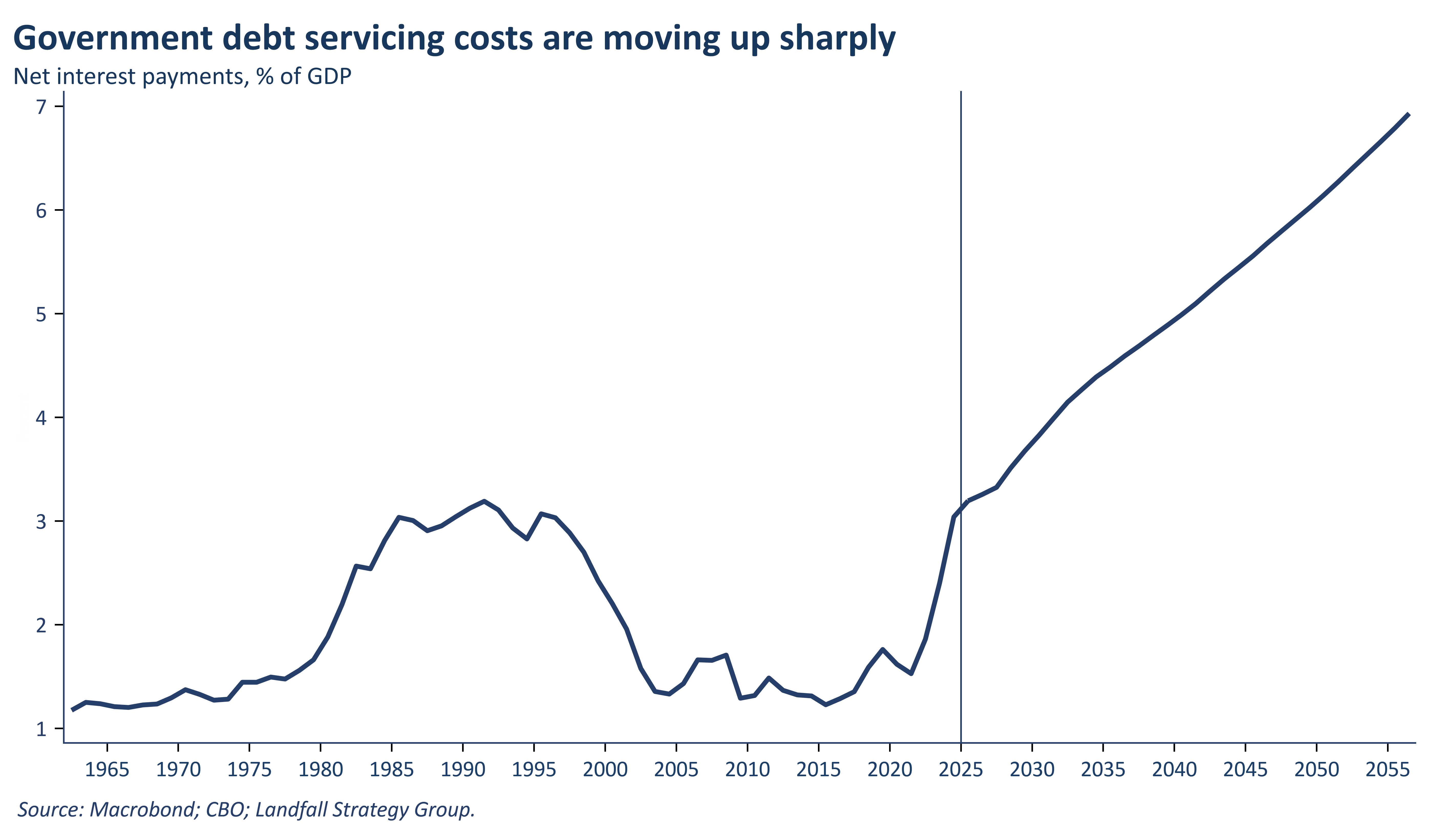
Material increases in policy rates would create substantial fiscal challenges. Keeping rates low to prevent a surge in debt-servicing costs will become an increasingly important strategic consideration for monetary policy.
US tariffs
The recent imposition of US tariffs under Section 301, to replace the struck-down Liberation Day tariffs, also has an important fiscal dimension.
Tariffs have also become a material source of fiscal revenue in the US. At their peak in October 2025, tariffs were bringing in ~US$30 billion per month, or ~5% of federal revenue on a rolling 12-month basis. But net tariff revenue is now negative, as refunds are provided on Liberation Day tariffs (so far, over US$100 billion). The new tariffs will not be as income-generating as the Liberation Day tariffs, but they will still be fiscally material.
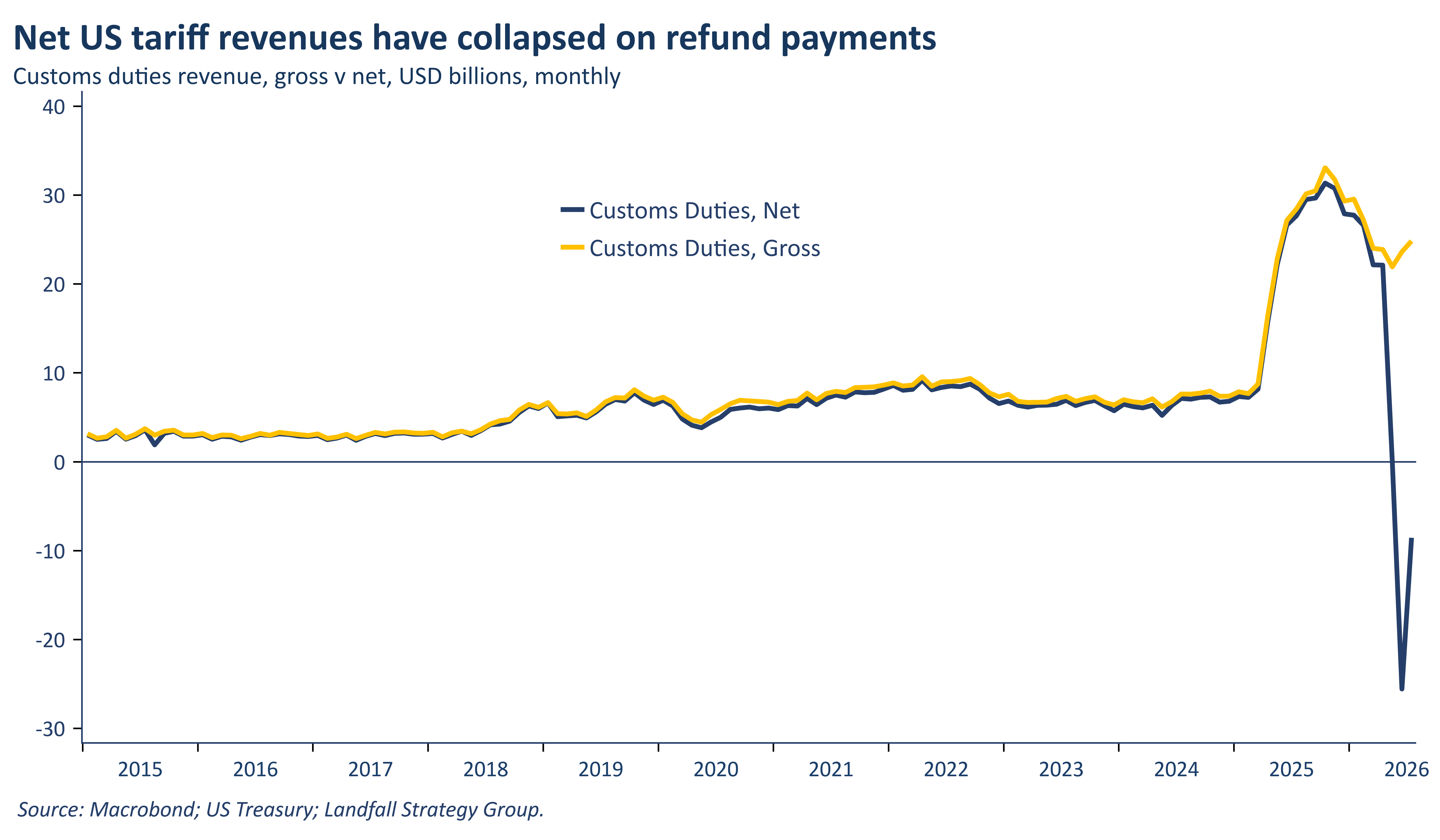
Beyond Mr Trump’s long-standing personal commitment to tariffs, and the changing geopolitical context, the fiscal context means that tariffs will likely endure. Any future Administration will be constrained in materially reducing tariffs without some compensating fiscal measures—which will be politically challenging.
Looking forward
These three episodes are importantly motivated by a common fiscal constraint. Governments are facing the challenges and opportunities of regime change from a starting point of record-high peacetime public debt levels.
Fiscal primacy in an age of debt will provide the strategic backdrop to a range of consequential shifts in macro policy/institutions and geopolitical posture, notably in the US. For example, monetary policy support will likely mean fiscal dominance and financial repression, with lower real interest rates for the US (and others) as yields are capped in various ways and Treasuries’ ownership is required/incentivised.
Capital wars will intensify as the US attempts to attract/retain capital in a context where current account surplus countries are allocating more capital at home. The US will use economic and geopolitical pressure to attract capital in increasingly aggressive ways, including from historical friends and allies.
The return of fiscal primacy, and other dimensions of global regime change, will lead to substantial changes across the global economic and geopolitical system. The past few decades will be an increasingly poor guide to the future.
Thanks for reading small world. This week’s note is free for all to read. If you would like to receive insights on global economic & geopolitical dynamics in your inbox every week, do consider becoming a free or paid subscriber. Group & institutional subscriptions are also available: please contact me to discuss options (more information is available here).
*David Skilling ((@dskilling) is director at economic advisory firm Landfall Strategy Group. The original is here. You can subscribe to receive David Skilling’s notes by email here.
We welcome your comments below. If you are not already registered, please register to comment
Remember we welcome robust, respectful and insightful debate. We don't welcome abusive or defamatory comments and will de-register those repeatedly making such comments. Our current comment policy is here.