
By Gareth Vaughan
The Reserve Bank is unlikely to enforce an industry wide rule for how banks would apply a haircut to the interest component of a term deposit under new rules for dealing with bank failures, potentially opening the way for savvy depositors to shift their savings to the bank pledging to freeze the least interest.
A spokeswoman for the Reserve Bank confirmed to interest.co.nz it's likely banks will be allowed to adopt an individual approach to freezing interest on term deposits in the event of a bank failure and the prudential regulator enacting its Open Bank Resolution (OBR) Policy.
"At this stage, it is anticipated that banks will adopt the approach which fits best with their existing systems, rather than an industry wide solution," the Reserve Bank spokeswoman said.
Banks operating different systems for the treatment of term deposits potentially means some banks may have different plans in place for the treatment of interest should the OBR policy be implemented on them.
This may effect the amount of money available to depositors, which some may want to factor into which bank they deposit their savings with.
Some depositors, especially those with big sums to deposit, may want to use the level of deposit interest a bank plans to freeze - or make available - as a bargaining chip in deciding which bank to deposit their money with.
Meanwhile, the Reserve Bank spokeswoman's comments come after a submission from bank lobby group the New Zealand Bankers' Association on the Reserve Bank's IT pre-positioning for OBR consultation paper highlighted three options being considered by the Reserve Bank for dealing with term deposits (see table below).
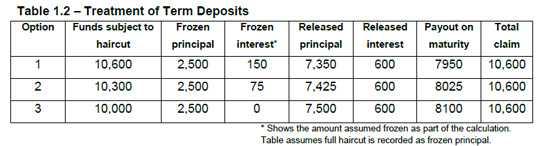
The NZBA said there was "a level of support" for Option 2, - with interest accrued up to the date of statutory management subject to the haircut, but interest accruing after the date of statutory management not subject to the haircut.
In May the Reserve Bank revealed that it was delaying the deadline for banks to pre-position for its OBR policy by six months. It now says all registered banks with retail funding of more than NZ$1 billion, which ranges from the country's newest bank The Co-operative Bank to the biggest bank ANZ New Zealand, must have OBR functionality in place by June 30, 2013. The previous deadline was the end of 2012.
Effectively the the OBR policy will give the Reserve Bank a new tool it could use to deal with a bank failure. If implemented the policy is touted as allowing a bank to open for business on the next business day after its temporary closure following an insolvency event or it being put into statutory management, and being able to provide customers with full or partial access to their accounts and other bank services.
The key feature of the policy is that creditors - including depositors - are able to access a portion of their funds immediately after the bank fails and is placed in statutory management. The bank can quickly reopen with the unfrozen or accessible portion of funds guaranteed by the government to avert a further run by creditors. The idea is creditors' additional funds can be unfrozen at later dates as the final losses are determined.
Also in May Reserve Bank Deputy Governor Grant Spencer said the OBR policy should be seen as a complement, rather than a substitute, for the various “recovery plan” tools in the event of a bank failure such as living wills and loss-absorbing debt instruments.
Moody's sees less government support
Pre-positioning for the OBR policy means the banks must redesign their core banking systems, leading to suggestions it'll prove a costly exercise. International credit ratings agency Moody's Investors Service told interest.co.nz last year the OBR policy will mean there's less expectation the government would use taxpayers' money to bail out one of the country's major banks if it got into strife and more pressure on a bank's owners/shareholders to cough up in the event of a bank failure.
Such comments have led to suggestions bank credit ratings could be negatively impacted by the OBR policy, although Standard & Poor's has played this down, saying in its initial view the OBR policy won't be a significant imposition on its view of banks' financial strength.
A Reserve Bank cost-benefit analysis, which it says points to a significant net benefit from the OBR policy, is due to be released soon. Meanwhile, the Reserve Bank says it will consult on the introduction of a new banking standard to cover pre-positioning for the OBR policy later this year.
'All unsecured creditors to be treated equally'
The Reserve Bank spokeswoman says it's intended that under OBR all unsecured creditors will be treated equally. However, policy work is "ongoing" about the precise treatment of derivatives. She noted a distinction between being pre-positioned and being subject to a haircut in the event of a bank failure.
"All unsecured creditors are intended to be subject to the same haircut. The pre-positioning is to ensure that customers (i.e. depositors and small businesses) have access to the non-frozen portion of their funds as soon as the bank re-opens, so as to minimise disruption in the wider economy as much as possible. The statutory manager will release the non-frozen portion of the remaining liabilities (i.e. wholesale funding) in due course," she said.
Covered bonds, meanwhile, will be beyond the reach of a statutory manager.
"Moreover, covered bond holders are secured creditors, and would be expected to look to their security in the first instance. To the extent that their security is not sufficient to cover their claim, they would become an unsecured creditor of the bank (through the dual recourse of covered bonds). This remaining claim would be subject to the same haircut as all other unsecured creditors, and would be released by the statutory manager in due course."
This article was first published in our email for paid subscribers this morning. See here for more details and to subscribe.
We welcome your comments below. If you are not already registered, please register to comment
Remember we welcome robust, respectful and insightful debate. We don't welcome abusive or defamatory comments and will de-register those repeatedly making such comments. Our current comment policy is here.