
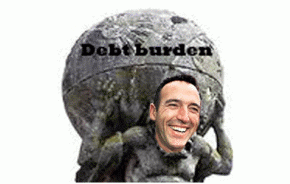
Reynolds Group Holdings, the holding company for Graeme Hart's global packaging group which is carrying about US$18.3 billion (about NZ$22.5 billion) of debt, has seen its equity deficit blow out to US$522 million (about NZ$644 million).
The figure is revealed in Reynolds' third quarter financial statements, covering the three months to September 30, showing the equity deficit has widened from NZ$131 million at June 30. On a conference call with analysts and investors, Reynolds CEO Tom Degnan said the group had launched a securitisation programme this month, securitising some of its receivables, and had drawn down US$540 million so far which will be used to repay debt. Degnan also said a €450 million bond due to mature in 2016 would be called early.
"We (Reynolds) are right where we had hoped we would be at this time," Degnan said.
The widening equity deficit comes with Reynolds reporting a US$103 million loss for the quarter, which is less than half the US$236 million loss the business recorded in the same period of last year. The improvement was helped by a US$385 million, or 13%, rise in revenue to US$3.454 billion. Cost of sales rose US$251 million, or 10%, to NZ$2.8 billion, leaving gross profit up US$134 million, or 26%, to US$650 million.
An income tax benefit for the Auckland headquartered Reynolds of US$87 million, versus one of just US$8 million in the September quarter last year, also helped the bottom line. Of this US$53 million was generated by using the New Zealand corporate tax rate of 28%. Although this was down from US$82 million in the third quarter last year, Reynolds benefited from improvements in other tax categories including "the effect of tax rate differences in foreign jurisdictions," "non-deductible expenses and permanent differences," and "unrecognised tax losses and temporary differences."
Focus on improving operating performance and deleveraging
Hart, who Forbes has estimated is worth US$5.7 billion, started assembling his packaging empire after completing his NZ$3.3 billion Carter Holt Harvey acquisition and delisting that company from the New Zealand stock exchange in 2006. Reynolds' largely US and European based businesses now include SIG, Reynolds Consumer Packaging, Evergreen, Closures, Pactiv and Graham Packaging.
SIG is a maker of aseptic beverage carton packaging (long life cartons) that allows the likes of juice, milk, soups and sauces to be stored for extended periods without refrigeration, Reynolds Consumer Products is the dominant US maker of foil, wraps and bags used for food storage and preparation, and Closures is the leading global provider of plastic bottle caps used for soft drinks and bottled water. Pactiv's products include Hefty garbage bags.
Degnan said Reynolds' diversity of geography and product lines was a strength.
"The cashflows we generate are steady and dependable. They come from products people consume everyday (and) we're in both mature and growth markets with excellent share positions," said Degnan.
"Going forward our focus will be on improving operating performance and deleveraging."
He said the group would continue to look for what were, by its standards, small 'bolt on" acquisitions - it made two in the September quarter - but didn't plan any more large scale transformative acquisitions in the near future. Chief financial officer Allen Hugli said Reynolds had spent a little over US$100 million on "transaction related fees" in the September quarter.
Debt at 6.2 times ebitda
Reynolds' quarterly net finance expenses rose US$68 million, or 13%, to US$587 million. The group's debt is split between "junk" bonds and bank loans. Credit rating agencies Standard & Poor's and Moody's Investors Service currently rate Reynolds' debt B and B3, respectively, with both ratings deep in speculative, or "junk", territory. See more on Reynolds Group's debt here.
The equity deficit came as total assets came in at US$22.5 billion and total liabilities at US$23 billion. Since June 30 liabilities are up US$500 million and assets are up US$200 million. The biggest chunk of Reynolds' liabilities is its US$18.3 billion of borrowings, and its biggest slice of assets is its US$12.3 billion of intangible assets including goodwill, trade marks, customer relationships, technology and software.
A management presentation accompanying the quarterly results shows Reynolds' debt at 6.2 times its pro-forma adjusted earnings before interest, tax, depreciation and amortisation of US$2.7 billion. This ratio is unchanged from June 30. The presentation also says the group refinanced US$6 billion of its capital structure in September resulting in about US$70 million of annualised cash interest savings.
For the nine months to September 30 Reynolds loss was US$61 million, down from US$474 million in the equivalent period of last year with profit from operating activities rising 70% to US$1.031 billion and income tax benefits doubling to US$129 million. This year's improvement largely stems from the US$4.5 billion, 2011 acquisition of Pennsylvania-based Graham Packaging, Hugli said.
(Update adds comments from Reynolds' CEO and CFO made in their conference call).
We welcome your comments below. If you are not already registered, please register to comment
Remember we welcome robust, respectful and insightful debate. We don't welcome abusive or defamatory comments and will de-register those repeatedly making such comments. Our current comment policy is here.