
Here's our summary of key economic events overnight that affect New Zealand with news risk is 'off' as investors end the week full of anxieties.
Wall Street is falling today, buffeted by a range of forces that include some weak earnings reports. Investors are punishing tech stocks that aren't profitable. The Ukraine uncertainties aren't helping, driving the risk-off mood. Investors also seem convinced the Fed will raise rates in March and have actually now priced in more than a +25 bps hike. Bitcoin is also being punished and all cryptos have lost more than -US$1 tln in capitalisation.
The US Conference Board leading index is marginally better for December, and they see US 2022 real growth at a healthy +3.5%. The Atlanta Fed's view is the US economy is expanding currently at a fast +5% pa rate, and the current blue chip consensus is even above that.
Canada's November retail sales results were released overnight and they were disappointing.
Japanese inflation came in at +0.8% in December and higher than for November. But their core inflation rate was unchanged at +0.5% although that is its post-pandemic high.
Hong Kong business confidence (as measured in a Hong Kong Government survey) is flat. But at least it isn't retreating.
In Germany, their new coalition government wants to attract 400,000 qualified worker immigrants per year to tackle both a demographic imbalance and labour shortages in key sectors that risk undermining the recovery from the pandemic.
In Australia, some key analysts are now saying that the RBA will abandon its current no-rate-change settings much sooner than anticipated, with rate rises to start in 2022. Westpac sees two hikes in 2022 from the current 0.10% and a regular set until 2024. ANZ agrees with Westpac that all this guidance will change at the RBA meeting on February 1, 2022. But the new expected track is far slower than what is proposed for New Zealand by the RBNZ which is already well down the path the Aussies are contemplating.
In NSW, there were 15,153 new community cases reported yesterday, a big fall, now with 259,132 active locally-acquired cases, but a record high 46 daily deaths. There are now 2,743 in hospital there and the deaths are the reason it didn't jump more. In Victoria they reported 18,167 more new infections yesterday, also a fall. There are now 252,399 active cases in that state - and there were 20 more deaths. Queensland is reporting 16,031 new cases and 13 more deaths. In South Australia, new cases have slipped to 3,777 yesterday with no more deaths. The ACT has 826 new cases with 2 deaths and Tasmania 866 new cases. Overall in Australia, 64,520 new cases have been reported.
The UST 10yr yield opens today at 1.76% and down -8 bps from this time yesterday. A week ago it was 1.77%. The UST 2-10 rate curve starts today flatter at +75 bps. Their 1-5 curve is flatter at +100 bps, while their 3m-10 year curve is also flatter at +171 bps. The Australian Govt ten year benchmark rate is down -6 bps at 1.90%. The China Govt ten year bond is down -2 bps at 2.73%. The New Zealand Govt ten year is back down -8 bps at 2.52%. A week ago it was at 2.47 so it up a net +5 bps since then.
Wall Street is into its Friday session down -1.0% in afternoon trade and heading for a sharp weekly retreat of -4.3%. Overnight most European markets fell sharply too, on average about -1.5%, with London down -1.2% and Frankfurt down -1.9% for weekly retreats of +0.7% and -2.2% respectively. Yesterday, Tokyo fell -0.9 and capping a weekly fall of -2.9. Hong Kong ended flat yesterday but booked a +2.4% weekly rise. +3.4%. Shanghai ended its Friday session down -0.9% but for the week was unchanged. The ASX200 was down a sharpish -2.3% yesterday and ended the week down a full -3.0%. The NZX50 didn't fare better, down -1.2% on Friday and down -3.5% for the week.
The price of gold starts today at US$1832/oz and -US$9 lower. But for the week it is up +US$15.
And oil prices start today down -US$1.50/bbl at just over US$85/bbl in the US, while the international Brent price is now just over US$87/bbl. For the week that is a +US$2/bbl rise however.
The Kiwi dollar will open today more than -½c weaker at 67.3 USc. Against the Australian dollar we are unchanged at 93.5 AUc. Against the euro we are much lower at 59.3 euro cents. That means our TWI-5 starts the today at 71.6 and with a -0.9% devaluation in a week and a -1.6% devaluation since the start of the year.
The bitcoin price has moved sharply lower today, this time by more than -11% to US$38,460. At this new level it is -43% below its November peak. Volatility over the past 24 hours has again been extreme at +/- 7.3%. Not helping, Russia's central bank has proposed banning the use and mining of cryptocurrencies on Russian territory, citing threats to financial stability, citizens' wellbeing and its monetary policy sovereignty.
The easiest place to stay up with event risk today is by following our Economic Calendar here ».
Daily exchange rates
Select chart tabs
62 Comments
In Australia, some key analysts are now saying that the RBA will abandon its current no-rate-change settings much sooner than anticipated, with rate rises to start in 2022.
Well that didn't take long. What happened to the idea of central banks maintaining credibility?
They ran out of credibility to maintain some time back.
The RBAs comments about leaving the OCR at 0.1% until early 2024 were laughable.
Exactly right. Only a fool would have believed that, even for just a second.
Would a fool believe the RBNZ and their statements about raising the OCR repeatedly?
Maybe you don’t need a central bank? Try the Russian system. One man says do, everybody does. For example Bitcoin, here today gone tomorrow.
Bitcoin is really tanking again. That's the problem with vaporware that doesn't physically exist, imagine waking up one day and finding its gone to zero.
It's fascinating to see how easily so many people can be suckered into believing in something that somebody else is pretending to believe in. Religious cultism has evolved.
You are talking about property right?
BTC heading to fair value. I.e zilch.
But of course if we understood it we’d be buying the dip.
Hold on tight to your analogue system.
Strategist says Federal Reserve in the 'worst' position he's ever seen by their own doing
Who is responsible for the current mess in stock and housing market ????
Not Covid19 BUT Reserve Bank for their reckless policy of LEAST REGRET for two years and even now are not as proactive as they were to support and promote ponzi. Fed announced in November/December that may take U turn than after a month or two will confirm and finally after four to six months (March) will act, whereas earlier was overnight.
In March 2022, they acted in haste to repent at leisure........has started.
Earlier was posted below, asking FED, what is their definition of too much debt
Should have an investigation into how homes.co.nz and/or similar agencies were allowed to manipulate house estimate to pump/fix house prices as many FHB fall for it as real estate agent used it as a tool to suit and influence innocent FHB.
https://i.stuff.co.nz/business/127537672/homesconz-criticised-for-allow…
Is their no accountability !
No, there's not.
Saw one listing that had a GV of $620K - renovations were carried out and GV was reassessed at $700K. Market value based on the reassessment before being changed by the REA was $1.06m midpoint. After the REA changed it on homes.co.nz site, it has a midpoint of $1.56m.
What a nice agent - he adds a half a million onto the what was the real market valuation!
Yep, should be illegal.
Here's the original listing which shows the old (i.e., real) market value of $1.06m;
https://www.realestate.co.nz/42084314/residential/sale/9-panorama-grove-harbour-view
Here's the amended homes.co.nz agent's input to market value adding half a million to the midpoint estimate;
https://homes.co.nz/address/lower-hutt/harbour-view/9-panorama-grove/0kQpZ
Started with Auckland properties but now other cities like Christchurch and even small towns valuation has been lifted depending upon RE agents appraisal.
Who will initiate a investigation. Asking culprits to monitor is a big task.
Similar scenario in the 80’s. What helped the downfall of RSL. Find a property worth say $350k get a bogus valuation $850k borrow $600k & walk away with leaving RSL to discover the minus side of their collateral. Later on same type dealings on vehicles did Provincial Finance in, start of the collapse of all those finance companies exposed by the GFC.
Kate
You've got to look behind these online property marketing companies to see who owns them.
Homes.co.nz is owned by private entrepreneurs.
I believe they give unrealistically high valuations to attract both vendors and real estate agents to their site as opposed to the other online marketers who give more realistic valuations; after all this is how they make their money: advertising both real estate agents and thence vendors' properties.
The naive would-be vendors are sucked in by the overly high valuations of their property and when they scroll down they spot the agents (their portrait photos) who pay Homes.co to advertise themselves on the site. The vendors naturally choose one of these agents to sell their home because in their minds these are the very agents who will achieve these outlandish valuations.
The agents will then have the vendors sign an listing agreement and after a fruitless initial period of marketing can then gently persuade the vendors to reduce their price expectations. The vendors are more or less compelled to stick with the agent's newer lowered price expectation because to change to another agent at that point would involve another outlay for marketing costs and an overly long delay in selling their home.
Anyone who thinks homes.co.nz or oneroof is a reliable indicator of value should not be allowed to buy property...(alot of kiwis)
It's been known for quite a while that agents manipulate these sites? Why do people think these sites operate - anyone wonder how they make their money?
Don't upset Carlos.
Carinaz, I suppose this article makes understandably frustrated FHB feel good but your claim that house prices are "pumped and fixed" by RE agents is quite simply untrue. You may not like to hear it but prices went crazy simply because buyers were outbidfing each other, not because the agent said "I think this house may be worth...$" In most cases buyers offered a lot more than what the agents figure. Also the agent has no interest in "pumping up prices" what they want is to make a sale, that's the only way they get paid.
Also the agent has no interest in "pumping up prices" what they want is to make a sale, that's the only way they get paid.
I can't understand why you keep saying this, it makes zero sense...
You really don't understand or are you being sarcastic?
RE agents only get paid if a house sells, if the vendor and buyer can't agree on a price, no income for the agent. So the agent's job is to bring the buyer up in price and the vendor down in price to a level they both agree, only then will an agent get paid.
I hope that clarifies it for you Nifty
Homes.co and Oneroof are actually often below the actual real sale price.
If anything they are on the conservative side.
Yvil - Yeah of course but in such a competitive industy how do they get a property to sell and continue to obtain business going forward? What do vendors want? Before you look to assign an agent to sell your house, what do you look for? Strong sale price indication on your property? History of the agents sales & prices acheived? Or... do you simply just want a sale - happy with RV perhaps?
It is the agent’s job to try and get the highest price possible for a property. There are various tactics they might use to achieve this, and not all of them are fair...Eg. Encouraging a bidding war, Revising the initial guide price up or down...
The agent works for the seller (as well as their own business) so will put those interests first.
The higher the sale price, the higher the commission & the more likely they'll have happy vendors, repeat business & recommendations...
British Medical Journal lets it rip. Given the quad vaxxed Israel experience it would be interesting to see the data - given our economies and healthcare systems depend on it.
"Editorials Covid-19 vaccines and treatments: we must have raw data, now
...Big pharma is the least trusted industry.30 At least three of the many companies making covid-19 vaccines have past criminal and civil settlements costing them billions of dollars.31 One pleaded guilty to fraud.31 Other companies have no pre-covid track record. Now the covid pandemic has minted many new pharma billionaires, and vaccine manufacturers have reported tens of billions in revenue.32
The BMJ supports vaccination policies based on sound evidence. As the global vaccine rollout continues, it cannot be justifiable or in the best interests of patients and the public that we are left to just trust “in the system,” with the distant hope that the underlying data may become available for independent scrutiny at some point in the future. The same applies to treatments for covid-19.
...In the pages of The BMJ a decade ago, in the middle of a different pandemic, it came to light that governments around the world had spent billions stockpiling antivirals for influenza that had not been shown to reduce the risk of complications, hospital admissions, or death. The majority of trials that underpinned regulatory approval and government stockpiling of oseltamivir (Tamiflu) were sponsored by the manufacturer; most were unpublished, those that were published were ghostwritten by writers paid by the manufacturer, the people listed as principal authors lacked access to the raw data, and academics who requested access to the data for independent analysis were denied.1234"
At the commencement of any public emergency such as a pandemic, the government should wheel a guillotine out of the basement and park it in front of parliament. To be used at the end of the emergency for anyone who took advantage of the emergency and deliberately harmed others for personal gain. That should do it.
Brian Tamaki should be first in line
All the Ozzy covid numbers going down fast , its pretty much all over here folks.
Well except for NZ & WA.
I do agree with Jacinda you need to spread the peak over several weeks.
To keep NZ very poor Health system afloat . Shame a few nurses were
refused entry , but she got the wiggles in . There is no escaping Omi we will all get it .
The main problem will be staff shortages every where during those peak weeks.
Yes there will be several hundred deaths , mostly old and died with covid .
l Betcha a lot more people over the last 2 years + this coming one have suffered
& died because of cancelled surgerys & other treatments than covid .
Happy weekend fellow kiwis , you are nearly at the end .
Nearly at the end? Let’s go Churchillian, paraphrasing. Not the beginning of the end, but perhaps the end of the beginning?
Nah, we’re at the end of the middle.
Foxy sorry mate , lets go with Churchill , start to finish only needs to be 2-3 months
Time for team of 5 mil & Jacinda to shine.
Lets do this.
Why when it's easier to kick cans and hire digital savy online PR consultants.
Poor Meat Loaf...unvaxed and passed away in a week.
Wall Street is falling today, buffeted by a range of forces that include some weak earnings reports. Investors are punishing tech stocks that aren't profitable.
Jay Powell and Christine Lagarde rush to hike short-term interest rates because their econometric models which don’t model money (they can’t) have modeled consumers acclimatizing to recent CPI rates by virtue of nothing more than assumptions about public feelings without regard to these other facts and factors.
While the Fed and ECB do that, their Chinese counterparts are going in the reverse direction. The PBOC cut its RRR, required rate of reserves, for the second time last year in December (in response to expected tight global money conditions), as well as dropping its Loan Prime Rate (LPR) for the first time since 2020.
Then, earlier this week, the PBOC acted again with another cut to the LPR to go along with a reduction in interbank RMB financing at medium terms (what they call the MLF). Sparked by weakening economic data as well as majorly sour anecdotes across China, it’s become much more difficult to benignly blame pollution controls and the spread of various coronavirus variants. Link
Wall street is falling is an understatement. Even if Nasdaq is in correction mode, most stocks have crashed beyond and are only fraction of their ATH. 60% to 80% down from ATH is new normal for now and many who bought in last year may have to hold, if opted for fundamentally sound companied for some time but if have both speculative stocks, it may be years as what we are facing now is not because for pandemic but doing of government and reserve banks and have screwed so badly that are : damned if you do and damned if you don't
Housing market is following but may not be as severe but unlike stock market 10% to 20% correction, if it happens will be a doomsday for many. Housing market may have not crashed earlier in NZ but it does not guarantee that can not happen just like interest rates were never zero percent ever before but it happened.
Because of goof ups by reserve banks and supported by government for political power everything will be in extreme - Up was in extreme so why should one expect the fall to be in extreme.
Wait and Watch with hope that it does not happen or will be a bigger health/mental crisis than coronavirus along with economical disaster.
Roy 1,
I keep being astonished by the appallingly poor standard of English I see all too often here. Your post might have been interesting, but it's virtually unreadable.
I don't think English is their first language. I also think there are some posting with multiple accounts, including Roy1, by looking at the language/phrases and layout of the comments.
‘Bitcoin is also being punished and has lost more than -US$1 tln in capitalisation.’
I think you mean crypto currencies have lost more than $1T.
Correct. My error.
The wealth effect of that paper trillion must have been massive. Now it's gone again.
Hugely deflationary in effect as well.
Just now from "coinmarketcap" website ..... Today's Cryptocurrency Prices by Market Cap = The global crypto market cap is $1.68T, a 13.25% decrease over the last day.....hardly 1 trillion $ down ?
Down ~USD$1.2T from their early november peak.
Thanks for the clarification Pragmatist ....it had me a little concerned when I first read it !
In Germany, their new coalition government wants to attract 400,000 qualified worker immigrants per year to tackle both a demographic imbalance and labour shortages...
They're not alone, across the world the pandemic accelerated existing demographic trends. [Link] English speaking countries are a long way behind other OECD countries, like Germany, simply because they attract more migrant workers. Low birthrates are a problem that compounds every 25-30 years of course.
Either way the era of cheap, abundant labour is concluding.
With wife and half a child that is about 1m immigrants a year. Allowing for difference in populations that is equivalent to 59k into NZ.
Would of thought their compulsory 600 hrs integration course for non-EU immigrants wold put plenty off moving to Germany.
I wish we had that sort of entry requirement as well. We could start with lessons about walking on the left side of the footpath..
I'll settle for Speaking English... Come to East Auckland...
How about writing it?
What does "would of" mean?
Wood of, perhaps?
Would’ve :)
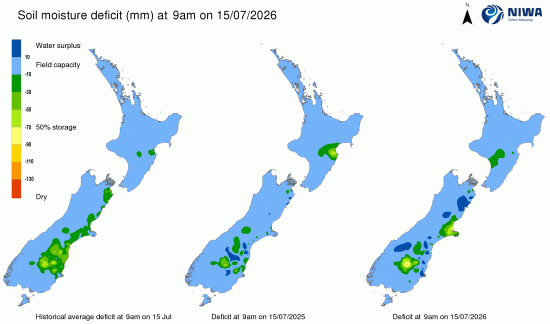
I wonder how long it will be before the North Island is completely red. Hoping for rain on Tuesday.
Seems very little talk about this and potential drought implications.
If I recall correctly, every NZ recession has been preceded by a drought.
Started of as four days rain. As we get closer to Tuesday it gets less and less.
Still hopeful, but...
Yes, the money-shakes have started. Detox has begun. Whatever happens, just keep breathing in long slow & even motions.
Been very disappointed in Germany's leadership over the past decade. Getting rid of their nukes was Merkel's major mistake. Not too many earthquakes in Northern Europe from memory. Now they'll have Shootin Putin in their faces wanting who knows what.
Chinese rates decline while Western rates increase. Mmm. Different cycles? Or different parts of the same cycle? A split tack is always a high risk manoeuvre. The winning or losing of this part of the game (chapter) is now taking place.
Interest.co (and MSM's) reporting of covid case numbers is becoming tiresome David. It is so last year's media-speak looking for eyeballs. It really comes down to our hospital capabilities, or not. I know that ours aren't in great shape to begin with, but covid hospitalisations are key number with bed availability percentages close behind. Perhaps interest.co might consider leading this discussion.
And finally, not too many CB supporters commenting on their brilliant banking industry abilities today. In NZ they've lost most of their 2nd tier leaders so no surprises here I 'spose. Follow the Jay leader & control the narrative - as the socialists say.
Abandoning clean green nuclear in favour of carbon emitting Russian gas was a major mistake from a number of perspectives. It’s a shame Europeans who pretend to care about climate change can’t see this.
Covid cases are very relevant. We are going to go through what NSW is going through so it is very informative to track their cases. It’s an equation with two variables - cases and hospital capacity - so I don’t know why you’d suggest we stop paying attention to cases at this point.
We welcome your comments below. If you are not already registered, please register to comment
Remember we welcome robust, respectful and insightful debate. We don't welcome abusive or defamatory comments and will de-register those repeatedly making such comments. Our current comment policy is here.