
Here's our summary of key economic events overnight that affect New Zealand, with news the American dollar has jumped to 20-year high as jobs data supports aggressive Fed rate rises and quantitative tightening. This will have tough, tough consequences for many other countries, especially those with debt in US dollars.
All eyes are now turning to the US labour market culminating in the August non-farm payrolls report out tomorrow. Today their jobless claims data for last week was a low +177,000 new weekly claims with now under 1.4 mln people on these benefits, a new modern low.
And so far there is no evidence yet in their job cuts and layoffs monitoring of anything but a strong labour market.
The consensus expectation for the growth in non-farm payrolls is +300,000 (sa) and continuing their two year streak.
There were factory PMIs out overnight for August. Both report an extension of the modest expansion in their factory sector. The widely-watched ISM one reported a rise in new orders and that was despite a sharp contraction in new export orders. The employment aspect turned higher after a retreat last month. Price pressure softened.
The internationally benchmarked Markit one reported similar trends although the new order intake was weaker in this survey.
Canadian building consent levels fell a rather sharp -6.6% in July, an result that was not expected. (They expected a -0.5% slip.) Its a situation very similar to Australia where housing construction is going into a steep reversal.
The surging US dollar is especially tough on Japan, and may be quite inflationary. Toyota is a major buyer of steel and those costs are rising sharply. They also insist their parts suppliers use 'Toyota steel' - and have raised prices recently to those suppliers, some by as much as +30%.
In China, the private Caixin factory PMI came in weaker than expected; in fact it is now contracting. A small expansion was expected but it actually reports the first contraction in the sector since May. It comes after widespread lockdowns and electricity shortages. Output grew at the softest pace in three months, both new orders and buying levels fell for the first time since May; and employment fell for the fifth month running. For the first time in quite a while, it was matching the official factory PMI so there is now question their manufacturing sector is retreating.
China has locked down the megacity Chengdu, in Sichuan Province, one of its biggest and most economically important cities. It is the country’s most drastic move to stop a coronavirus outbreak since Shanghai went into a damaging two-month lockdown in April.
And still about China, they have reacted with the expected indignation and denials over the release of this report which is likely to have a significant economic impact of firms doing business in the Uyghur regions in the west of China.
In the Taiwan Strait, Taiwan has shot down an unmanned Chinese drone, the first-ever such action on Chinese airspace incursions.
In Moscow, there has been another unfortunate accident. The boss of oil giant Lukoil accidentally fell out of a high-rise hospital window. A very Russian way of maintaining the discipline of the elite. Lukoil is Russia’s second-largest oil-and-gas company.
In the EU, there was a surprise in the data for German retail sales for July. They actually rose from the prior month, even after adjusting for inflation. A further retreat was expected, so this is a big miss by analysts there. But year-on-year, there is a small -2.6% retreat in retail volumes - quite modest given the tough situation the Germans find themselves in.
However, German factories contracted in August, a 26 month low, and the wind is going out of there manufacturing sails. In France, their factories aren't in contraction mode yet, but new orders fell in August. Overall the EU has just tipped into a factory contraction, but at least the cost pressures are subsiding now.
Globally, factories are barely expanding and now at a 26-month low. Output falls across consumer, intermediate and investment good sectors are widely recorded, but input cost and output price inflation are both easing. China weighs heavily on the global results.
In Australia, lending for housing retreated in July at a fast rate. In fact lending to investors fell at its fastest pace since mid-2015, and lending to owner-occupiers fell at its fastest pace since 2008. Bank lending to their construction industry dived a startling -35% in July from June. There's more than a whiff of fear in these figures.
The UST 10yr yield starts today at 3.25% and up an unusually sharp +11 bps from this time yesterday. The UST 2-10 rate curve is much less inverted at -25 bps. Their 1-5 curve is also much less inverted at -12 bps. And their 30 day-10yr curve is much steeper at +97 bps. The Australian ten year bond is +11 bps higher at 3.73%. The China Govt ten year bond is little-changed at 2.65%. And the New Zealand Govt ten year will start today at 4.05% and up +8 bps.
Wall Street is down -0.6% in late Thursday trade which makes it a -3.1% fall so far this week. Overnight, European markets were all lower by about -1.7%. Yesterday Tokyo fell -1.5%. Hong Kong ended down -1.8%. And Shanghai fell another -0.5%. The ASX200 closed its Thursday trade down a full -2.0%, but the NZX50 was the outlier, ending up an unusual +0.1% on the day.
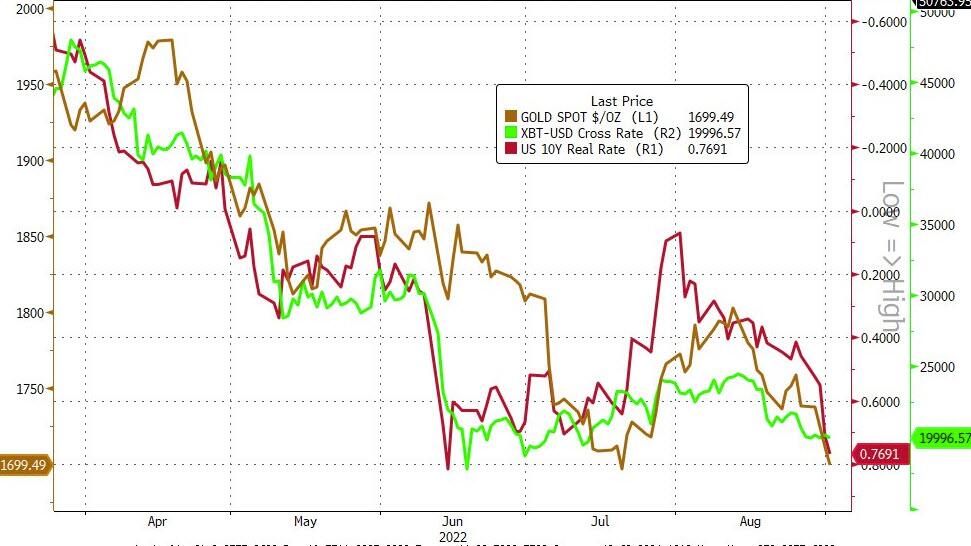
The price of gold will open today at US$1698/oz and down another -US$16 from this time yesterday.
And oil prices start today down -US$4/bbl at just under US$86/bbl in the US while the international Brent price is now just under US$92/bbl.
The Kiwi dollar will open today at 60.7 USc and down -½c from this time yesterday. Against the Australian dollar we holding at 89.5 AUc. Against the euro we are holding at 61 euro cents. That all means our TWI-5 starts today at 70.3 and another small retreat and all because of the muscular USD.
The bitcoin price is now at US$19,741 and down -1.2% from this time yesterday. Volatility over the past 24 hours has been modest at just on +/- 1.9%.

The easiest place to stay up with event risk today is by following our Economic Calendar here ».
We welcome your comments below. If you are not already registered, please register to comment
Remember we welcome robust, respectful and insightful debate. We don't welcome abusive or defamatory comments and will de-register those repeatedly making such comments. Our current comment policy is here.