
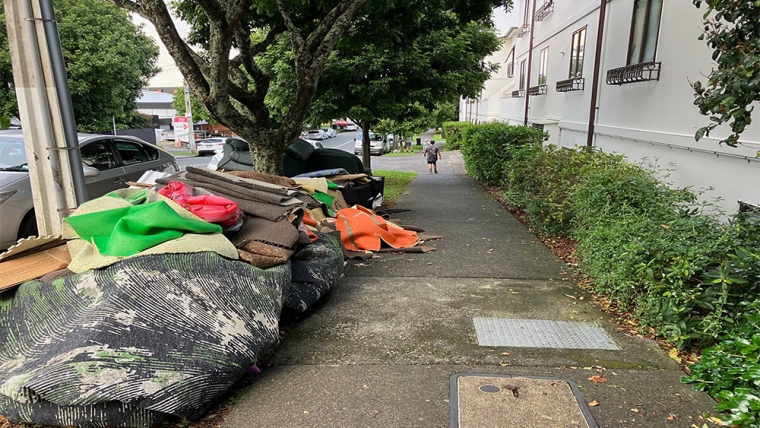
Cyclone Gabrielle will be NZs biggest weather event this century, but the economic damage is still unknown.
Damage to homes, infrastructure and agriculture is significant, and will lead to a drop in economic activity as people are stuck at home, unable to open their business or have crops under water that can’t be harvested and sold.
There will be an immediate localised impact, particularly in those hardest hit areas like the Hawke’s Bay, which relies heavily on agriculture and particularly horticulture, to underpin its economy.
Federated Farmers says Cyclone Gabrielle’s destruction is unprecedented, and for some farm businesses this will be a body blow.
Moody’s Analytics says the poor NZ weather will disrupt food supplies, and contribute to an inflation spike in the first half of this year.
Food prices have been running rampant and were up 10.3% in the year to January 2023, with fruit and vegetable prices increasing 16% compared with the previous year.
Food prices will be pushed higher as a result.
And Moody’s says construction costs will also jump, as huge demand is unleashed from the repairs and rebuilds.
For retail and hospitality, or anyone reliant on tourists, this weather couldn’t come at a worse time; what should have been a peak after several disrupted summer seasons.
Westpac Bank says tourist numbers were back at around two-thirds of the pre-Covid level before Auckland’s wild weather, and New Zealand’s tourism sector was making the most of being back open for business.
For those now closed and unable to cash in, it’s a kick when they’re down.
The overall economic impact will be substantial, with Finance Minister Grant Robertson saying Cyclone Gabrielle will have a multi-billion dollar price tag and maybe as much as $13 billion.
Robertson says the bill will be smaller than the covid-19 pandemic, but comparable to the Kaikoura and Canterbury earthquakes.
The Covid-19 Response and Recovery Fund totalled $61.6 billion. This funding included about $20 billion paid out as wage subsidies and resurgence payments to businesses, and was a national response to the pandemic.
Auckland’s Delta covid lockdown alone was estimated to have cost the economy $8 billion.
The 2016 Kaikoura quake damaged the main road and rail link, and the cost of that quake was estimated at about $3 billion by Treasury, with more than $1.8 billion in insurance claims including close to $1 billion for high-rise building losses and claims in Wellington.
An economic report found this quake resulted in a $500 million hit to New Zealand’s GDP in the 18 months afterwards.
The bill from the Christchurch earthquakes was much larger again, at about $40 billion.
These earthquakes cost private insurers more than $21 billion and EQC paid out about $10 billion.
After Christchurch more than 7,000 homes were red-zoned and 1,354 commercial buildings needed to be demolished.
Already, the transport ministry, Waka Kotahi, has estimated the damage to roads during just the North Island flooding before Cyclone Gabrielle may cost $1 billion to fix the roads.
And then inflation?
We’ll get another spending boom as a result. This is of course, not good news for inflation, however, the insurance money is already flowing and will continue to flow, as people replace cars, couches and computers damaged in the storms and the clean-up turns to rebuild.
But there’s a fair bit of pain to get through first.
Robertson has hinted there would be "sector-by-sector" economic support packages, and more regional support.
Some in the Hawke’s Bay are pushing for a wage subsidy for those worst affected.
The Government has announced an $25 million rural support package, and $5 million for emergency support for businesses affected by the Auckland flooding.
It has set up an insurance claims resolution service to help settle claims for homeowners after a natural disaster.
The service will be modelled on claims resolution services used after the Canterbury earthquakes.
Insurers are warning there will be significant delays to assess and settle the thousands of insurance claims from the rugged weather.
The Insurance Council says the flooding and cyclone Gabrielle will mean a bigger bill for extreme weather events than the insurance industry paid out for the entire year of 2022.
We welcome your comments below. If you are not already registered, please register to comment
Remember we welcome robust, respectful and insightful debate. We don't welcome abusive or defamatory comments and will de-register those repeatedly making such comments. Our current comment policy is here.