
Here's our summary of key economic events overnight that affect New Zealand, with news of a lot of second-tier data and some of it isn't very good.
But first, US jobless claims were in fact little-changed from the prior week, although seasonal adjustment generated a higher number. There are now just under 1.8 mln people on these benefits but that is up from 1.5 mln a year ago. Despite the headline seasonally-adjusted rise, the actual data isn't really showing any increase in new claims.
But they may be on their way. The Philly Fed factory survey dived to its lowest level since the pandemic and its eighth consecutive negative reading. This survey covers the Pennsylvania manufacturing rust-belt heartland and is quite a negative signal.
US existing home sales in March dipped from February to an annual rate of 4.44 mln when a 4.5 mln rate was expected.
Chinese foreign direct investment is falling and quite quickly now. It hardly changed from February to March and is now only +4.9% ahead in nominal terms from a year ago. In February it was +6.1% ahead. In the 30 years of this data, we have never seen such a month where there was virtually none. This is very unusual and no doubt is ringing alarm bells in Beijing.
Meanwhile, China's central bank kept lending rates unchanged yesterday, adding to signs that it has put monetary stimulus on hold while it watches the progress of what they hope will be a consumer-driven economic recovery. The PBoC's one-year loan prime rate, a reference for lending to companies, stayed at 3.65%. The five-year rate, a benchmark for mortgage interest rates, remained 4.3%. Both have been unchanged for eight months.
From a very low base, Chinese mortgage lending rose +50% in the March quarter from the same period a year ago as homebuyers took advantage of lower interest rates. It is a signal that policies to bolster the property market are kicking in.
Taiwan export orders rose in March from February but were still -25% lower than year-ago levels, a consequence of the vice China has on the island nation.
Consumer confidence in the EU edged up in April, according to the latest 'flash' survey. It was a faster improvement than was anticipated.
German producer prices rose in March to be +7.5% higher than year ago levels. But in February they were more than +15% higher, so we are witnessing a very fast correction there recently. In fact, from February to March prices fell at a much faster than expected rate, a very sharp -2.5% in just one month.
Last week freight rates for containerised shipping actually rose. It was a tiny move up, but was the first we have seen in a very long time. It was primarily driven by the Shanghai to Los Angeles route which rose +11% in a week. The Shanghai to New York route rose +12%. But apart from these two major trades, most other rates are still falling. Bulk cargo freight rates were little-changed last week, still running at their long term average levels, levels we first saw in 1988!
The UST 10yr yield starts today at 3.55%, and down -5 bps from this time yesterday. The UST 2-10 rate curve is little-changed at -64 bps. Their 1-5 curve inversion is now at -111 bps and marginally more inverted. But their 30 day-10yr curve is now inverted at just -2 bps with this inversion about to vanish. The Australian ten year bond is down -6 bps at 3.55%. The China Govt ten year bond is still at 2.85%. But the New Zealand Govt ten year is down -7 bps to 4.28%.
Perhaps we should also note that 'green bond' issuance reached US$858 bln in 2022 (NZ$1.4 tln). This is no small market of financing that comes tied to showing climate benefits, but it is still only 5% of all bonds issued. However it is hard not to view this as much more than greenwashing.
On Wall Street, the S&P500 is down -0.9% in its Thursday trade with a growing selloff. Overnight, European markets closed quite mixed, flat in London and down -0.6% in Frankfurt. Yesterday Tokyo ended up +0.2%. Hong Kong ended its Thursday session up a mere +0.1%. Shanghai ended down just -0.1% at its close which was a big late recovery. The ASX200 ended its Thursday session little-changed while the NZX50 ended down -0.3%.
The price of gold is at US$2005/oz and back up +US$11 from this time yesterday.
And oil prices are down another -US$2.50 and just over US$77/bbl in the US. The international Brent price is just under US$81/bbl.
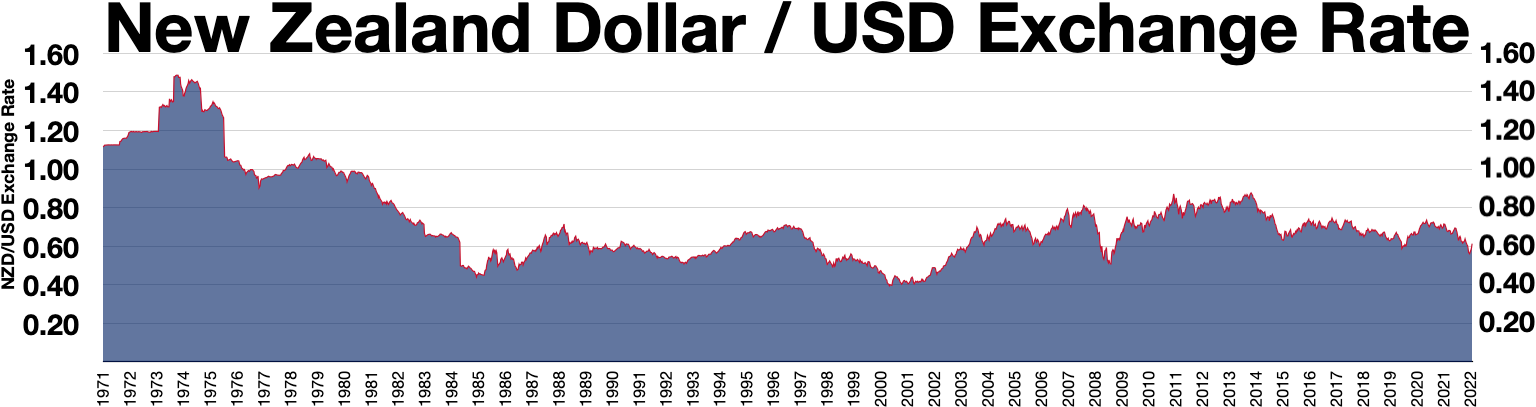
The Kiwi dollar is softer against the USD and now at 61.9 USc. Against the Aussie we are much weaker at 91.6 AUc and more than -¾c lower. Against the euro we are down -¼c at 56.4 euro cents. That means the TWI-5 is at 69.5, down -40 bps.
The bitcoin price is lower today, now back down to US$28,475 with another -2.7% fall from this time yesterday. Volatility over the past 24 hours has stayed modest at +/- 1.9%.

The easiest place to stay up with event risk today is by following our Economic Calendar here ».
We welcome your comments below. If you are not already registered, please register to comment
Remember we welcome robust, respectful and insightful debate. We don't welcome abusive or defamatory comments and will de-register those repeatedly making such comments. Our current comment policy is here.