
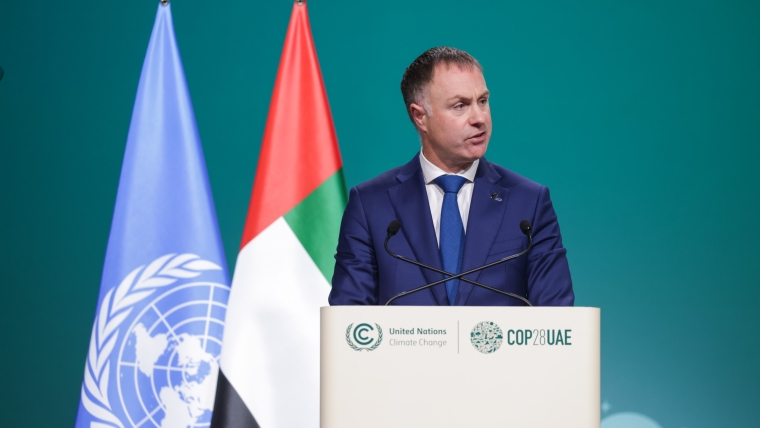
The Climate Change Minister says it’s critical New Zealand has a comprehensive framework on how to deal with climate adaptation – and it involves all political parties being at the table.
“The future successes of New Zealand and the resilience of our economy will be determined by how we respond and prepare for the impacts of climate change and ensure that we transition to a low emissions economy,” he said in a speech at a Financial Services Council event on Wednesday.
Watts is the Minister of Revenue as well as Minister of Climate Change. He has served as the MP for North Shore since 2020 and worked as a chartered accountant and paramedic before entering Parliament.
In his keynote speech, he outlined five pillars making up the Government’s climate strategy, and described climate change as a “serious area of business” for the Coalition Government.
“The climate change strategy ensures that we not only meet the impacts and reduce the impacts of climate change, but also prepare for its future effects,” Watts said.
The five areas include; resilient infrastructure and well prepared communities, clean energy being abundant and affordable, nature based solutions to address climate change, world leading climate innovation to boost the economy, and credible markets to support the climate transition.
Clean energy is high up on the Government’s radar and Watts said New Zealand was “blessed with renewables”.
“We should have abundant clean energy that is affordable. And so boosting the energy sector to make clean energy that is abundant and affordable is one of our focus areas,” he said.
Watts added that if NZ could produce that energy here, the country wouldn’t need to import fossil fuels from offshore.
Watts said he was pleased Parliament had reached a bipartisan consensus to conduct an inquiry on climate adaptation under the Finance and Expenditure Committee.
The inquiry will provide recommendations and principles on the framework and report back to Watts on the 5th September.
Watts said this would ensure the Government would have the fundamental elements to be able to put in place an Adaptation fFramework Legislation Bill into the House in early 2025.
In 2023, Green Party co-leader and then Climate Change Minister James Shaw had asked the Environment Select Committee to begin an inquiry into climate adaptation but it wasn’t completed before Labour lost last year’s election.
“That is critical. That will be one of the first countries in the world to have a comprehensive framework on how to deal with climate adaptation. And importantly, we have a bipartisan agreement around that. In my job, that can't be underestimated. It's not always the case,” Watts said.
“From my perspective, Government does need to lead in this space to get all the parties around the table. And we need an enduring framework. We can't afford for such a big topic area that impacts inter-generationally [to] flip flop due to the politics in Wellington.”
Watts said who pays when it comes to climate adaptation and mitigation is a “very difficult and complex and challenging question” – but required at a New Zealand Inc level.
“The reality is we are having to deal with the impacts of climate change, and that is a significant fiscal cost at a broader economic level,” he said
When Budget 2024 was released in May, Watts announced that among other projects, the Coalition Government would make investments into climate resilience projects like stop banks and floodwalls and end “ring-fencing” of the ETS revenue made from the Climate Emergency Response Fund (CERF).
The CERF was set up from funding in Labour’s Budget 2022 where Waka Kotahi was tasked with setting up a climate fund that aimed to support the goals outlined in the then Government’s Emissions Reduction Plan.
Watts said at Budget 2024 that future climate investments will be considered through the regular Budget process and approximately $2.6 billion of high-value climate initiatives previously funded by the CERF would continue.
We welcome your comments below. If you are not already registered, please register to comment
Remember we welcome robust, respectful and insightful debate. We don't welcome abusive or defamatory comments and will de-register those repeatedly making such comments. Our current comment policy is here.