
Building industry giant Fletcher Building [FBU] is reporting another after-tax loss - this one of $11 million - for the first half of the 2026 financial year.
The latest result compares with a loss of $134 million in the first half of 2025 and a $419 million full-year loss last year.
Fletcher Building managing director and CEO Andrew Reding said the first half of the 2026 financial year "was another demanding period for the building industry, with subdued markets across New Zealand and Australia".
He said the first quarter of the year was "particularly weak", while the second quarter was "more stable".
"In that environment, our core manufacturing businesses held up well, supported by disciplined cost control and better operational execution. Just as importantly, we continued to make real progress on our strategy around simplifying the Group, strengthening the balance sheet, and embedding a decentralised operating model that improves accountability and performance," he said.
The company once again didn't pay a dividend and has said it won't resume dividends till it gets its net debt into the lower half of a $400 million to $900 million range. As at the end of the half-year (December 31)the company had net debt of $1,164 million, which Reding said was "below internal expectations".
Last month Fletcher Building announced the sale of its problematic construction division to French company VINCI Construction, part of the VINCI Group, for $315.6 million.
Towards the end of last year it was reported that Fletcher was seeking initial offers for its residential business before Christmas 2025.
There's no update on that pending sale with the latest results announcement. The company doesn't say too much at all about the residential division in the announcement, which does suggest a sale might not be far away.
In the appendix to the company's results presentation, Fletcher Building says 223 units were "taken to profit" in the latest half, which is some 81 units (-27%) lower than for the first half of 2025.
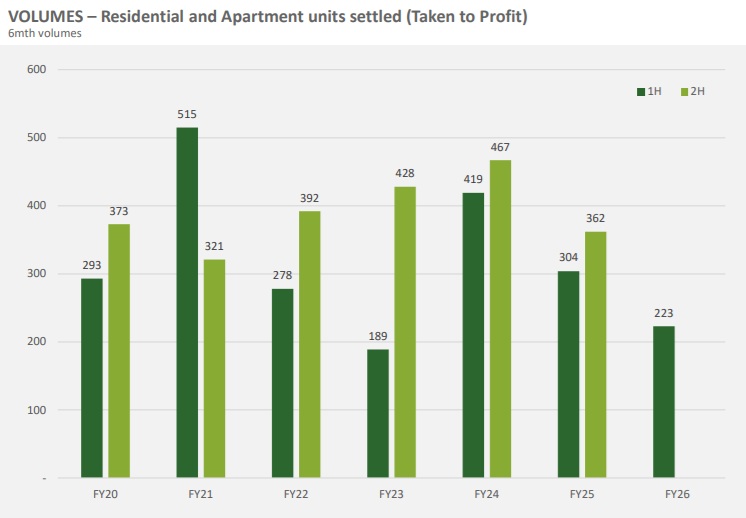
The operational (EBIT) profit for the division in the latest half was $12 million, which is $2 million lower than for the same period a year ago. The company has just under $1 billion worth of invested capital with the residential business, which is up about 9% on the same period a year ago.
In terms of the outlook for Fletcher Building, Reding said New Zealand market volumes were largely flat in the second quarter of the year and overall remain subdued "with meaningful improvements not expected until calendar year 2027".
Volumes in Australian businesses are mixed with Laminex and Fletcher Insulation starting to show a positive volume trend which, if continued, should support earnings
"Margin compression remains a challenge across a number of Business units, but cost out initiatives in Business Units, Divisions and Corporate have helped support profitability and operating leverage should provide upside as volumes recover," Reding said.
"Our best estimate for Construction [sale] completion remains Q1 FY27 and Residential and Development strategic review remains underway; any potential cashflow and cost out benefits should be seen from FY2.
"Looking ahead, we expect the benefits of actions already taken on costs, portfolio simplification, and capital discipline to progressively support performance as market conditions improve."
9 Comments
A strong buoyant building industry underpins all economies as it provides a long food chain of related industries. Our principle monopolistic building supply company continues to report losses. But hey the economic recovery is well and truly underway. The ASB reckons the economy is humming.!
The coalitions early fiscal decisions dug a big hole under the rug and then pulled the rug out from under the building and construction sector. They did it really fast and over 15K of jobs and hundreds of SMEs evaporated in 12 months.
Kainga Ora had ramped up - over a long time period - to building 6000 homes a year. And it was doing this by borrowing commercially against its portfolio of property so was not a cost to the government. That productive capacity and the momentum it provided to the sector was halted immediately - no ramp down or adjustment period at all.
And it was doing this by borrowing commercially against its portfolio of property so was not a cost to the government
Who pays back the borrowings?
They do - they are operating commercial loans that the repay with the rental income from their housing portfolio - like any other property owner.
But the amount charged to tenants is often greatly under the cost of the debt. Often as low as $50 a week.
The answer is subsidies pay for the loans.
If not the government, who is funding the subsidies?
A heavily dominant position in an environment where our building construction and material costs are much higher than comparable markets in the rest of the rest of the world, and FBU is still an agent of mass shareholder value destruction.
- How is that possible?
- Is it a reflection of a sclerotic and broken building industry?
- Anyone else hoping they'll be bought by someone who will effectively manage them and can leverage volumes, like Home Depot or China State Construction Engineering Corporation?
Dominant in some product lines but a good number of their divisions operate in highly competitive sectors. I would argue FBU share holder value destruction is more a product of breathtakingly incompetent management decisions (with a little bit of bad luck in the mix). Don't know which 'comparable' markets you are referring to, NZ has unique characteristics including difficult physical transport routes, end of the South Pacific shipping line spoke, sub mass market etc. Building materials are always going to be more expensive on these two little islands.
You're right: we are a tiny market that undercuts volume leverage, a long way from anywhere with fragile and expensive logistics networks. But there are caveats.
By comparable markets, I mean notionally developed and diversified economies, where in New Zealand's case, you'd expect a premium of around 10% or so over the price of what you'd pay in Australia for the same volumes of product.
In the case of manufacturing we always tried to disintermediate the supply chain to reduce the number of ticket punches for goods shipped or made here, and got to that sort of level, but not the 35%+ premiums on what you'll see if you look across the Tasman - and Australia has supply challenges that would would make your head hurt - but they still rail a lot of freight and haven't been completely overpowered by the trucking lobby.
What Fletcher seem to be unable to grasp is the concept of cost rather than price, and you're right about that, too: it takes breathtakingly bad management to get that far adrift from profitability in their situation, but that makes me wonder how did their senior management get selected, and is it a microcosm of the building industry as a whole?
Coming from a manufacturing background - where the cost control was obsessive, most things are bespoke designs for series production, and innovation was a constant - I have no idea how an industry survives assembling commodity materials so poorly and wastefully, sees as normal purchaser incentive schemes that would result in industrial buyers being summarily fired if they used them, where a it'll-be-right cost plus mentality seems unshakable, productivity is terrible and innovation is seemingly regarded with suspicion.
There are bright spots, like Simplicity Living's affordable housing that seems to be being produced for about 35% less than it can be built by government, and the buildings are designed to have a 150 year service life - but they have embraced manufacturing practices, rather than the building industry zeitgeist that really doesn't seem to care too much on the assumption that the sunk costs are so high once a project is under way that the customer has to pay.
Will stop ranting now, but coming from my background, the state of our building industry makes me put my head in hands.
Well said.
Building products seem relatively expensive here compared to a lot of the other stuff we buy, but that's because it was probably made by a New Zealander.
We welcome your comments below. If you are not already registered, please register to comment
Remember we welcome robust, respectful and insightful debate. We don't welcome abusive or defamatory comments and will de-register those repeatedly making such comments. Our current comment policy is here.