
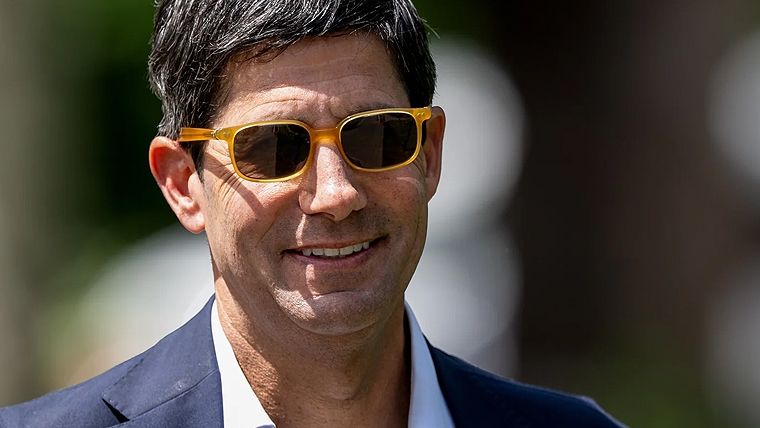
Now that Kevin Warsh has been nominated as the next chair of the US Federal Reserve Board, it is worth asking how different a Warsh Fed would be from the current one.
President Donald Trump had made it clear that he wants a Fed chair who will push for lower policy rates to juice the economy and support his broader agenda. But Warsh has a history of monetary hawkishness, voicing concerns about the risk of excessive inflation even during the depths of the post-2008 deflationary cycle. Moreover, he is a mainstream Republican globalist who favors free trade and immigration, not a protectionist-nativist MAGA ideologue.
So, why did Trump choose him? Aside from the need to calm markets that have been spooked by his attacks on Fed independence, one reason may be that Warsh believes that AI and other technological innovations will reduce inflation and thus allow for lower policy rates.
But there is a problem here: If AI reduces inflation, it would do so through higher GDP and productivity growth, implying the need for a higher equilibrium real (inflation-adjusted) policy rate and real long-term rate, even if lower inflation implies a potentially lower nominal policy rate. On net, then, AI would not necessarily justify a lower neutral federal funds rate. If Warsh and Trump’s other ally on the Fed board, Stephen Miran, think otherwise, they could be in for an unpleasant surprise.
A second possible reason is that Warsh has voiced support for credit-easing policies. But there could be a problem here, too. With Michelle Bowman, another Trump appointee, now in charge of bank supervision, the Warsh Fed will probably accelerate efforts to ease credit conditions even at the risk of fueling credit and asset bubbles. And that, in turn, could undermine financial stability at a time when markets are already frothy, leverage is high, and private credit is wobbling.
Warsh believes that unwinding the Fed’s balance sheet will allow it to reduce policy rates more sharply, on the grounds that quantitative tightening (QT) causes financial conditions to tighten. But he is simply wrong about this. Under the post-2008 regime, the interest rates on excess reserves paid to banks nullify the impact of those reserves on credit creation and financial conditions. That is why the Fed has been able to reduce its balance sheet by 25% without triggering tighter financial conditions. There is no reason to think that more QT will justify much lower policy rates.
Warsh’s opposition to the current ample-reserves regime may come back to bite him. After all, the recent aggressive QT policy already put so much stress on the repo and money markets that the Fed had to revert to pursuing backdoor quantitative easing (through the purchase of short-term bills and reverse repos) last December. If Warsh truly wants to avoid new emergency QE episodes, he should favor, rather than oppose, ample excess reserves. If he can’t see that now, he will realize it the next time financial stresses occur.
Moreover, Warsh has suggested that he may support a new Fed-Treasury accord in which monetary policy would be further removed from fiscal policy and public-debt management. For example, this could mean reducing the Fed’s balance sheet and buying short-term public debt rather than long-term bonds – as was the case before the global financial crisis.
But putting aside the fact that this could also phase out the current ample-reserves regime, further reducing the Fed’s holdings of long-term bonds would force the Treasury to double down on its Activist Treasury Issuance policy, implying that there would be even more manipulation of the market for long-term debt and mortgage-backed securities. In fact, a new Fed-Treasury accord could lead to even more backdoor ATI and more mixing of monetary and fiscal policy – the exact opposite of the arrangement’s stated goal. Has either Warsh or Secretary of the Treasury Scott Bessent considered these risks?
Warsh has also decried the Fed’s “mission creep” into issues such as financial stability, climate change, and inequality. But financial stability absolutely should be a Fed objective, especially if other Fed policies could lead to excessive credit easing. Moreover, since climate change could affect financial stability, owing to large stocks of potentially distressed, impaired, or stranded assets in real estate and other sectors, it would not be appropriate simply to ignore the issue. And in the face of a “K-shaped recovery,” where many households survive from paycheck to paycheck while a privileged few grow wealthier than ever, ignoring inequality may turn out to be a mistake, especially if it is exacerbated by AI.
Fortunately, the Fed chair is not an absolute monarch. Warsh will have only one vote out of 12 on the Federal Open Market Committee (FOMC). Though he will be primus inter pares (first among equals), he cannot bully the committee into doing whatever he wants. That is good news for markets, given how misguided some of Warsh’s stated positions are.
Moreover, recent economic data suggest that US growth remains above potential – in fact, it could even accelerate this year after a modest soft patch last year – while inflation remains stubbornly above the Fed’s 2% target. So, even the single rate cut that the FOMC has penciled in for 2026 may not be justified. With other risks looming – like a protracted war with Iran that sends oil prices higher and puts upward pressure on inflation and inflation expectations – the Fed may well find itself raising rates, rather than cutting them.
Once confirmed, Warsh will quickly get a reality check. The views he has expressed as a pundit are unlikely to survive an encounter with the real world of markets and geopolitics.
*Nouriel Roubini, Professor Emeritus of Economics at New York University’s Stern School of Business. Copyright: Project Syndicate, 2026, published here with permission.
We welcome your comments below. If you are not already registered, please register to comment
Remember we welcome robust, respectful and insightful debate. We don't welcome abusive or defamatory comments and will de-register those repeatedly making such comments. Our current comment policy is here.