

Business confidence as measured by ANZ’s Business Outlook (ANZBO) survey dipped slightly in September, reflecting the country’s “bumpy” economic recovery.
ANZ surveys 1,500 New Zealand businesses every month to analyse where the economy is heading over the next 12 months and releases a report every month.
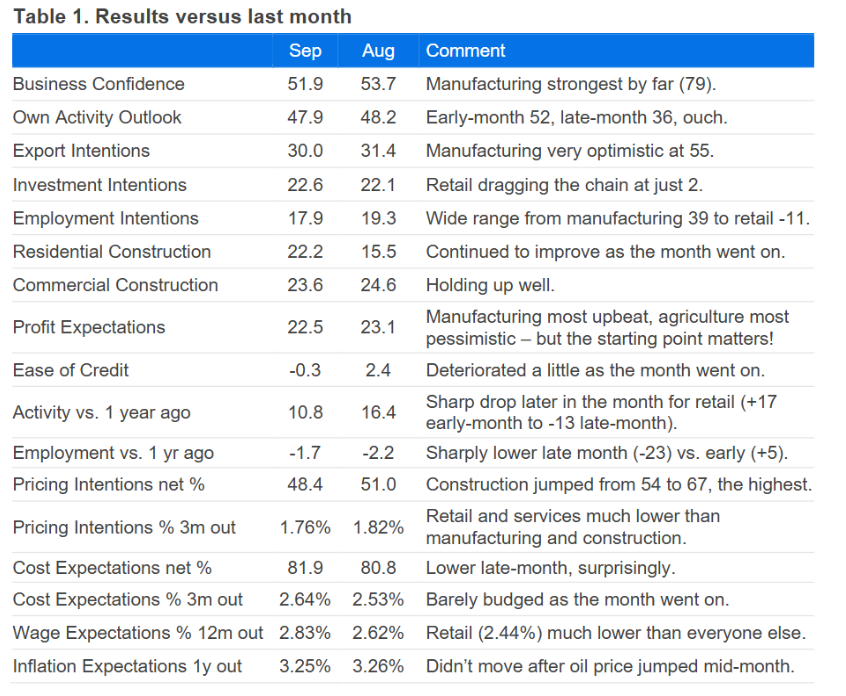
Business confidence as measured by the survey was +52 in September, slightly down from the +53.7 confidence rating in August. Reported past activity fell 5 points to +11.
“For the month as a whole, the survey continues to tell a story of recovering activity, with a good number of firms reporting stronger activity than a year ago,” ANZ senior economist Miles Workman said.
“The bumpy recovery continues.”
While most survey responses had been received promptly around September 1, a quarter were received after a reminder went out three weeks later. Workman said responses received later in the month – after oil prices rose sharply again – had lower activity indicators, while cost and price measures were similar or lower.
The Dubai spot oil price rose from US$100/bbl at the start of the month to a peak of US$128 and then down to US$111 as the reminder went out on September 22 (currently US$107.7/bbl).
One-year-ahead inflation expectations didn’t move after oil prices jumped mid-month.
“Inflation expectations were steady at 3.25%, cost expectations were up 1 point to net 82% expecting higher costs and pricing intentions eased 3 points to a net 48% expecting to raise prices,” Workman said.
He said it was encouraging for the Reserve Bank that inflation indicators were unmoved as the month went on, but described it as “very early days.”
The latest survey results include responses from before and after the Reserve Bank (RBNZ) raised the Official Cash Rate (OCR) by 25 basis points to 2.75% from 2.50% on September 2.
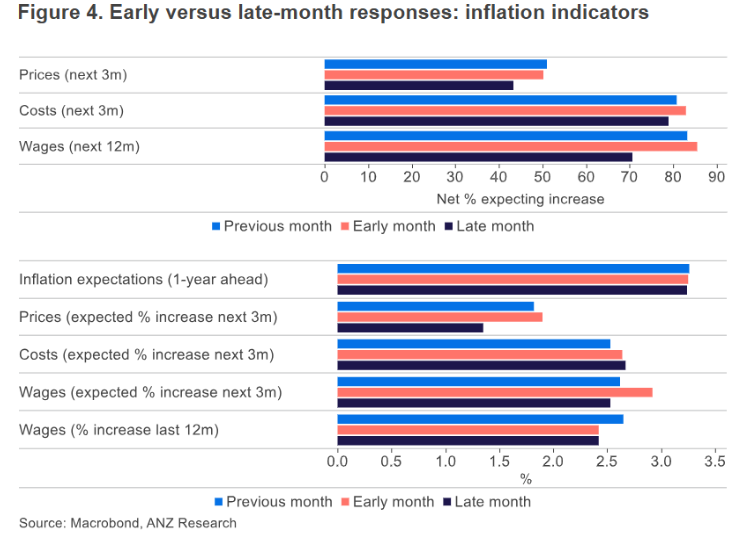
Although inflation expectations weren’t affected in ANZ's September business outlook survey, as the month went on and oil prices rose, there was a hit to all activity indicators in the survey, except investment.
“The weighted share of firms picking out shortages of skilled labour as either one of their biggest problems or one of the biggest drivers of their investment decisions are generally consistent with the degree of spare capacity in the economy, as estimated by the RBNZ,” Workman said.
“This month’s survey suggests a renewed confidence impact of the lift in oil prices, but activity indicators late [in the] month were nowhere near the lows plumbed in late March and into April.”
How firms respond to the renewed uncertainty will have direct implications for how the economy rounds out 2026, according to Workman.
“There is real momentum in some sectors, but there are real headwinds too. One thing is for sure: waiting for certainty is a decision to do nothing for potentially a long time,” he said.
We welcome your comments below. If you are not already registered, please register to comment
Remember we welcome robust, respectful and insightful debate. We don't welcome abusive or defamatory comments and will de-register those repeatedly making such comments. Our current comment policy is here.