

ANZ’s latest Business Outlook Survey shows business confidence dipped slightly in August, but still remains relatively high.
ANZ’s chief economist Sharon Zollner said the latest survey painted a picture of firms who are “keen to get on with things despite a volatile global economic backdrop.”
“Cost and pricing intentions remain elevated, but there is widespread optimism that the worst is past and that the economy is getting back on track. Risks are easy to point out, certainly, but we share that optimism,” she said.
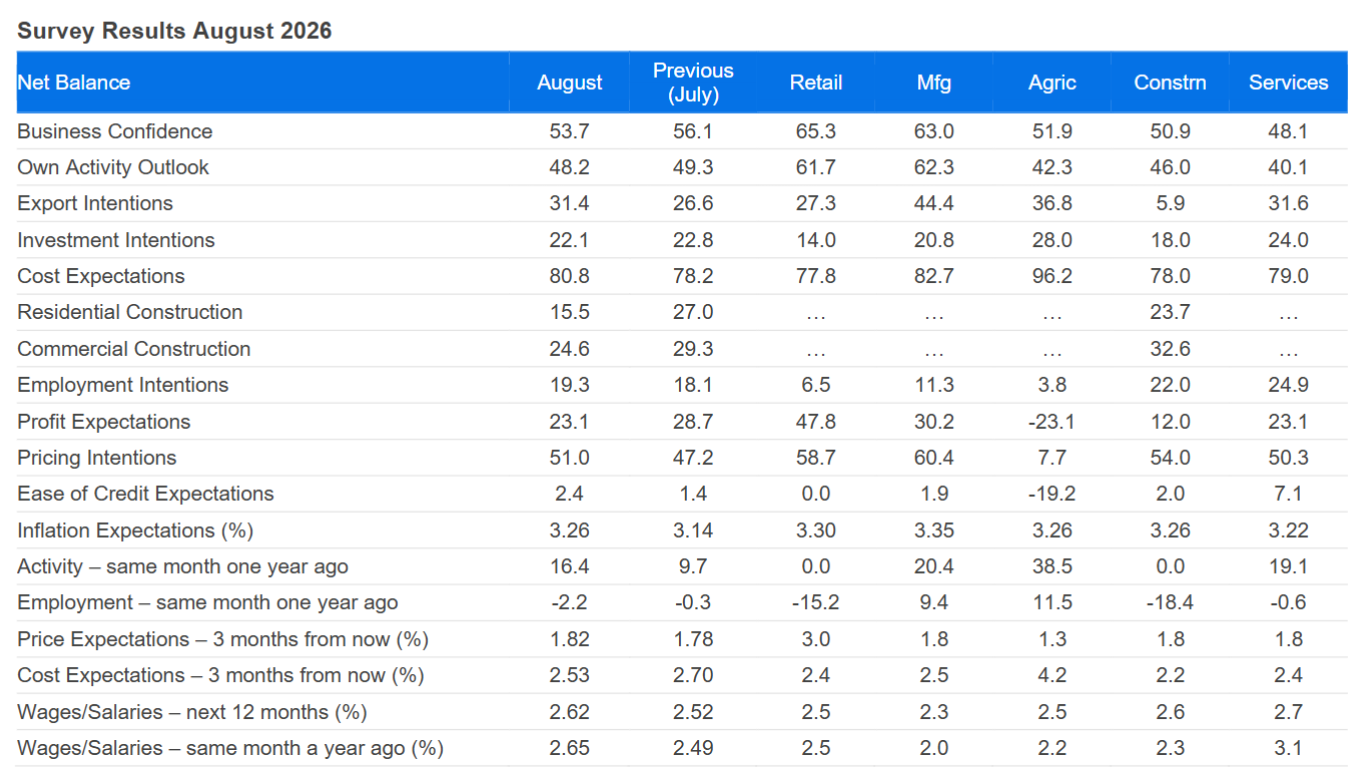
The net percentage of those expecting/reporting improvement and those expecting/reporting deterioration in economic conditions edged down from 56.1 in July to 53.7 in August. The own activity outlook dipped to 48.2 in August, from 49.3 in July. The own activity outlook measures what individual businesses expect from their own trading activity, while the general business confidence outlook measures expectations around the economy.
Confidence in agriculture in August was at 51.9, services at 48.1 and retail at 65.3. Confidence in construction was at 50.9 in August.
Activity compared to a year ago for agriculture was at 38.5, while retail was flat, manufacturing was at 20.4 and the services sector was at 19.1
Zollner said the most encouraging result in August’s survey was the lift in past activity, which jumped 6 points to 16 in August, thanks to a boost in services.
“The lift in past activity suggests the bounce-back is already underway,” she said.
Inflation indicators were mixed, lifting to 3.26% over a 12-month timeframe in August from 3.14% in July and cost expectations rose from 78.2 to 80.8 over the same period. Pricing intentions rose from 47.2 to 51.0 in August.
More firms are expecting cost increases and to raise their own prices, Zollner said, but the size of expected cost increases is getting smaller.
“Wage intention indicators are very interesting currently,” she said, noting that the net proportion of firms expecting to give wage increases is much more volatile and has moved consistently in the opposite direction to oil prices in recent months.
“That is, when fuel costs rise, firms think they can’t afford to give wage increases, and vice versa.”
Wage expectations moved up from 2.52% to 2.62% in August, the highest since March. In comparison, the size of expected wage increases remained more modest, Zollner said.
She said the increase in firms expecting to give wage increases in August is potentially a “red flag” compared to the Reserve Bank’s wage forecasts, but described the data as being volatile and having a short history, so ANZ has put it in the ‘watching brief’ pile for now.
“However, there is a growing pile of data that suggests there might be a meaningful mismatch between the skills firms are looking for and what they are currently finding in the labour market – that’s inflationary for a given rate of economic growth,” she said.
The survey reported that export intentions jumped again for a second month in a row, rising 4.8 points to 31.4.
Investment intentions edged down to 22.1 in August from July’s 22.8 and employment intentions had almost doubled, up from 9.4 in June to 18.1 in July.
We welcome your comments below. If you are not already registered, please register to comment
Remember we welcome robust, respectful and insightful debate. We don't welcome abusive or defamatory comments and will de-register those repeatedly making such comments. Our current comment policy is here.