
By Bernard Hickey
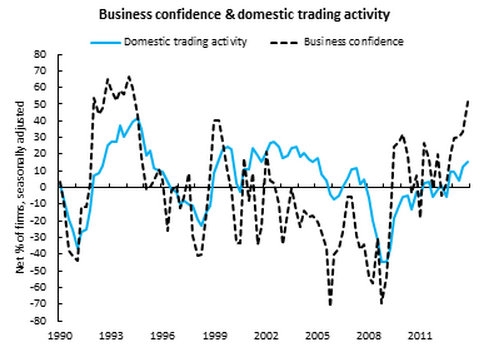
The New Zealand Institute of Economic Research (NZIER) has reported from its Quarterly Survey of Business Opinion (QSBO) that businesses were the most confident about the economy since June 1994 in the December quarter of 2013.
The survey found a net 32% of businesses expected their own activity to improve in the next quarter, up from a net 24% in the previous quarter and the highest level since March 2002. A net 52% expected the general business situation to improve, up from a net 33% in the September quarter and the highest level since mid 1994.
NZIER Principal Economist Shamubeel Eaqub said the economic recovery was broadening across the regions from Canterbury and becoming self-sustaining.
The survey found exerienced inflation pressures remained subdued, but that a net 24% expected to increase their prices in the next quarter, unchanged from the previous quarter. A net 70% expected interest rates to rise, up from a net 30% in June.
Eaqub said reported hiring rose to its highest level since December 2006 and a net 12% expected to hire more in the next quarter, although this was down from a net 16% in the September quarter. "Labour is gradually becoming harder to find, suggesting that wage inflation will increase over the year ahead," Eaqub said.
"2014 has a better outlook for households in particular as wages start to rise," he said.
Eaqub said the survey did not, however, contain a 'smoking gun' to argue for an early hike in the Official Cash Rate. He said the Reserve Bank was more likely to wait until the March quarter Monetary Policy Statement (MPS) before increasing the OCR from its current record low 2.5%. The Reserve Bank's December quarter MPS also suggested a March start to rate hikes.
Other highlights from the QSBO included:
Experienced activity strengthening
A net 15% of respondents reported improved domestic trading activity in the December quarter in seasonally adjusted terms, up from 12% in the September quarter and a net 4% in the June quarter. NZIER said the experienced activity (as opposed to expected activity or views on the economy) suggested annual economic growth of 3.5% in the December quarter, which would be the highest since early 2005.
Canterbury building investment intentions stall.
The September quarter's surprise slump in building investment intentions was confirmed in the December quarter, which NZIER said suggested the Canterbury rebuild was at its 'peak' pace. "This could suggest that the pace of growth, but not the level of activity, has peaked," NZIER said.
Peak capacity?
The QSBO's measure of capacity utilisation actually fell in the December quarter to 90.2% from 91%, despite those citing capacity as a constraint rising to a net 12.7% from 10.8% and being above the long run average of 8%.
NZIER said the lack of spare capacity was becoming most acute in Canterbury and was elevated for exporters, although was less constrained for domestic businesses.
Wage growth and jobs growth coming?
The survey showed a net 7% employed extra workers in the December quarter, up from a net 1% in the previous quarter. However it remained below the previous quarter's expectations that a net 17% would employ extra staff. The survey also found the ease of finding skilled labour worsened to a net negative 30% from a net negative 29%, with the percentage reporting it difficult to find unskilled labour rising to a negative 10% from a negative 5%.
"Difficulties finding labour typically take up to a year to push up wages -- this suggest wage growth will quicken in 2014."
Inflation pressures subdued
A net 10% reported increasing their selling prices in the December quarter, up from a net 10% in the previous quarter. But this also underperformed the previous quarter's expectations, when a net 24% expected to increase their prices.
Economists react
Westpac Senior Economist Michael Gordon said the economy was picking up faster than the Reserve Bank assumed, but inflation pressures remained in check, meaning the bank could afford to wait until March before hiking.
"Inflation pressures have remained in check, and while they are likely to build over time, the RBNZ doesn't seem at great risk of falling behind the curve. Our view remains that the RBNZ will begin raising the OCR in March (using its next review on 30 January to signal such a move), with five 25bp hikes over the course of this year," Gordon said.
ASB Economist Christina Leung said there was little in the QSBO to suggest a smoking gun for the RBNZ to hike in January, although capacity as a constraint continued to trend up, led by Canterbury.
"The key concern for the RBNZ would be the extent to which this flows through to widespread inflation pressures. We do not see anything in today’s QSBO which would trigger the RBNZ to lift the OCR in the January meeting. While the RBNZ is more confident of the broadening in the NZ economic growth, the contained inflation environment means we expect they will wait until the March MPS to lift the OCR," Leung said.
(Updated with more detail, chart, economist reaction)
We welcome your comments below. If you are not already registered, please register to comment
Remember we welcome robust, respectful and insightful debate. We don't welcome abusive or defamatory comments and will de-register those repeatedly making such comments. Our current comment policy is here.