

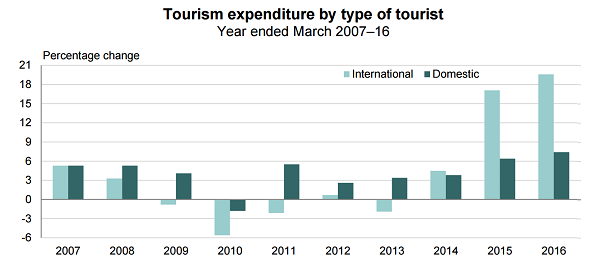
Spending by overseas tourists jumped 20% to a record $14.5 billion in the year to March 2016, says Statistics New Zealand.
Its Tourism Satellite Account: 2016 shows this leap follows a 17% increase the previous year.
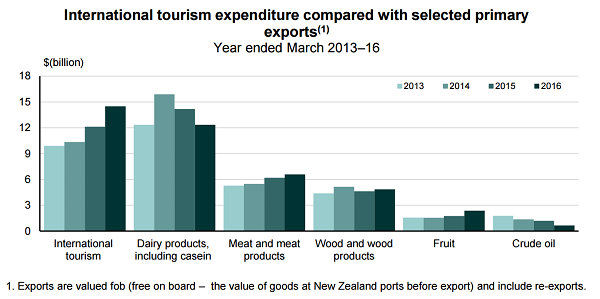
With the number of short-term international visitors to New Zealand increasing by 10%, international tourism expenditure contributed 21% to New Zealand’s total exports of goods and services.
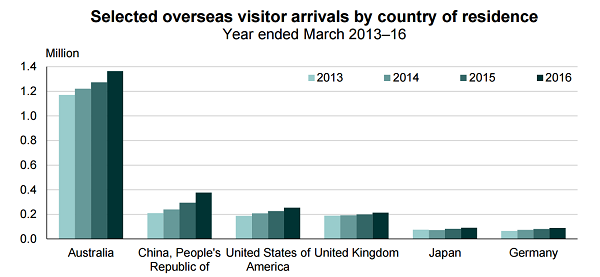
“Increasing visitor numbers from across key international markets, on the back of expanding airline and cruise capacity, drove the increase in spending by international tourists,” says Stats NZ’s national accounts senior manager Daniel Griffiths.
As for domestic tourism, spending increased by 7% to $20.2 billion.
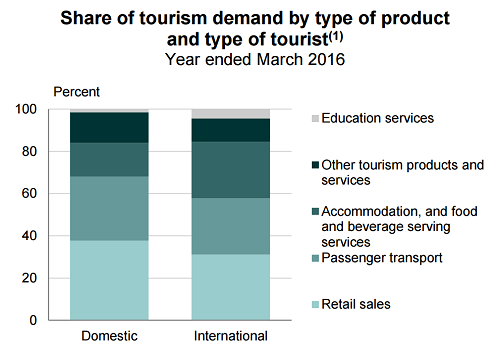
“The increase in domestic spending was particularly strong in the retail, passenger transport, and hospitality sectors,” Griffiths says.
Altogether, tourism expenditure increased 12% to $34.7 billion, following a 10% increase the previous year.
Stats NZ says tourism generated a direct contribution to gross domestic product (GDP) of $12.9 billion, which is equivalent to 5.6% of GDP.
The indirect value of industries supporting tourism generated an additional $9.8 billion – 4.3% of GDP.
Stats NZ says 188,136, or nearly 8% of all employed people in New Zealand, worked in the tourism sector in the last year.
Tourists generated $2.8 billion in GST revenue.
Here is a selection of noteworthy graphs from the Tourism Satellite Account: 2016.
This one shows the rapid growth of New Zealand’s international tourism sector:
This graph shows the value of international tourism in relation to some of New Zealand’s other exports:
This graph shows where tourists are coming from:
This graph shows how tourists are spending their money:
We welcome your comments below. If you are not already registered, please register to comment
Remember we welcome robust, respectful and insightful debate. We don't welcome abusive or defamatory comments and will de-register those repeatedly making such comments. Our current comment policy is here.