This is Part I of an ExportNZ paper commissioned from the NZIER.

Trade liberalisation is getting a bad rap…
There exists in many countries an underlying alienation of a significant portion of the population concerning the exercise of power by what they see as economic and political elites that the voters cannot influence… Some sense of democratic renewal is needed to avoid alienation; there is a sickness in western democracies.1
Concerns about globalisation and trade liberalisation are growing. The rise of Donald Trump, the UK Brexit vote and the rise of nationalist political parties in much of Europe all point towards a sea change in public attitudes around trade and economic integration.
And domestically, we have seen a breakdown in New Zealand’s long-cherished bipartisan support for trade deals, with Labour choosing to vote against the passing of legislation to enact the TPP. The extent of public opposition to TPP dwarfed that associated with the New Zealand-China Free Trade Agreement (FTA).
…and is bearing the brunt of a wider set of public concerns
One possible explanation: When Americans talk about “trade” today, we're not really talking about trade. Rather, “trade” has become a scapegoat for other economic forces and policy choices that have increased inequality, and a proxy for ethnic tensions and white anxiety about loss of social status.2
It is true that in some parts of the US and Europe there has been broad economic decline over the last decade; heightened exposure to international markets has certainly had an impact on some uncompetitive industries in some places (and often without the benefit of any significant social safety nets).3
However, technological change and ongoing ripples from the 2008 Global Financial Crisis have also had a large impact on the prosperity of these depressed regions. The former has led to greater automation, which boosts workers’ productivity – a good thing, albeit at the expense of more jobs in some sectors.4 The latter has dented households’ wealth and restricted the ability of many governments around the developed world to use fiscal policy to boost growth (e.g. via tax cuts).
It is also salient to recall that the growth in trade since the 1950s has resulted in an unprecedented rise in global living standards, lifting hundreds of millions out of extreme poverty.5 However, a fair portion of the public’s current concerns about trade liberalisation is due to the perception that its benefits are not evenly shared.
While the empirical evidence on income inequality in New Zealand doesn’t bear these concerns out – at least not in recent decades6 – and cause and effect are often confused, these perceptions matter.
New Zealand is a ‘global player’ 7
They matter because New Zealand benefits from a liberal global trading environment. The goods that New Zealand is best at producing are often highly protected in our key export markets. Likewise, the potential expansion of our dynamic services economy – sectors such as ICT, transport, international education, financial services, or professional services such as engineering – can be curbed by heavy regulation in some markets.
Lower tariffs and non-tariff barriers, as well as reduced production and export subsidies in agriculture (and freeing up constraints on trade in services), will help Kiwi firms compete on a more level playing field. This in turn should lead to increased exports, firm expansion and more job opportunities.
New Zealand households also benefit from trade liberalisation that lifts imports. As discussed below, when we import goods and services that we are relatively less competitive in producing, this lifts the purchasing power of our income (i.e. how many goods and services we can buy) and allows a wider variety of products to be enjoyed.
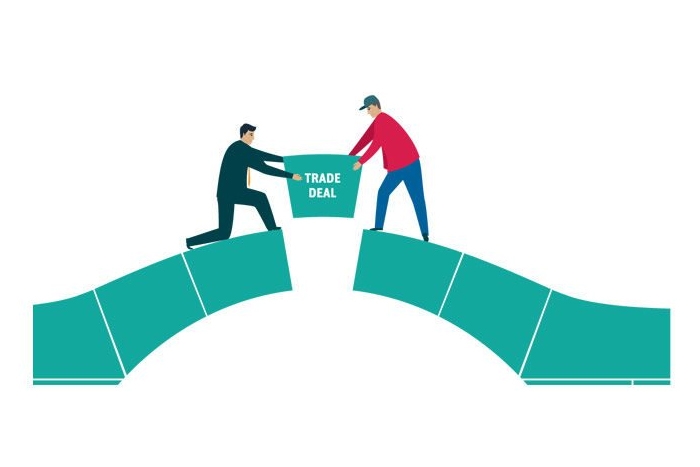
A small and distant country like New Zealand also needs internationally-agreed trade rules in order to continue to enjoy the benefits of trade – without agreed rules in the shape of free trade agreements or multilateral treaties, if our key trading partners decided to put up the drawbridge, we would have little ability to insist that they keep their markets open.
New Zealand is not the US or EU
We need to be careful to avoid blindly ‘importing’ other economies’ concerns (e.g. the US ‘rust belt’ perceptions of the hollowing out of manufacturing due to Chinese imports). New Zealand has a much more flexible economy than those of rural US states and much of Europe:
- Our industries have been exposed to international competition for almost thirty years since the mid-1980s reform period, and the structure of the economy has adjusted accordingly. Our industries don’t hide behind tariffs or other trade barriers that just lead to inefficiencies and misallocated resources that make any eventual adjustment to trade liberalisation more painful.
- Our manufacturing sector in particular has already changed in size and scope in response to changes in global production patterns and technological change. It is no longer in decline, despite common misperceptions. Manufacturing has stabilised at around 10-11% of the New Zealand economy in recent years and its share of New Zealand’s exports has not materially changed for a decade.
- Our labour market is able to respond quickly to changes in global economic conditions, as witnessed by our adjustment to the GFC, which was far less severe and much shorter than in many other places.
- Our fiscal policy settings place a priority on avoiding ongoing budget deficits and we are now paying down debt, which will help us cope with future economic shocks.
- Our monetary policy is independent and, while struggling to be effective in a world awash with unprecedented amounts of ‘cheap’ money, is generally regarded to have been effective in controlling inflation and contributing to economic stability.
And historically, there has been widespread support of globalisation and trade liberalisation in New Zealand – more so than in many other parts of the world. Yet the ‘social license’ granted to New Zealand’s politicians to pursue FTAs and multilateral treaties to open up access for New Zealand exporters and investors, while not yet revoked entirely, has been put on notice.
We need a new narrative on trade, because trade itself has changed
Trade creates many losers, and rapid immigration can disrupt communities. But the best way to address these problems is not to throw up barriers. It is to devise bold policies that preserve the benefits of openness while alleviating its side-effects.
Let goods and investment flow freely, but strengthen the social safety-net to offer support and new opportunities for those whose jobs are destroyed. To manage immigration flows better, invest in public infrastructure, ensure that immigrants work and allow for rules that limit surges of people (just as global trade rules allow countries to limit surges in imports). But don’t equate managing globalisation with abandoning it.[]
To be durable, policy solutions need to be politically feasible, able to be practically implemented, and effective and efficient in achieving their goals.9
One of the challenges in determining whether policy solutions are “effective and efficient” reflects the nature of trade in the 21st Century. These days, “trade” goes beyond traditional models of bulk commodities being sold from one country to another, and into areas such as investment, intellectual property, services and even environment- or labour standards-related aspects. Goods are increasingly made “in the world”, crossing borders and using multiple inputs of goods, services, technology, intellectual property and processes in many different markets.
Modern trade agreements accordingly go beyond the old tariff-cutting models and into areas such as behind-the-border regulatory coherence, rules for cross-border investment, protection of the environment or intellectual property provisions.
Change is the only constant; we can’t wind back the clock
Our impression is that issues such as investor-state dispute settlement, or patent rules for medicines – decried by opponents of trade liberalisation over the past few years – have created a degree of doubt amongst many different groups of people in New Zealand as to why FTAs matter and who benefits (and doesn’t) from them, as well as broader questions about perceptions of “sovereignty”.
As a result, it has become more difficult for these groups to determine whether trade liberalisation will be ‘effective and efficient’ in improving their living standards.
The response of politicians, policymakers and researchers to these concerns has not been sufficiently compelling. More needs to be done to remind stakeholders of the benefits of trade liberalisation – and the costs of the alternative.
There must also be an acknowledgment that globalisation is a reality and the clock cannot (and should not) be turned back to pre-globalisation days, no matter how much some governments may think that this would satisfy domestic constituencies.
A good starting point is to shift the focus of the public narrative away from “Trade liberalisation will boost exports” back towards a more household-centred story. Trade should only ever be considered as the means to a far more important end: lifting household living standards. Recent media releases by the Minister of Trade, including on the Trade Agenda 2030, are starting to emphasise this point, which is to be welcomed.
Notes:
[1] Geoffrey Palmer. http://thespinoff.co.nz/politics/29-06-2016/the-political-elites-foisted-a-new-system-on-ordinary-brits-little-wonder-theyre-grabbing-it-back/
[2] Washington Post. 30 June 2016. ‘‘Trade’ has become a hot election topic. Here’s what it really means.’ https://www.washingtonpost.com/opinions/what-trade-opponents-really-dont-like/2016/06/30/2e9939e0-3ef7-11e6-80bc-d06711fd2125_story.html
[3] See for example, Autor, Dorn and Hanson. 2016. ‘The China shock: Learning from labor market adjustment to large changes in trade’. NBER Working Paper No. 21906, January 2016. http://www.nber.org/papers/w21906
[4] See OECD. 2012. Policy Priorities for International Trade and Jobs, (ed.), D. Lippoldt, www.oecd.org/trade/icite for an overview.
[5] The number of people living in extreme poverty around the world has fallen by around one billion since 1990; since 1990 the share of world GDP made up by trade has grown from $3.5 trillion to $18.9 trillion in 2014 (World Bank Group and World Trade Organisation. 2015. ‘The role of Trade in Ending Poverty’).
[6] “[T]here have been some fluctuations since the mid 1990s, but there is no evidence of any sustained rise or fall in BHC household income inequality in the last 20 years using the Gini and top 1% share, or the last 10-15 years using the 90:10 percentile ratio”. Ministry of Social Development. 2016. ‘The 2016 Household Incomes Report and the companion report using Non-income Measures (the NIMs Report): Summary’.
[7] Yeabsley, J. (ed). 2001. Global player? Benchmarking New Zealand's competitive upgrade. NZIER Research Monograph 67.
[8] http://www.economist.com/news/leaders/21702750-farewell-left-versus-right-contest-matters-now-open-against-closed-new?frsc=dg%7Cc
[9] Nixon, C. 2016. ‘Durable policy approaches: Framework development and literature review’. NZIER Public Discussion paper 2016/2. http://nzier.org.nz/static/media/filer_public/b3/19/b3191379-4adf-4686-989f-1dd9eb973410/wp2016-2_final_durable_policy_bargains.pdf
This is Part I of an ExportNZ paper commissioned from the NZIER. The full Report is available here. This article is here with permission.
5 Comments
Trade is good at any level when there is an exchange of goods or services the parties cannot do for themselves and are able to exchange stuff they do have for mutual benefit.
Not so good if all you are doing is exploiting a resource or market which belongs to the other party, that is not "trade".
".....Trade should only ever be considered as the means to a far more important end: lifting household living standards......" Well yes. But is that in fact the way it actually happens? Households don't seem to be at the top of the benefits list in actuality.
Seems to me an important component of globalisation is ownership of the enterprises, which this article ignores. Note the chinese moves into vertical integration and control within the dairy industry. That could be promoted as "trade and good", but in my view delivers as always the benefit to the owners - so bad.
Remember always what Marx says - the ultimate benefit always flows to the owner - which is why I have always tried to be the owner.
While I agree fully that NZ needs to be open to trade, I think this article does confuse immigration with trade, and I also think you misunderstand the opponents' reason to oppose TPPA-type arrangements.
"Trade creates many losers, and rapid immigration can disrupt communities".
Here, you put trade and immigration into the same box, which implies that to accept trade, you must also accept the current rampant immigration, which is false.
"Trade should only ever be considered as the means to a far more important end: lifting household living standards."
I absolutely agree, and the only way to do this is to lift productivity. Importing cheap labour does the opposite, and limits our potential for competitiveness in a technologically changing world.
"issues ... decried by opponents of trade liberalisation over the past few years"
You have misunderstood what type of person is against these issues. Most people are not opposed to trade liberalisation, yet not as many people are in favour of the TPPA-type trade agreements.
In fact, I would say that people just haven't been able to have a good enough discussion of the issues you refer to, because any debate just raises accusations of being anti-trade. This kills the debate before it has started, much like raising the xenophobia accusation when trying to debate immigration.
I would also challenge the assertion (but stand to be corrected here) that "The rise of Donald Trump, the UK Brexit vote and the rise of nationalist political parties in much of Europe all point towards a sea change in public attitudes around trade and economic integration"
In my view, the Brexit vote was largely to do with a) immigration and b) opposition to unelected officials in Brussels imposing laws on Britain.
I do agree that the Trump win was about trade, but I wouldn't go so far as to say complete protectionism. Indeed, Trump does want trade, but only bilateral trade, because he is in a commanding position one-on-one.
To paint this as all connected and a growing issue is in my view to misinterpret the reasons for each specific situation.
The concerns about things like the TPP run a hell of a lot deeper than a few dollars a week. Selling out control of your country, the only one you have some say in, to Mega corp or other governments is all Ok if there's a dollar in it or never mind about an honest days work we can always fall back on your "social safety net"? Yuk!
"It's barbarism. I see it coming masqueraded under lawless alliances and predetermined enslavement. It may not be about Hitler's furnaces, but about the methodical and quasi-scientific subjugation of Man. His absolute humiliation. His disgrace"
Odysseas Elytis, Greek poet, in a press conference on the occasion of receiving the Nobel Prize (1979)
Thanks for the blog, John. I agree that we should be trading with other countries on fair terms and there are some unfair barriers to tarde that should be removed.
However, you have not substantively addressed the main arguments against agreements like the TPPA. If it was just about lowering tariffs and quotas, there wouldn't be a problem. In reality, the TPPA and other similar agreements contain measures on patents, copyright, government procurement, local government permits and licences, RMA and environmental regulation, public health, education, the internet and a range of other measures. It gives the most litigious corporations in the world the right to sue our government over restrictions (even if they are non-discriminatory). There are valid concerns over these provisions especially since they were negotiated in secret, without public consultation or research on the potential implications. These treaties affect a wide range of people and interests in New Zealand, not just big business.
So your approach of saying that "we just need to remind the public of the benefits of trade liberalisation" isn't enough. Nor is the idea that winners will compensate the losers. The reality is far from it - what I hear from big business is usually to reduce corporate tax to as close to zero as possible.
The dangers of protectionism come not from the protesters, but from those who push the boundaries of corporate rights too far, as occurred in the early 20th century. We need a change to these agreements to remove trade barriers, but not legitimate regulation in the public interest. We need trade rules that are fair, sustainable and support our local economy, including SMEs. The Greens will push for these trade reforms at the coming election.
Barry Coates, Green Party spokesperson on Trade and Investment
We welcome your comments below. If you are not already registered, please register to comment
Remember we welcome robust, respectful and insightful debate. We don't welcome abusive or defamatory comments and will de-register those repeatedly making such comments. Our current comment policy is here.