
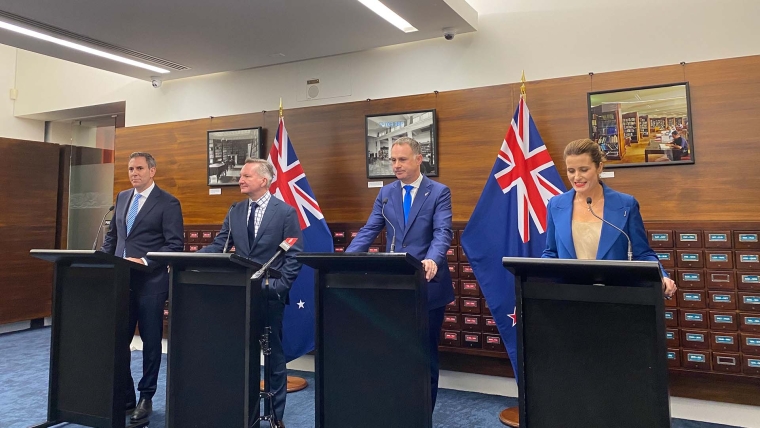
Despite the Government rolling back its climate policies, Australian politicians meeting with Finance Minister Nicola Willis and Climate Change Minister Simon Watts say both countries are committed to net zero - they just have different ways of getting there.
Net zero has been a long-term target for New Zealand, where all greenhouse gases except methane emissions from waste and agriculture biological processes, are to reach net zero by 2050.
The comments from Australian politicians, Climate Change and Energy Minister Chris Bowen, Treasurer Jim Chalmers, come as they met Watts and Willis for the Australia-New Zealand Climate and Finance Ministers’ 2+2 Dialogue in Auckland on Friday.
Chalmers and Bowen previously said the meeting was about "seizing the golden economic opportunities of the net zero transformation, boosting trade and investment and making our economies more resilient and productive".
Speaking to reporters on Friday, Willis said the meeting was about how to make New Zealand and Australia's economic relationship work "even harder to drive investment, lift regional resilience, build long-term productivity across both of our economies and our Pacific region, and to work together on our climate goals".
"As we look to the future, there is real value in working closer together to channel investment into high productivity sectors including digital services, advanced industries, energy, data, logistics - we wish to work together as nations that share insights, lower barriers and align regulations to encourage that investment."
Willis said both countries had a focus on energy security and affordability, and if their finance and climate settings lined up - "banks, exporters and fund managers don't need to build two systems".
"That means lower costs, greater certainty and more capital flowing into the investments and adaptations that will keep our economy strong in the next decade and allow us to achieve our climate goals."
Climate policies
But recently, the New Zealand Government has been in the spotlight for rejecting all of the Climate Change Commissions’ emission targets recommendations. This adds on to changes made to the country’s climate policies.
These include restricting the Climate Change to monitoring rather than advising on, emissions-reduction plans, removing the requirement for Emissions Trading Scheme settings to align with New Zealand’s Paris Agreement targets, and reducing the target for methane emissions. The New Zealand Government also reversed the offshore oil and gas exploration ban in June.
And on Tuesday, Finance Minister Nicola Willis told the Finance and Expenditure Committee in a meeting that the Government was not prepared to send billions of dollars offshore to meet the Nationally Determined Contributions (NDC) under the Paris Agreement.
Under the Paris Agreement, every country has set out its own NDC - this is to show the contributions countries will make towards delivering on the Paris Agreement goals. The obligations under the 2015 Paris Agreement is to limit global warming to “well below 2 °C” and attempt to keep it to 1.5 °C.
Countries can transfer carbon credits earned from reducing greenhouse gas emissions to help other countries meet their climate targets.
On Tuesday, Willis said she did not believe it was in the best interests of New Zealanders to send billions of dollars offshore.
It remained a priority for the Government to meet its Nationally Determined Contributions, Willis said.
"We are working hard to ensure that our priority of domestic climate action is met."
Experts told RNZ it would not be possible for the country to meet its climate change commitments by only focusing on domestic emissions reductions.
‘Every country makes its own decisions’
Speaking to reporters on Friday morning, Chalmers was asked about the New Zealand Government’s decision to not buy carbon credits to meet its Paris Agreement obligations and his thoughts on this.
Chalmers said New Zealand has committed to net zero and committed to the Paris Agreement.
“Every country makes its own decisions about the best way to meet its targets,” Chalmers said.
“We recognise that different countries go about it in different ways.”
Bowen said “we’re both committed to net zero but we have different pathways to get there because we’re different economies”.
“Agriculture is not as big an emitter in Australia as a proportion as it is in New Zealand, for example. That provides different challenges for our New Zealand friends.”
When asked about buying carbon credits and whether Australia would be using offshore mitigation, Bowen said Australia doesn’t use international credits or allow them in its accounting.
“We believe in domestic abatement so we don’t count international credits in our system either.”
When asked if they had any concerns about the roll back of some of New Zealand’s climate policies such as the reversal of the oil and gas exploration ban, Bowen said gas was a flexible fuel which supported renewables.
“Every country will find their own way of navigating the gas journey but we can’t pretend that we don’t need gas for the foreseeable future to support the renewables transition. That’s the way we see it in Australia,” Bowen said.
Methane target
Discussing the methane target, Watts said “at the end of the day, we are a major exporting nation of primary goods”.
“We need to ensure that we are balancing the reality of how we derive revenue in this country through exports in the primary sector, and not put in place policies that are going to drive that export and that food production to other countries that have a higher emissions profile.”
Watts said it was critically important that they have realistic and practical targets for farmers.
And when it came to the Paris Agreement, Willis said it was a global agreement about reducing global emissions.
“New Zealand wouldn’t be doing much for the world if we shut down our carbon-efficient farmers so that farming could occur in a less carbon-efficient way elsewhere.”
‘No two countries do things exactly the same’
In a report from Stuff, New Zealand’s trading partners such as the UK and the European Union (EU) allegedly have or are planning to raise concerns with the Government about how its roll back of climate policies could impact free trade deals.
But Trade Minister Todd McClay told RNZ his counterparts from the UK and the EU have not raised trade concerns with him over the country’s climate policies.
Asked if they were aware of this, Chalmers said “even countries as close as ours don’t have identical policies across a whole range of policy areas including this one”.
“But we do have the same objective which is to try and make sure that we’re maximising the industrial, the economic, the environmental benefits of cleaner and cheaper, more renewable, more reliable energy.”
Chalmers said: “I don’t give our friends free advice about the best policy mix to meet our shared objectives.”
“No two countries do things exactly the same and that’s all we’re seeing here.”
We welcome your comments below. If you are not already registered, please register to comment
Remember we welcome robust, respectful and insightful debate. We don't welcome abusive or defamatory comments and will de-register those repeatedly making such comments. Our current comment policy is here.