
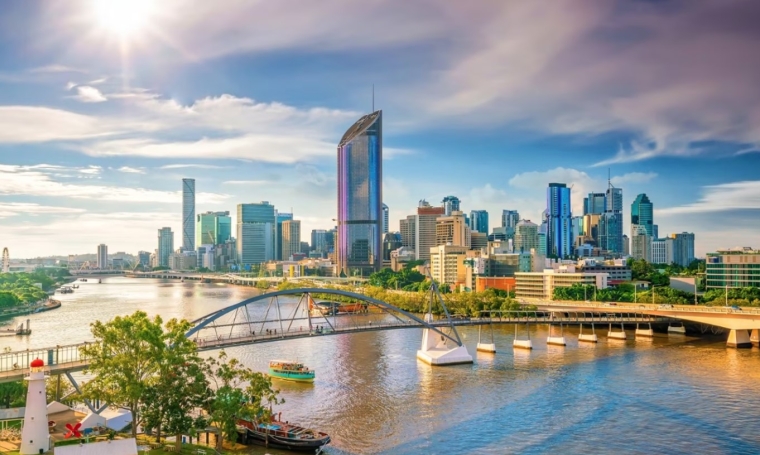
Many Australians, particularly Sydneysiders and Melburnians, tend to be disparaging about Queensland’s capital city Brisbane. Or Brisvegas as it’s often called.
But there’s no doubt Brisbane is having a moment. And it’s not just the hype attached to the coming Brisbane 2032 Olympic Games.
For many years Brisbane has been the largest beneficiary of interstate migration, often southerners moving to the city for better weather and/or lower house prices. It also appeals to foreign migrants attracted by its sunny, outdoor lifestyle, its vibrant economy, and its proximity to Queensland’s beaches.
Over the last decade Brisbane’s population has grown faster than any other Australian capital city.
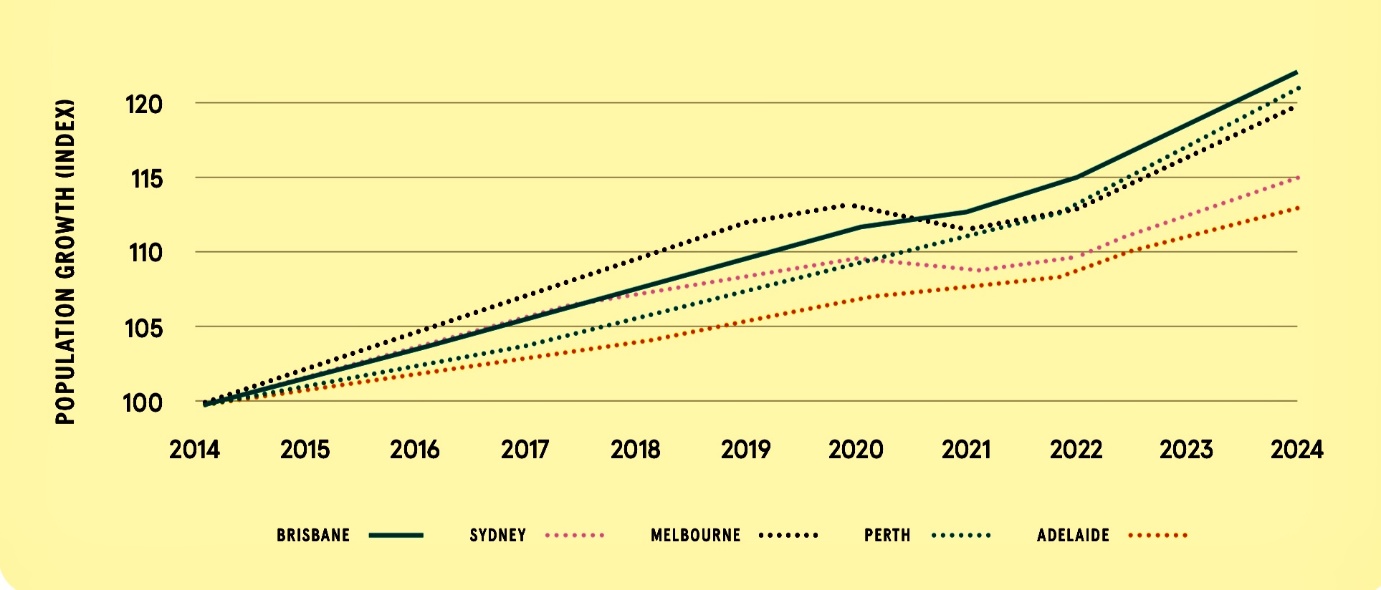
Source: Brisbane State of the City Report
The population of the City of Brisbane is now about 1.4 million and that of the greater metropolitan region around double that. The current growth rate exceeds 2.5%.
The Brisbane growth story is closely aligned to that of the wider south-east Queensland region that incorporates the Gold and Sunshine Coasts as well as Brisbane. That region is projected to grow to 4.5 million residents by 2032 and 6 million by 2046.
A large part of Brisbane’s population rise is attributable to the success of its economy which has enjoyed the fastest growth of Australia’s capital cities since the Covid-19 pandemic. According to the 2025 State of the City Report Brisbane’s economy exceeded A$200 billion (NZ$230 billion) in 2024, an increase of 16% since 2020. That has seen the city add hundreds of thousands of new jobs.
Two major contributors to that growth are the ‘experience’ economy and healthcare. The former, which spans tourism, events, entertainment, and the arts, has grown 30% since 2020, the fastest growth for this sector of any Australian capital city.
Tourism now generates around $14 billion annually for Brisbane and in 2025 Brisbane Airport had its busiest year ever with 25 million passengers.
The following table from the 2025 State of the City Report is an interesting demonstration of Queensland’s economic resilience in recent years. Most residents of Sydney and Melbourne are well aware of the tough times endured by many in the hospitality sector post-Covid. The picture looks very different for Queensland.
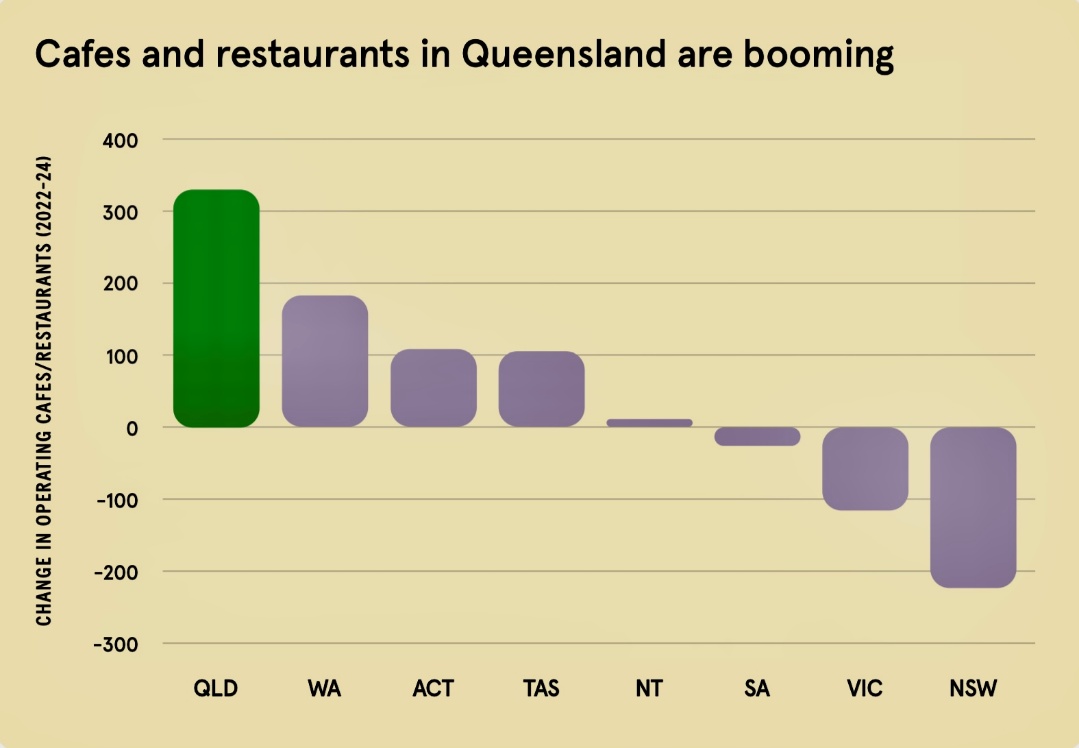
Source: Brisbane State of the City Report
However, the contribution of the cafe economy to Brisbane’s economic growth is dwarfed by the boom in construction. The 2025 State of the City Report identifies a pipeline of major projects worth more than $100 billion. These include the $5.4 billion Cross River Rail (a new 10.2km rail line involving tunnels under the Brisbane River), a $5 billion expansion of Brisbane Airport, the Port of Brisbane’s 224-hectare Future Port Expansion, and 17 new or upgraded facilities for the 2032 Olympics with associated transport infrastructure upgrades.
Listed property developer and investor Charterhall claims that Brisbane has ‘$202 billion of infrastructure projects either under construction or committed’.
One of the more intriguing new projects in Brisbane is the construction of a massive billion dollar facility in the Brisbane Airport industrial precinct for what’s described as ‘the world’s first utility-scale, fault-tolerant quantum computer’. The computer is being developed by PsiQuantum, a Silicon Valley-based quantum computing company that was co-founded by former graduates of the University of Queensland.
Np doubt the presence of this world first facility in Brisbane owes a great deal to almost $1 billion of funding provided jointly by the Queensland and federal governments.
Historically Brisbane has appealed to business because of its lower cost structure, and to workers because of its lower housing costs. The danger is that the city will become a victim of its own success as growth drives up demand and with it costs.
This has already occurred to a significant extent in the housing market. At the end of 2025, the median dwelling value in Brisbane hit $1,036,000, up a robust 14.5% for the year. That’s still attractive compared to Sydney at $1,281,000 but off-putting for residents of Melbourne where the median dwelling value finished 2025 far behind at $827,000.
Except for a brief blip in 2022, Brisbane has experienced strong house price growth over the last five years.
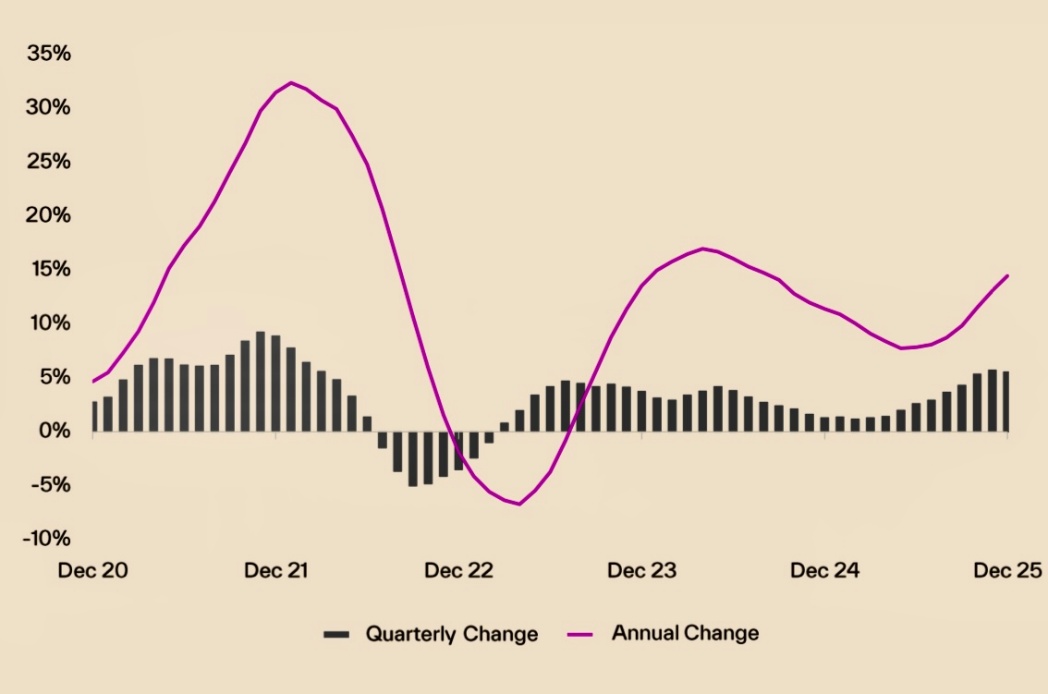
Source: Cotality Australia
Brisbane faces an acute housing shortage, a rapidly growing population, and a construction sector struggling to meet the city’s enormous demand for infrastructure and commercial, industrial, and residential property. It needs more engineers and designers, more builders and tradies. In the lead up to the Olympics it will continue to attract those workers from other Australian states (and New Zealand) but housing them will be a challenge.
Rising costs are a concern for any city hosting the summer Olympics. Brisbane is significantly smaller than the 2028 host city, Los Angeles, and the previous hosts Paris and Tokyo. However, the primary financial risk rests with the state of Queensland.
Come what may, the 2032 Olympics will put Brisbane on the world stage and boost south-east Queensland’s allure as an international tourist destination.
For the moment at least, the rise of Brisbane looks set to continue.
*Ross Stitt is a freelance writer with a PhD in political science. He is a New Zealander based in Sydney. His articles are part of our 'Understanding Australia' series.
We welcome your comments below. If you are not already registered, please register to comment
Remember we welcome robust, respectful and insightful debate. We don't welcome abusive or defamatory comments and will de-register those repeatedly making such comments. Our current comment policy is here.