

Race and religion are now centre stage in Australia and questions are being asked about the state of social cohesion.
Inevitably some politicians are eyeing opportunities for political gain.
The current turmoil stems from the Hamas attack on Israel of 7 October 2023, the subsequent war in Gaza, and the resulting protests on Australia’s streets and in many of its universities.
It came to a head with the Bondi terrorist attack last December in which two ISIS-inspired terrorists murdered 15 people at a Jewish celebration on Australia’s most iconic beach.
These events will have long-term political and cultural consequences for Australia.
In the immediate aftermath of the Bondi attack, the federal government was blamed by some of its political opponents and many in the Jewish community for allowing a climate to develop in which antisemitism flourished. This referred primarily to what critics argued was the government’s tolerance of antisemitic behaviour in pro-Palestine, anti-Israel protests about the war in Gaza.
The most extreme case of blaming the government for Bondi came from Israel’s Diaspora Affairs Ministry. It claimed that the “blood of the victims is on the hands of the Australian government”. Unsurprisingly, many Australians did not take kindly to such criticism from a government responsible for tens of thousands of deaths in Gaza.
The state of social cohesion in Australia will now receive comprehensive consideration from a recently established Royal Commission on Antisemitism and Social Cohesion.
Hearings for the Royal Commission commenced on Tuesday 24 February in Sydney. The terms of reference are complex, but the key avenues of inquiry are tackling antisemitism, examining the Bondi terrorist attack on 14 December 2025, and making recommendations that ‘would contribute to strengthening social cohesion in Australia and countering the spread of ideologically and religiously motivated extremism in Australia’.
But what exactly is social cohesion and is it actually under threat in Australia?
The Australian Institute of Health and Welfare provides a useful definition –
Social cohesion is a multi-dimensional concept referring to social connectedness, solidarity and trust amongst individuals, within and across communities and organisations, and within society at large.
The Gaza/Bondi turmoil reveals two threats to social cohesion. The first is bigotry in the form of antisemitism and islamophobia. This is an unfortunate but longstanding problem. Views differ as to how prevalent it is.
The second threat to social cohesion is the ‘importing’ of foreign conflicts to Australian shores. This has been a stark feature of the last two years as Israel/Gaza related violence and protest has become a regular event, particularly in Sydney and Melbourne.
Australians value the peace and relative safety of their homeland. They don’t want that jeopardised by disputes from overseas being played out here. A large and diverse immigrant population increases the potential for friction over foreign conflicts, but it has not previously been a major problem.
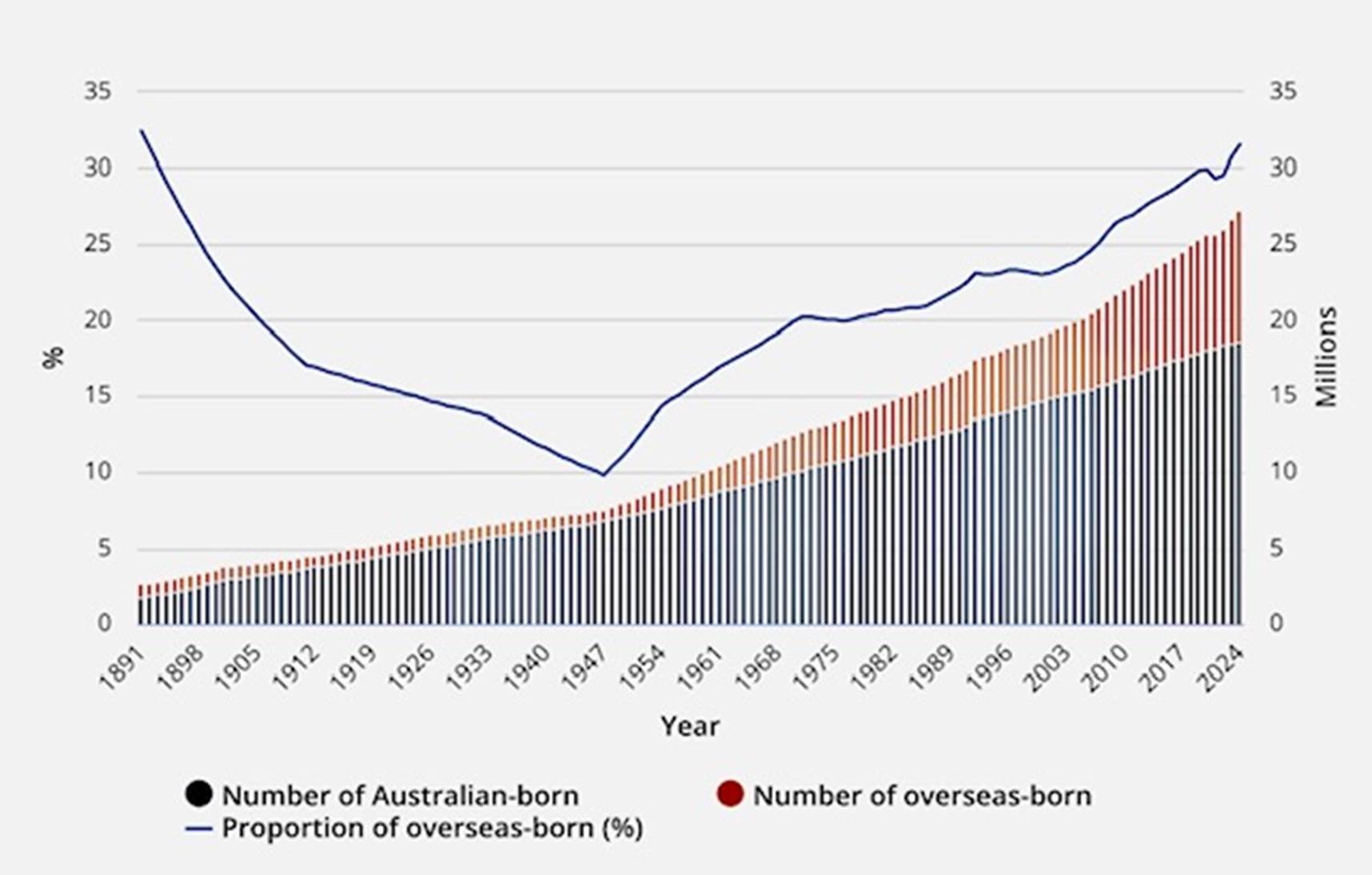
Australia has one of the highest per capita migrant populations among advanced countries. The foreign-born figure is more than 32% (including over 600,000 kiwis). That compares with around 15% in the United States and 30% in New Zealand.
Proportion of Australia’s population born overseas
Source: The Australian Bureau of Statistics
The foreign-born population of Australia has gone from just a tenth to a third over the last eighty years. The degree to which foreign conflicts have not been imported is a tribute to the success of the country’s multicultural society.
However, the rapid rise in the polls of the openly anti-immigration One Nation Party over the last year suggests something may be changing. The party now regularly scores between 20% and 25% in federal and state polling. Up from just 6% in the election last May.
Remarkably, the latest Roy Morgan poll for New South Wales has One Nation on 30% ahead of the state Labor government on 25%.
No doubt part of that increase is attributable to voters’ dissatisfaction with Australia’s ongoing inflation predicament. But given that One Nation is an economic policy vacuum, and its leader Pauline Hanson constantly attacks immigration, it seems likely the Bondi attack and the domestic strife driven by the Israel/Palestine conflict are part of the party’s growing support.
The violence in Sydney this month surrounding the visit of the Israel President Isaac Herzog may have been a factor in the NSW poll results.
The Australian Prime Minister Anthony Albanese is attempting to address the social cohesion issue and to ‘turn down the temperature’. In 2024 he created two Special Envoys, one to combat antisemitism and one to combat islamophobia.
In January Parliament passed the Combatting Antisemitism, Hate and Extremism Bill. That legislation gives the government the power to outlaw hate groups and makes it an offence for religious officials to advocate violence and extremism.
And now the Royal Commission. It may eventually provide some answers and recommendations but in the meantime, it will keep antisemitism, islamophobia, and the state of Australia’s social cohesion in the headlines.
Pauline Hanson and One Nation will be happy about that.
*Ross Stitt is a freelance writer with a PhD in political science. He is a New Zealander based in Sydney. His articles are part of our 'Understanding Australia' series.
We welcome your comments below. If you are not already registered, please register to comment
Remember we welcome robust, respectful and insightful debate. We don't welcome abusive or defamatory comments and will de-register those repeatedly making such comments. Our current comment policy is here.