

The deficit between what we earn overseas and what we spend as a country has expanded, which may come as a mild surprise to economists.
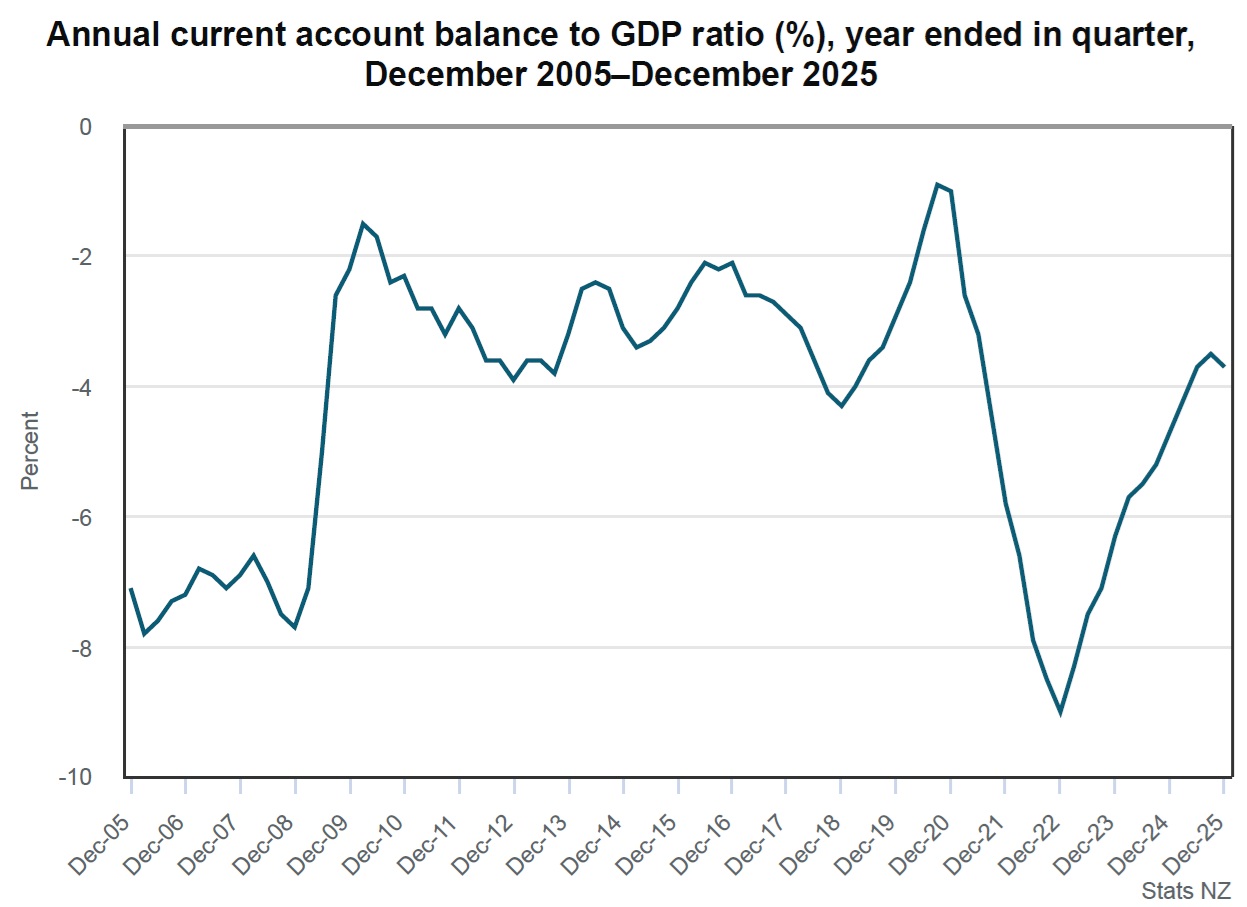
Statistics NZ reports that in the 12 months to December 2025, New Zealand’s annual current account deficit was $16.3 billion (3.7% of GDP), up from $15.4 billion (3.5% of GDP) in the September 2025 quarter.
While the deficit has widened a little, it can be considered sustainable, particularly compared with where we've come from in the not-so-distant past. In December 2022 the deficit peaked at 9% of GDP.
High current account deficits as New Zealand has had in the past attract (in a bad way) the attention of the global ratings agencies. In a worst case scenario high deficits can potentially lead to cuts in our sovereign credit ratings, making overseas borrowing harder and more expensive.
But that's not the situation at the moment.
BNZ economist Matt Brunt said it is important to note that a current account deficit is not necessarily a bad thing.
"It depends what the funds are being spent on and the rate of return being achieved. That said, a nudge higher in the annual deficit may raise an eyebrow or two at the rating agencies even if the deficit is much smaller than its 9.0% peak in late 2022. The change of trajectory will be noted.
"Our current forecasts see the annual current account deficit pushing well above 4% of GDP in 2026. International rating agencies may take some comfort that NZ’s net international liability position continued to decline to 44.3% of GDP in December 2025," Brunt said.
In terms of the quarterly figures, Stats NZ said New Zealand’s seasonally adjusted current account deficit for the December quarter widened by $857 million to a deficit of $4.6 billion.
"The widening of the primary income deficit (by $664 million), and the goods deficit (by $321 million), were the main contributors to the current account deficit," Stats NZ's international accounts spokesperson Viki Ward said.
The services balance was a surplus of $122 million, the third surplus since the March 2020 quarter.
In the December 2025 quarter, the primary income deficit was $3.7 billion. Primary income flows between New Zealand and the rest of the world represent income earned from investments and compensation of employees.
Stats NZ said New Zealand's investors earnings fell $336 million in the December 2025 quarter, when compared with the September 2025 quarter, while foreign investors earnings increased by $349 million.
The decrease in New Zealanders' earnings from their overseas investments this quarter was mainly due to a fall in dividends earned, while foreign investors earned more profits from the ownership of shares in New Zealand businesses.
The seasonally adjusted goods deficit was $866 million in the December 2025 quarter, following a deficit of $545 million in the September 2025 quarter.
Goods imports increased $716 million (3.5%) to $21.4 billion, led by rises in petroleum and products, and electrical and mechanical machinery and equipment.
Goods exports increased $394 million (2.0%) to $20.6 billion, led by a rise in the value of meat exports.
New Zealand's net international liability position was $197.2 billion at 31 December 2025, $5.7 billion lower than $202.9 billion at 30 September 2025.
New Zealand's overseas assets rose $2.0 billion at December 2025 compared with September 2025, while liabilities fell $3.8 billion.
"Changes in valuations of both assets and liabilities were major features of the smaller net liability position," Ward said.
We welcome your comments below. If you are not already registered, please register to comment
Remember we welcome robust, respectful and insightful debate. We don't welcome abusive or defamatory comments and will de-register those repeatedly making such comments. Our current comment policy is here.