sign up log in
Want to go ad-free? Find out how, here.

Scott L. Montgomery explains why the Persian Gulf has more oil and gas than anywhere else on Earth

Economy / opinion
Scott L. Montgomery explains why the Persian Gulf has more oil and gas than anywhere else on Earth
oil
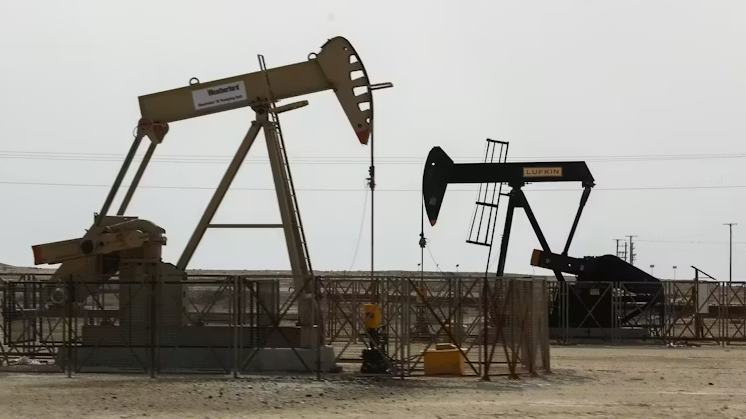
Oil wells in the Persian Gulf region are among the most productive in the world. Jakub Porzycki/NurPhoto via Getty Images.

By Scott L. Montgomery*

It has been said that Persian Gulf countries are both blessed and cursed by their vast oil and gas reserves. Geologic forces over millions of years have meant the region is an energy-rich global flash point, as it is now with a war underway that’s causing a global energy crisis.

As a petroleum geologist who has studied the region, I still find myself amazed at the size of its hydrocarbon endowment. For instance, there are more than 30 supergiant fields, each holding 5 billion barrels or more of oil, around the Persian Gulf. And wells in the region produce two to five times more oil each day than even the best wells in the North Sea and Russia.

Modern geoscience has identified several key factors of rocks that make a region particularly rich in petroleum, including their ability to generate and hold hydrocarbons. In the Persian Gulf region, all of these factors are at or near optimal levels.

For sheer abundance and ease of production, it simply doesn’t get any better than the Persian Gulf region.

A map of the Persian Gulf region shows locations of oil and gas fields.
The Persian Gulf region is rich in oil fields, marked in green, and gas fields, marked in red. Central Intelligence Agency via Library of Congress.

A quick history

Humans knew about the presence of hydrocarbons in the area long before flooding created the Persian Gulf at the end of the last ice age, between 14,000 and 6,000 years ago. Natural seeps of oil and gas are common along rivers and valleys in many parts of the region. Thousands of years before the start of the Common Era people used bitumen, a form of heavy oil, for building mortar and to waterproof boats.

The first modern oil discovery came in 1908 at a known seepage site in western Iran. In the 1950s and ’60s, an era of rapid expansion in oil and gas exploration, it became clear that no other region on Earth was likely to have a similar abundance.

Other areas with huge volumes of oil and gas have been found, such as West Siberia in Russia and, more recently, the Permian Basin in the U.S., but none compare either with the scale of reserves or the high rates at which oil and gas can be produced in the Persian Gulf.
Geologic setting

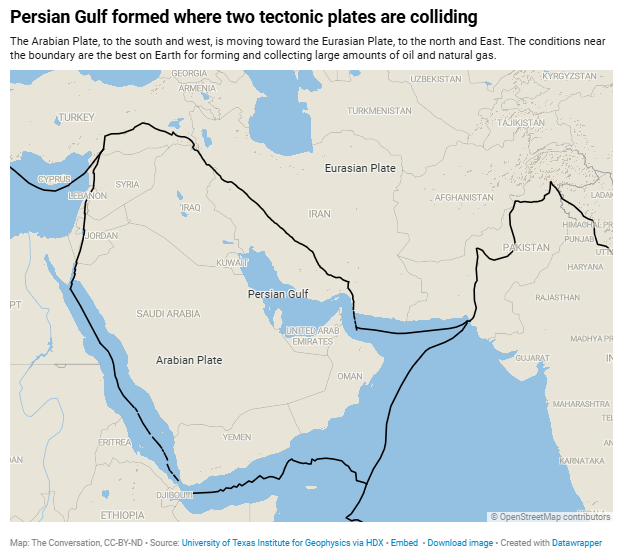
The Persian Gulf region is located where two continental plates are colliding: the Arabian Plate to the southwest and the Eurasian Plate to the east and north. This collision has been happening for about 35 million years and has resulted in a dynamic setting where rock layers have been bent and broken and, at deeper levels, transformed by significant heat and pressure.

Geologic features differ a great deal between the two sides of the Gulf. On the Iranian side, the the Zagros Mountains stretch 1,100 miles (1,800 kilometers) from the Gulf of Oman to the Turkish border. Part of the great Alpine-Himalayan mountain system, the Zagros are made up of highly folded and broken rocks that formed over the past 60 million years from the collisions of Africa, Arabia and India with Eurasia.

On the Arabian side of the Gulf, that type of bending and fracturing didn’t occur. Instead, the compressive forces of collision warped a rigid platform of deep, hard rock known as “basement rock” into broad, dome-like structures of enormous size, extending for tens, even hundreds, of square miles.

Underlying the Persian Gulf itself is a basin filled with debris eroded from the rising of the Zagros Mountains. In its deeper portions, the basin was subjected to high temperatures and pressures necessary for the generation of oil and gas.

Overall, it is an excellent setting for generating and trapping hydrocarbons on a large scale.

An overhead view of a folded and rumpled landscape.
A satellite view of an area of the southwestern Zagros Mountains shows long ridges and valleys, evidence of tectonic plates colliding. NASA via Flickr.

Rocks that make oil

Oil and gas form from organic material such as marine zooplankton and phytoplankton, originally concentrated in shales, mud-rich limestones and other rocks exposed to elevated temperatures and pressures. When rocks are composed of at least 2% organic material, they are considered to be high quality for oil and gas generation.

The Gulf region has a particularly large number of layers of such source rocks, some of which are especially thick, widespread and organically rich. Examples are the Hanifa and Tuwaiq mountain formations on the Arabian side of the Gulf, which formed during the Jurassic period, about 200 million to 145 million years ago, and the Kazhdumi formation in Iran, which formed in the Cretaceous period, about 145 to 66 million years ago. These rocks have between 1% and 13% organic content, and even more in some places.

Oil and gas structures

The region’s bent and fractured rock layers, and its domes, are well suited for trapping hydrocarbons.

Folds of the Zagros, which are legendary for geologists due to their spectacular forms on satellite imagery, contain hundreds of billions of barrels of oil and cubic meters of natural gas. A glance at a map of oil and gas in the Persian Gulf region will show a northwest-southeast trend of long, sausage-shaped fields reflective of major fold structures. These features actually include hundreds of individual fields of varied size, reaching from southern Iran through northeastern Iraq.

On the Arabian Plate, the large dome structures have formed especially large oil and gas accumulations. These include Ghawar oil field in Saudi Arabia, the largest in the world, which could produce over 70 billion barrels of crude oil. The South Pars-North Dome gas field, shared by Qatar and Iran, could produce at least 1,300 trillion cubic feet (46 billion cubic meters) of gas – equivalent in energy content to more than 200 billion barrels of oil.

The most important reservoir rocks are limestones in which portions have been partly dissolved, enhancing the ability for oil and gas to move through them. In Zagros reservoirs, fluid flows through fractures created by the folding and faulting related to plate collisions. And in places such as the Arab-D reservoir at the Ghawar Field in Saudi Arabia and the Asmari limestone in many Zagros fields, these high-quality oil-storage rocks cover huge areas – hundreds and even thousands of square kilometers.

Nothing on this scale exists anywhere else on the planet, onshore or offshore, testifying to the unique petroleum geology of the Persian Gulf region.

Large industrial towers stand side by side.
A natural gas refinery at the South Pars gas field on the northern coast of the Persian Gulf, in Asaluyeh, Iran. AP Photo/Vahid Salemi.

Future possibilities

The combined result of these factors is that roughly half of the world’s conventional oil reserves and 40% of its gas lie beneath just 3% of the Earth’s land surface.

U.S. Geological Survey assessments suggest that, even after more than a century of drilling and production, large amounts of oil and gas remain to be discovered in the Persian Gulf region. In a 2012 report covering the Arabian Peninsula and Zagros Mountains, the agency estimated there could be as much as 86 billion barrels of oil and 336 trillion cubic feet of natural gas in the rocks, in addition to the amounts that have already been discovered.

More oil and gas could also be produced using the horizontal drilling and fracking techniques pioneered in the U.S. in the 2000s and 2010s. Saudi Arabia and the UAE are now trying those methods in their petroleum fields. It’s too early to say how successful they may be, but research indicates they could allow even more production.The Conversation


*Scott L. Montgomery, Lecturer in International Studies, University of Washington.

This article is republished from The Conversation under a Creative Commons license. Read the original article.
We welcome your comments below. If you are not already registered, please register to comment

Remember we welcome robust, respectful and insightful debate. We don't welcome abusive or defamatory comments and will de-register those repeatedly making such comments. Our current comment policy is here.

50 Comments

This - despite the author's cred, is a puff-piece. 

Let's take an example: 'And in places such as the Arab-D reservoir at the Ghawar Field in Saudi Arabia and the Asmari limestone in many Zagros fields, these high-quality oil-storage rocks cover huge areas – hundreds and even thousands of square kilometers.'

Note the present tense, and the lack of volume/flow data. 

The peak production of the Ghawar oil field in 1981 reached 5.7 million barrels per day, making it the highest sustained oil production rate ever achieved by any single oil field in history. 

It peaked after 30 years, and is down to 3-point-something currently. As all fields do. 

He's right about the location (ex tar-sands) though. Hence all the conflict - you cannot run modernity on anything less potent, and the potent is leaving us. 


Up
2

Not only but also...

"More oil and gas could also be produced using the horizontal drilling and fracking techniques pioneered in the U.S. in the 2000s and 2010s. Saudi Arabia and the UAE are now trying those methods in their petroleum fields. It’s too early to say how successful they may be, but research indicates they could allow even more production."

It begs the question why , if the reserves are copious and available they feel the need to adopt a technically more difficult and less productive method.

Up
4

LMBF. Yep good question. Then there's this confident assertion : U.S. Geological Survey assessments suggest that...... large amounts of oil and gas remain to be discovered in the Persian Gulf region. Thinking I should hold off buying and EV for a bit. 


Up
2

Don't fall for PDK's doomer metaphysics!

The Ghawar "supergiant" oilfield may have "peaked" in 1981 but has continued massive output to this day. It still pumps out 3.8 million barrels a day. Peak just means the maximum flow from a freshly exploited field. This flow can be assisted with different extraction techniques decades later.

To use one field's minor rate of decline to imply that "modernity" is on the brink of disaster is simply just pushing a narrative.

Oil supply is about global production which has grown significantly since Ghawar peaked way back in 1981.

Up
5

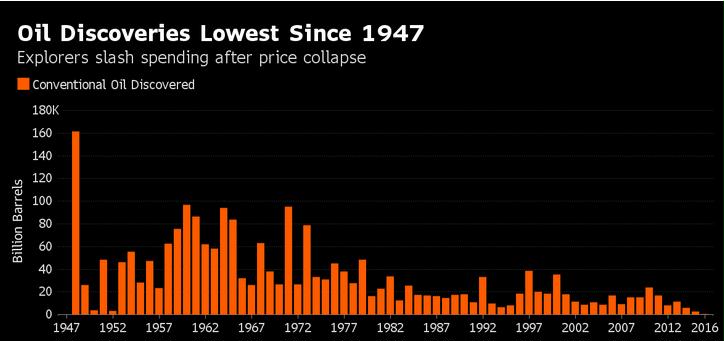
Perhaps the rate of global discoveries, might tell you something. 

Global Oil Discoveries Collapse to Decade Lows Despite Frontier Breakthroughs | OilPrice.com

oil-discoveries-lowest-since-1947-woods-mackenzie-bloomberg.jpg (724×341)

Discoveries peaked in 1964, and you cannot extract what you haven't discovered. 

Ironically, the EV approach doesn't work ex fossil energy - meaning I can identify your incorrect presumption: that modernity can be permanent. 

Up
1

Saying “discoveries peaked in 1964” doesn't have anything to with supply. Global oil output is higher now than when discovery rates peaked. We have made significant improvements to oil extraction techniques since 1964.

Up
3

"Saying “discoveries peaked in 1964” doesn't have anything to with supply."

You may wish to reconsider that statement...it may not impact current supply but it will certainly impact future supply (availability)

Up
2

It just tells you we’ve already mapped the easy‑to‑find oil fields. Future oil flows are dependent on recoverable reserves, recovery factors, and technology.

Up
2

No - you've mapped all the fields -certainly the giants and super-giants. 

What you are finding is less and less - and more importantly, less every year than is being burned. 

Micawber comes to mind

Up
0

It tells you supply is going to decline (and become expensive in terms of EROEI)...the closing of Hormuz has reduced supply by what?, approx 10% to 20% and we can see the chaos that is creating. You may wish to look into the lifespan of fracked wells and reappraise your confidence in technology....nothing comes for free.

Up
0

By using the closing of Hormuz in an argument you are conflating a geopolitical disruption with geological depletion. That's a category error!
Your worldview predicts decline yet reality shows growth. If your model contradicts the data, your model must be wrong. Nothing coming for free has always been the case. We can't accept that as "analysis".

Up
2

Are you so blind that you do not see the reason why the closing of the Strait is causing so much chaos?...it isnt geopolitics may be a clue.

Up
0

We? You and Yvill are alone in this. 

Your error - and it's both obvious and gross - is that you conflate. The decline is in stocks, the growth is in flows. 

I think it is so silly as to be stupid, but I guess its a genuinely-held misconception. 

Try envisaging a 1,000 litre water-yank, up the hill, full. First day, you empty a litre, second day 2 litres, 3rd day 4, then 8, 16, 32... You're doubling per time, which is exponential growth, which is what we've been attempting (and energy-use has been in lockstep with work, unsurprisingly). 

On the tenth day, you have half-emptied the tank (and it was the clearest water at the top - the sludge is still in the bottom, and now more of a percentage of the remainder, than it was at the beginning). You would say that you've never stopped growing (you are describing the flow). I'm here to tell you there has never been less water left in the tank - it's half empty. 

Now, you CAN keep increasing the flow briefly, from there; but not for a whole doubling-time, obviously (there being only half left). But the drippy look at the end of the hose will come sooner that if you'd throttled back the flow... And the dregs will appear near the end, blocking the hose.. 

Understand? 

Up
0

Your tank analogy doesn't match what we see in the real world. It's an absurdly simplistic and false analogy that doesn't take into account ongoing investment and innovation, energy flows, alternative sources and so on. You are comparing a single tank with a complex global system. A single supply of limited stock. In the real world we would see things like inflow pipes attached to a roof or a windmill pumping water from a well into the tank. That one tank wouldn't be the only source of water. There is rain, a river, a lake, an ever filling subterranean reservoir somewhere or water locked in ice.

A much more complex system actually exists. With energy, we are looking, not at a single stock, but a complex and dynamic, multi-source, global system. Almost all degrowther "arguments" boil down to category errors. A single tank is not in the same category as a complex, multi-source, global system. It falls down if we add inflow water to the tank from a stream originating from melting ice on a nearby mountain. Why can't I add that factor in? Because then your analogy doesn't work does it? Real world data contradicts your model which leads to the conclusion that your model is wrong.

Also, why are we doubling our use every day? At that rate the entire world's water supply would be used up in 71 days! Why not increasing by 1-3% per year? Why not increasing efficiency too? Why not improving and developing all systems? And, why not investing in alternative sources of water supply if use is increasing? That's what's happening in the real world.


Up
1

The decline is in stocks, the growth is in flows. What decline? When the Club of Rome write its report in 1972 proven reserves were 300 billion barrels, now they are 1.7 trillion, with record production. You need a bigger tank.


Up
0

"Global oil output is higher now"

I take it you mean all liquids, because conventional oil peaked in 2008. A barrel of corn ethanol just doesn't have the same kick as a barrel of ME crude.

Up
1

He's arguing from a 'need to believe' POV.

Hence the nonsense that modernity - Ford Rangers and all - can somehow be maintained on lignite - one step up from peat. 

I don't think there are very many thinking like that, now. 

Up
0

I think it is you, PDK and your acolytes, that 'needs to believe'. Projecting much?

No one has mentioned lignite nor peat in this thread - strawman argument. The world has quite a significant portfolio of other energy sources.

Up
3

You did recently, did you not? 

Or was that Yvill?

I get you mixed up...

:)

Up
0

Ethanol is ~1% of global liquids. The growth that lifted supply since 2008 came from Brazil’s pre‑salt fields, U.S. shale oil, Canadian synthetics from bitumen, deepwater Gulf of Mexico, and now Guyana.

So, not from biofuels. Your cheap rhetorical trick may fool the casual reader but not me.

Up
3

All good Dr Smith. You do realise the sources you quote are a sign of depletion right?

Up
1

Depletion shows up in falling production, not rising production. If output is growing, you’re not looking at depletion, you’re simply looking at new supply.

Looking at a few oil wells that are depleting and then claiming that all oil is depleting is a classic category error.

Up
2

Your comment is BS.

If a source is finite (and the article says this: Nothing on this scale exists anywhere else on the planet, onshore or offshore, testifying to the unique petroleum geology of the Persian Gulf region) then any production is depletion. Irrespective of whether it's increasing or decreasing, rate-wise. 

Sheesh. 

Comments asserting perpetual motion - because that is what growth-forever asserts - fall in the face of the Second Law of Thermodynamics. Which they purposely don't teach in Economics.  

Up
0

Ahh, the Second Law of Thermodynamics — the last refuge of the energy‑doomer. Invoking entropy doesn’t turn a tautology into energy analysis.

Up
2

You trying to separate energy from the 2nd Law? 

I like it. 

But you may be some time....

Up
0

Converting a concentrated energy store representing millions of years of plant captured solar energy, burning it over a two hundred year binge and converting it into dissipated heat that leaks into space, or heats the oceans and atmosphere, is the epitome of entrophy. 

Up
1

PT - we should meet up one day. 

We're not impossibly distant - physically :)

Up
1

I'd like that PDK. You're welcome to drop in. We're inland a bit from Timaru. 

Up
0

"Depletion shows up in falling production, not rising production"

Or maybe just change the definition of oil to include chip fat?  

Up
0

Maybe change the description of extraction, to extraction. 

Just where we got 'production' from I don't know, but it is a misnomer. 

Up
1

Not sure how that adds to the debate, DC? 

Firstly it's cherry-picked (starts 2000).

Secondly it doesn't seem to differentiate between qualities of oil, although it does mention 'conventional', before fudging that with fracking, a sentence or two later. 

And it doesn't address the ZS misunderstanding, upthread; when you reach the half-way point, volumetrically, of an extraction - you can indeed keep increasing the rate of extraction for a while. That has the obvious ramification of truncating the run-out timeframe, and of steepening the inevitable drop-off. You cannot have your barrel and have it too. 

This is the question that is now being addressed in the wider domain, and which will soon overtake economics-speak. Nobody will give a damn about interest-rates or RBNZ announcements - they'll all be too busy gathering personal energy, primarily food, to have time to spare. 

Up
1

It also studiously ignores EROEI

Up
2

There's a little bit to unpack here. I trust DC wont mind if I answer.

First, why would we need to differentiate between qualities of oil in this context? Especially considering that oil derived from fracking is generally of a higher quality, being sweeter than the sour ME conventionally pumped oil. You're making a category error here. Just because the extraction method is different doesn't mean it is lower quality.

What is meant by half-way point? The half-way point would only apply to a single oil well. We are looking at a global oil supply system that is not at the half-way point. Global supply is still rising so we are not at the half-way point. Your notion of the half-way point is just a gut feeling. Human ingenuity has enabled us to keep pushing that half-way point further out although it is practically impossible to determine a true half-way point. It doesn't make much sense in a global system which could be described as dynamic. Oil use is dynamic also.

You don't have any data to support the claim that people will be "busy gathering personal energy, primarily food, to have time to spare". This is just apocalyptic cosplay really. We're looking for energy analysis here! :)

I know, it appeals to the doomers and preppers but it's extremely unlikely to play out that way when you consider the energy dynamics of the world.

There will be energy transitions as we progress, however I predict that economics and things like interest rates will still matter quite a lot. In fact they will be essential for the eventual transition. We will manage the transition in a timely and orderly way using fossil fuels, alternative energy, investments, capital, technology, markets and government policies. 

I guess the last point is where we differ greatly.


Up
2

You need to begin to understand EROEI.

Up
1

You need to understand how to apply EROEI. EROEI is a useful engineering metric, but it doesn’t govern global supply. If it did, production wouldn’t be higher today. The global system can handle a wide range of EROEIs because energy extraction works like a portfolio. You don’t discard every investment that doesn’t match the return of your best one.

Up
1

EROEI, governs nett energy. Supply is irrelevant if there's low/no nett energy gain. Simple. 

Up
2

Oh, yes it does. 

If it is below 1:1, you are going backwards. Yes, you can do that while you have hight EROEI sources to cannibalise - making hydrogen from electricity dammed/delivered by fossil energy, for instance - but you're eating into the total margin in doing so. And margin is 'of stock' - which you are depleting.

Please listen to the link upthread - you too, DC.

There is nothing which comes even close to replacing FF. 


Up
1

Nobody is proposing to run the global system on below 1:1 sources. The key thing is that EROEI doesn’t need to be identical across all energy types. High EROEI sources will support the development of lower EROEI ones. Technology, investment, and policy will drive a changing energy mix. A mix that will continue to include fossil fuels for the foreseeable future.

Up
1

I will give you the best example i can come up with...a real world example.

i live approximately 1 litre of fuel consumption from my nearest fuel source...i can drive there and buy fuel (if it is available) but there is no point in going to buy that fuel if i only buy 1 litre. There is a very good chance that soon i will have to expend 3 + litres of fuel to access fuel in the near future...that means that everytime I refuel i expend a greater of quantity of fuel to access that fuel. If when I get to the fuel station I can only purchase 3 litres of fuel I am am in a net loss position and there is no point in going to get fuel as I will use more than I can get.

Multiply that by the world.

Up
1

But surely if I offer more money?

Or maybe demand more litres as a property-right?

:)

Up
1

You can’t use an example of personal fuel logistics and project it onto a global, multi‑source energy system. That’s a category error. The global system is dynamic. There will be new sources, new technologies, and new energy mixes in the future.
 

Up
1

One can but try

Up
1

Invalid argument. 

There will be - is the first invalid posit. This is energy we are talking about (not technology, BTW). It cannot be made, so only harnessed, and dissipated in the process of turning it into work. I live on PV and a home-built microhydro. None of those, none of their component parts, has been extracted, processed, delivered - ex fossil energy. It's never happened, and EROEI-wise, never will. There isn't the margin; I am coasting on fossil input, spread over 25 further years or so. 

Sources? So you acknowledge the physical nature of the quest, ant the finite nature of the planet? I have no doubt our species will survive - in small groups here and there. But at this rate of material throughput? Nup. 

And one of the major problems is feedstock; the oil/gas bonanza gave us bitumen, synthetic rubber, plastics, adhesives.... What replaces epoxy, for instance? A worse glue, is what. 

Up
0

More thermodynamics theatre. You’re using fundamental physics as if it shuts down a conversation that’s actually about engineering and system behaviour. Fossil fuel is finite but that doesn't mean collapse is imminent or that new technologies wont arise or that new sources wont be found or that there wont be energy transitions. Claiming that no new technologies or sources will emerge contradicts 150 years of empirical energy history. And petrochemicals like epoxy are a tiny fraction of fossil fuel use. They won't determine the viability of the global energy system.
 

Up
1

You won't allow yourself to learn. 

Technologies are not energy.

Technologies are not energy

Technologies are not energy. 

150 years of resource drawdown, you mean? First coal, then oil and gas - as fast as we could go? That's not empirical energy history - it's a frenzy. 

Sorry, wrong tense. 

Was. 

Up
0

You can repeat the mantra as often as you like, but nobody is claiming technology is energy. Technology determines what energy is accessible, at what scale, and at what cost. For example, your PV system makes sunlight accessible as electricity.

Up
1

No, the fossil energy which extracted, smelted, processed and assembled my PV, has enabled the technology to harness the solar energy. But the technology is totally subject to entropy, and the fossil source is diminishing, and there's nothing on the horizon (or under the ground) which scales to 300 million boe/day. Not even close. 

Up
0

Just because your PV was made with fossil fuel energy doesn't mean future PVs need to be as well. A lot of modern PV manufacturers are utilizing renewable energy sources with limited fossil fuel input. Entropy wont prevent the technology we have, and future technology, from functioning. Engineered systems are designed to deal with entropy. In the future, energy will be a mixture of electricity, renewables, nuclear, storage, and remaining fossil fuels.

Up
1