

Productivity in New Zealand is lagging. This is clearly evident from data produced by the Stats Dept and published on 23 April.
In the last five data years (2020-2025), labour productivity increased by just over one percent in total. Capital productivity during this period declined by 6.7 percent. Multi-factor productivity declined by 3.0 percent.
According to Deloitte, New Zealand’s recent performance places us at 63 out of 67 mid and high-income countries.
These data align with the same story I told in my recent article ‘Searching for growth’.
The New Zealand economy is in a funk!
What are we doing wrong? Or is this just ‘the way things are’ for a small country isolated at the bottom of the world?
I decided to seek out the conventional wisdom as to why our productivity growth is so disappointing. I did this by inquiring of AI as to what was the cause of the problem, knowing that AI would give me the conventional wisdom, but most likely an absence of insights.
And I was right. AI told me that it was due to too many small firms, lack of capital, lack of innovation, and a ‘she’ll be right’ attitude, but nothing helpful in finding a path forward.
I then searched the internet looking for insights from the leading commentators. Once again, I came up with lots of generalities but nothing specific that I found particularly helpful.
I then decided to look at individual sectors of the economy, as to which ones had experienced productivity growth and which had stagnated. Actually, I knew what I was going to find, but it was good to get confirmation from official sources.
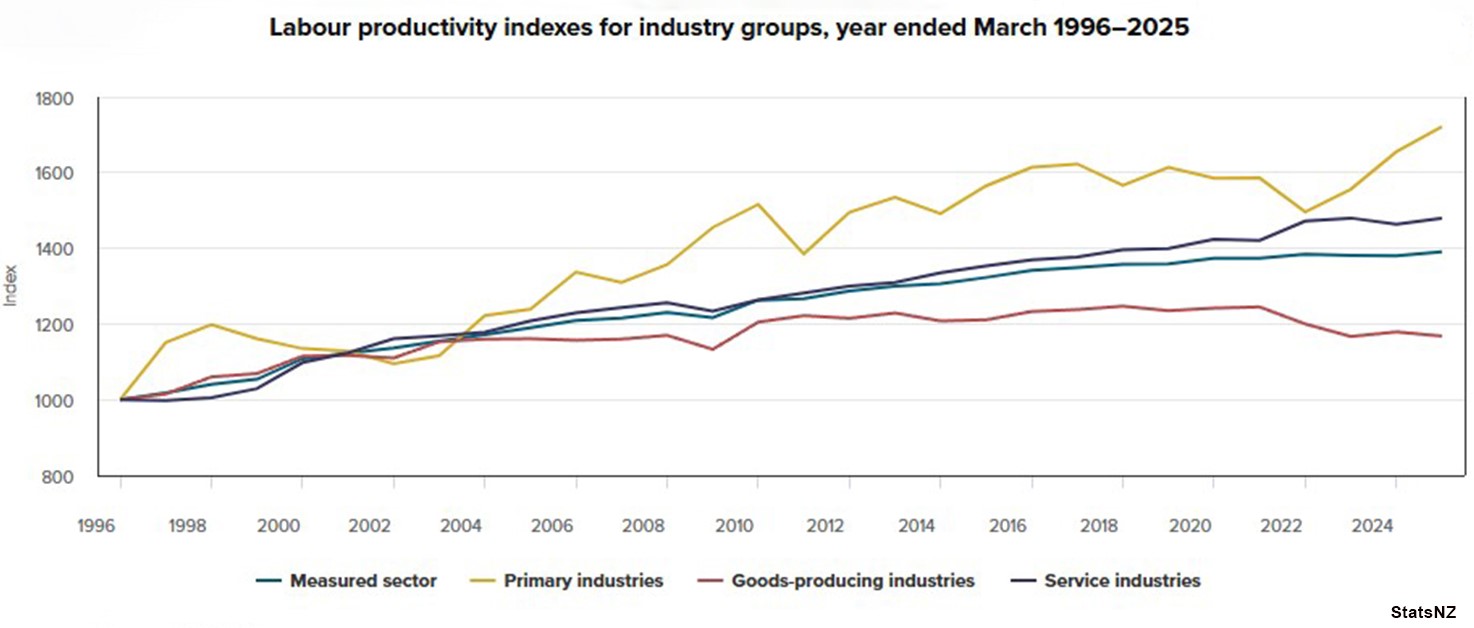
Between 1996 and 2025 labour productivity in the primary industries (see graph) increased by 72%, the service industries improved their labour productivity by 48%, and the goods-producing industries improved labour productivity by 17%.
However, all of the productivity improvement in the goods-producing sector had occurred by 2013. From there through to 2025, labour productivity in the goods-producing sector declined by 10%, right back to where it was in 2008. To put it bluntly, our goods-producing industries are a basket case.
This big decline in labour efficiency in the goods-producing sector does not mean that the workers were slacking around. But it does mean that they have been creating less inflation-adjusted value for each hour of work.
In economic language, we lack competitive advantage in manufacturing, with this arising in particular from a lack of scale, together with our isolation from the rest of the world.
I also blame our education system and societal problems that result in too many people lacking appropriate work skills and attitudes. However, some people may not agree with me about that. Or if they do agree, are not ready to make the necessary societal changes.
The big question is what are the specific things we can do to get New Zealand out of its economic funk?
I have spent all of my life focused in the main on the primary industries, and I marvel at the increase in labour productivity that has occurred there. When I first started milking cows in 1965, it took two of us two hours of hard work to milk 140 cows. These days, two people can milk 1000 cows in a little over two hours. Back in those days a one-man farm typically comprised about 1000 ewes plus perhaps 50 cows. Today, the number of ewes per labour unit would be over 2000.
Intriguingly, almost all of the technology, at least in terms of infrastructure, that has taken us from there to now’ has not come out of the formal research and development system. Rather, it has come from private companies and farmers themselves.
There will be further increases in labour productivity in primary industries, linked to further infrastructure investment. However, this will occur by using existing labour more efficiently. It won’t involve additional jobs.
Dairy is going to remain our biggest export industry, and the source of much of our national wealth. It helps pays for all of the cars, computers, clothing and even food that we import. But I see the future dairy industry looking very different to how it currently looks.
Perhaps the most exciting technology is what is called ‘wearables’. These are electronic collars and ear-tags which record what a cow is doing. This includes whether she is eating or ruminating, whether she is ready to be mated, and whether she has any health problems, All of this information is transmitted digitally back to the computer in the farm office.
These new wearables can also control where a cow is allowed to go without any physical fences. With current technology a herd can be shifted up to six times a day. This means that in winter time the invisible fence can be set up to shift itself one or two metres each hour so as to provide a fresh break of feed, thereby greatly limiting wastage.
This invisible fence technology is now well established on dairy farms, and is in the ‘early follower’ stage in the innovation cycle. It probably won’t be long before the majority of farmers use the technology as a management aid.
Equally exciting is the potential of this technology on beef farms, particularly in the North Island, as a management aid.
It has long been established that intensive grazing is fundamental to high performance on pastoral farms, but the cost of fencing, plus the labour in continually shifting stock, has been a constraint for beef. Invisible fences, that are set from a laptop computer, and send gentle messages to the animals where they must not go, are changing all of that.
I could write a lot more about the wearables technology, but the key point here is that these digital technologies will further increase labour productivity on New Zealand pastoral farms. In the process, it will lead to less workers rather than more.
This brings us back to the reality that it is the primary industries that underpin our wealth as a nation through the primary industry export earnings that, according to the Ministry of Primary Industries, comprise 82% of the goods that we export.
However, our major primary industries are limited by nature. There is no more land to be developed into pastoral farms. And in the last 25 years, science has been unable to improve the efficiency of converting solar energy via photosynthesis into grass.
Also, there is only one crop that I can identify with the potential to significantly increase multi-factor (capital and labour) productivity of our primary industries. That crop is kiwifruit.
At this point I am going to raise a fundamental issue without attempting to resolve the issue in this article. The key issue is population.
Do we need an increasing population to raise productivity in the economy? Or does an increasing population simply mean that we have to spread our national export earnings, constrained by nature’s boundaries, across more people?
Does this mean that a population policy is necessary to underpin the economic wellbeing of New Zealanders? I see that as a topic for an article in the near future.
*Keith Woodford was Professor of Farm Management and Agribusiness at Lincoln University for 15 years through to 2015. He is now Principal Consultant at AgriFood Systems Ltd. You can contact him directly here.
We welcome your comments below. If you are not already registered, please register to comment
Remember we welcome robust, respectful and insightful debate. We don't welcome abusive or defamatory comments and will de-register those repeatedly making such comments. Our current comment policy is here.