
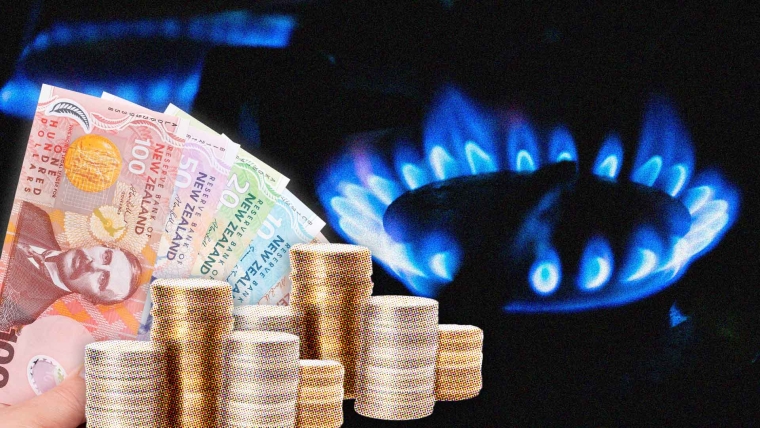
The Government is backing a Gas Transition Loan Guarantee Scheme, an initiative which aims to help businesses eliminate or reduce their dependency on gas.
Finance Minister Nicola Willis says the Government-backed scheme is expected to make up to $1.2 billion of bank loans available to businesses to eliminate or reduce their dependency on gas.
The announcement, made by Willis, Energy Minister Simeon Brown and Associate Energy Minister Shane Jones on Monday, is a Budget 2026 initiative.
Willis says: “Under the scheme, the Crown will guarantee 80% of each supported loan in return for banks passing on lower interest rates to borrowers. This will make loans more affordable for firms wishing to switch fuel sources."
Speaking to reporters at a post-Cabinet press conference, Willis says from previous schemes, those favourable terms could be worth as much as one and a half percentage points in interest rate terms.
About $48 million has been set aside from Budget 2026 to cover potential losses from the scheme.
To be eligible for the scheme, a business must be a current user of reticulated New Zealand natural gas and have an annual gas consumption of at least 1000 gigajoules (GJ).
The Government says an average household with gas uses about 25 GJ a year for cooking and heating while the country’s 14 largest gas users consume over 300,000 GJ each per year.
Willis says by helping people move to alternative fuel sources, “the Government can help preserve jobs, improve New Zealand’s economic outlook, and leave more gas available to firms who have no viable alternative to gas.”
Intervention
Willis says a focus in this year's Budget is addressing long-term challenges that can impact New Zealand's future prospects.
"This includes work to fix problems which can make being in business unaffordable."
Pointing to to high energy costs and the country's "rapidly reducing supply of natural gas", Willis says, "this shortage has added pressure to electricity bills and made life particularly difficult for firms who depend on gas to operate".
"A factor in some recent business closures has been the high price of energy to power industrial processes, with tight gas supplies causing some businesses to shrink or even shut."
"Dwindling gas reserves are affecting gas users directly, and they are affecting all New Zealanders indirectly through the reduction in job and income opportunities that arise when employers are struggling," she says.
"I support Government intervention in businesses or markets when it is very well targeted and where there is a compelling case to achieve broader economic objects. The gas situation in New Zealand meets that criteria."
Banks to decide on borrowers & lending terms
The scheme will run "at arm's length from the Government", Willis says. "Banks will be the lenders, retaining their usual commercial disciplines. The exact terms of the lending will be subject to negotiations between the parties."
Willis says the banks will decide who's credit worthy and the terms for lending.
"This is the Government providing our backing, reducing the cost of this lending using our Crown guarantee. We're not pretending to be bankers and we're not picking winners."
According to the Government, 12 of the 17 currently operational gas fields in New Zealand are expected to stop producing within 10 years.
Loans
Energy Minister Simeon Brown says the Budget also provides $5.9 million for the Energy Efficiency and Conservation Authority (EECA) to work with businesses who choose to look into transitioning away from gas.
Brown says these loans will enable businesses to reduce their energy costs and stay competitive by helping them switch some or all of their processes to run on alternative fuel sources, such as electricity or bio energy, and to invest in other energy efficiency measures."
Businesses that meet the threshold for being part of the scheme could be using gas for things like water heating, food processors and brewers or heating interiors for places like hotels and aged care facilities, or commercial growers using greenhouses, Brown says.
Brown says to access this finance, businesses must achieve genuine gas savings of at least 15% while “maintaining or increasing production, ensuring the focus is on growing the economy and protecting jobs, not shrinking output”.
“EECA estimates that if the full $1.2 billion of lending goes ahead, up to 10 PJ (petajoules) of gas use could be reduced per year.”
The maximum value of a supported loan under the scheme will be $50m of new lending.
Willis says Treasury is working with commercial banks to put the final details to the scheme, "which I expect to formally begin in July or August".
Later this week, EECA will have a website for firms interested in exploring their options for transitioning away from gas, Willis says, and she encourages interested businesses to look at this and have a chat with their bank.
Change to the Gas Act
Jones says as part of improving transparency in the gas market, the Government also plans to pass legislation which requires industry participants to disclose to regulators and others, critical information on gas supply and demand.
Jones says: “The most recent figures show a 23 per cent decline in New Zealand’s gas reserves in the past year and production this year is now expected to be 15% lower than expected at the beginning of the year."
“Fragmented and incomplete information on supply and demand is weakening market confidence and contributing to upward pressure on prices.”
“There is no time to waste. A small change to the Gas Act, to require improved information disclosure, will be passed as part of Budget measures," Jones says.
We welcome your comments below. If you are not already registered, please register to comment
Remember we welcome robust, respectful and insightful debate. We don't welcome abusive or defamatory comments and will de-register those repeatedly making such comments. Our current comment policy is here.