
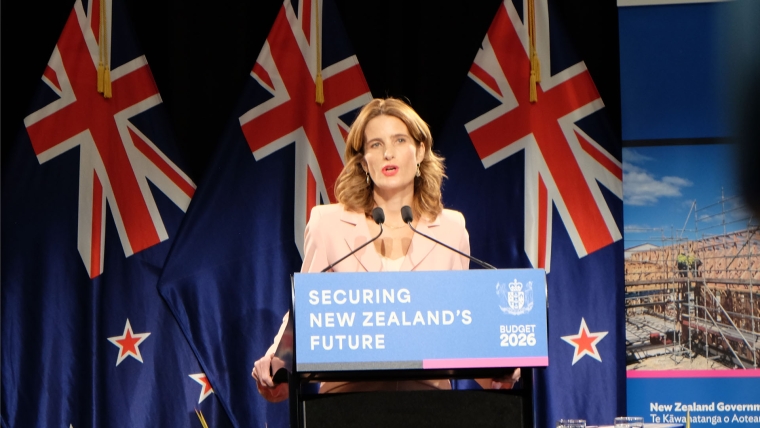
Snips, tweaks and an optimistic outlook from Treasury makes up Budget 2026, as banks face a new levy, almost half a billion dollars is set aside for support if the fuel crisis worsens, and rail gets a major boost.
Finance Minister Nicola Willis described it as the "responsible" Budget, with Treasury forecasting a return to surplus in 2028/29, a year earlier than was forecast in December.
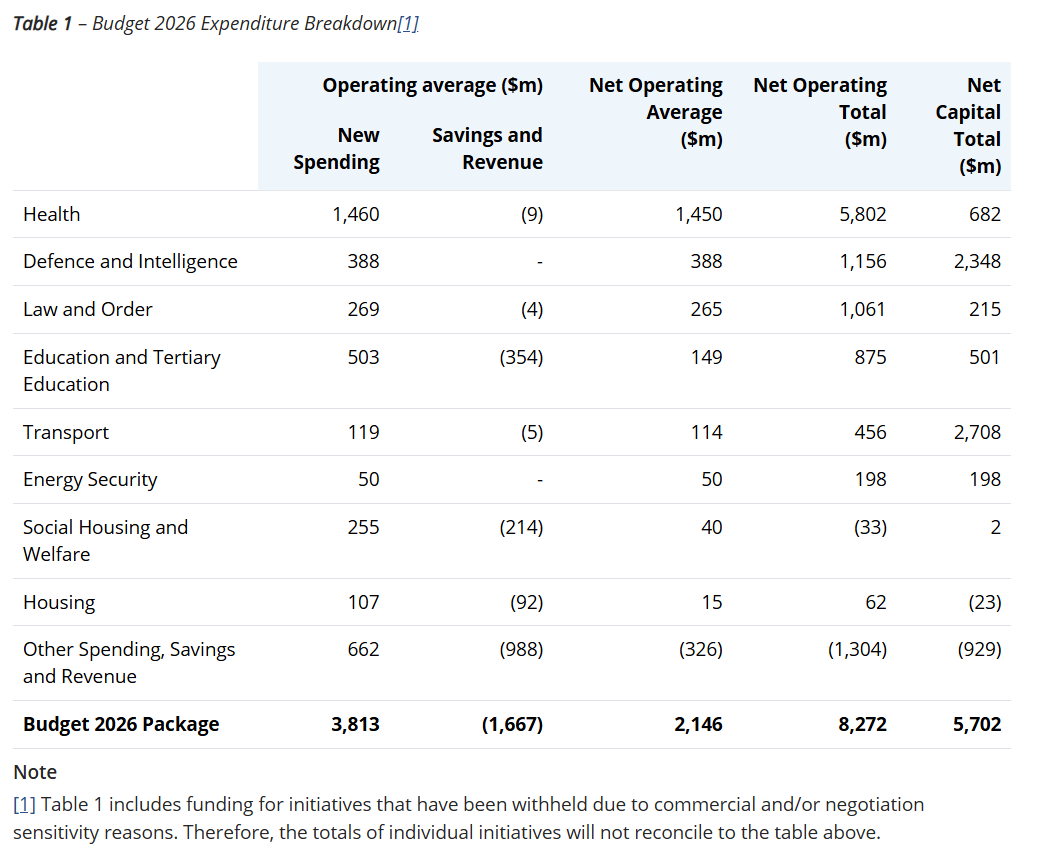
The net operating package was $2.1 billion, incorporating $3.8b of new spending a year on average, which included $1.7b of savings and revenue, mainly from the public service overhaul, the scrapping of the final-year fees free scheme and reduced Kāinga Ora construction costs.
The books
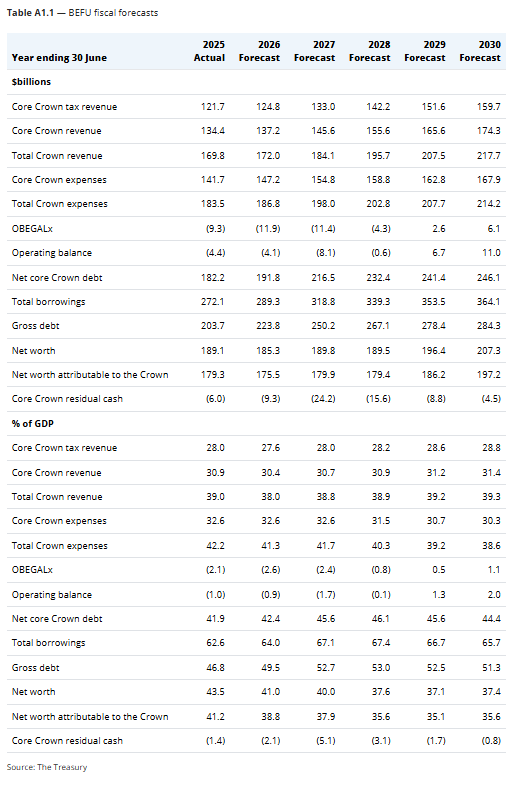
The OBEGALx, the Operating Balance Before Gains and Losses, excluding the revenue and expenses of the Accident Compensation Corporation, was expected to improve compared to the half-year economic update, returning to surplus a year early, expected at $2.6b in 2028/29, which was an improvement of $3.5b.
That was due to increased tax revenue of $3.1b, a smaller than previously forecast Budget package, and it was partly offset by an increase in benefit payments.
"Over the forecast period as a whole, the Middle East conflict has pushed up inflation, which supports an increase in core Crown tax revenue, but this is offset by the conflict’s impact on real economic activity, particularly at the start of the forecast period, and higher benefit payments," Treasury's Budget update stated.
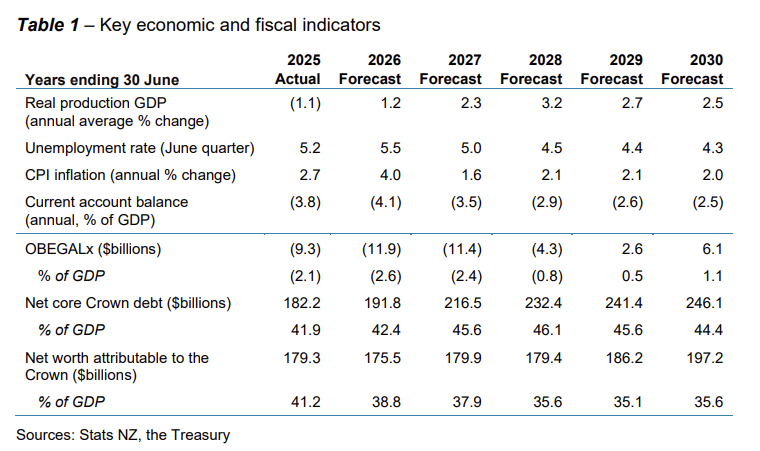
Annual average real GDP growth was weaker in the near term due to the oil shock, reduced by 0.5%-points in 2025/26 to 1.2% and by 1.1%-points in 2026/27 to 2.3%. Then in 2027/28, it is expected to rebound and grow by 0.6%-points quicker than forecast at 3.2%, before returning to trend growth.
Net core Crown debt as a share of GDP continued increasing, peaking at 46.1% of GDP in 2027/28, before declining to 35.1% in 2028/29.
Treasury said as the oil price shock was assumed to be relatively short-lived, Treasury did not expect it to impact on the level of economic activity in the latter part of the forecast period.
The Government's fiscal strategy outlook stated there were two possible levers to achieve fiscal consolidation, either by managing expenditure or raising revenue.
"With prudent control of spending, the Government does not intend to seek major additional sources of revenue, although will maintain an active tax policy programme," it said.
Middle East
Treasury said while the "oil prices could fall more quickly than in the central forecast, we consider that risks are skewed to the downside."
In that scenario, Brent crude oil prices increases to US$135 per barrel for nearly half a year, inflation would surge to 5.4% by the September 2026 quarter and economic activity was weaker, and unemployment peaks at 5.8%.
"Weaker nominal GDP would reduce aggregate tax revenue over the forecast period. As a result, in 2028/29, the OBEGALx is $2.1 billion lower than in the central forecast, although still returning to surplus."
What's in the Budget
Banking levy
Banks, non-bank deposit takers, insurers and financial market infrastructure providers will be hit with a levy to pay for Reserve Bank services, estimated to recover around $209 million over the next four years.
Council carrot
Councils will receive a payment for infrastructure as an incentive based on a proportion of the national average new dwelling consent value.
Housing and Infrastructure Minister Chris Bishop said this would be both an incentive for growth and help cover some of the costs as a result.
Budget 2026 allocates $400 million over four years for the Incentives for Growth Fund. Broken down, the Budget 2026’s summary of initiatives suggests $100 million each will be allocated in 2026/2027, 2027/2028, 2028/2029 and 2029/2030.
Super Gold card and Superannuation super charged
Super Gold card holders will be able to use their cards as an official form of identification, with new pictures and security measures to be added.
Contributions to the Super Fund also increase, forecast to a total of $3.1b over the next four years which is $2.2b more than expected. Another significant change is the Guardians of the NZ Superannuation lowering their assumption of long term expected returns from 7.8% to 7.2%.
Fuel contingency
$400 million is to be set aside in case the situation in the Middle East worsens the outlook for New Zealand.
Infrastructure boost
Budget 2026 puts $7b into capital investment, which will go into hospital upgrades including a new tower block in Whangarei, the next stage of the Waikato expressway and 10 school redevelopments.
Rail roading
KiwiRail gets $1b for its planned network investments between 2027-2030, alongside $106.9 million to continue Auckland and Wellington metropolitan rail infrastructure renewals. Willis denied this was a "blank cheque" for Winston Peters and rail.
We welcome your comments below. If you are not already registered, please register to comment
Remember we welcome robust, respectful and insightful debate. We don't welcome abusive or defamatory comments and will de-register those repeatedly making such comments. Our current comment policy is here.