

Young people experienced the largest increase in underutilisation in the year to June 2026, according to the latest labour market figures from Statistics New Zealand.
The underutilisation rate measures the untapped capacity in the labour market, or people who would like to work more. It includes unemployed people, the potential labour force and underemployed people.
Stats NZ sees the metric as just as important as the unemployment rate and found young people were hit particularly hard by a jump in the underutilisation rate, which reached 13.8% in the June 2026 quarter.
The underutilisation rate for 15 to 24-year-olds rose to 37.0% from 33.6% in the 12 months to June, with the number of underutilised people in this age group increased by 21,600 annually to 180,200.
The largest increase in underutilisation for this age group came from unemployment, up 12,200 in the year to June.
Breaking down the group further shows the underutilisation rate for 15 to 19-year-olds rose to 53.8% in the June 2026 quarter from 50.5% a year earlier. The unemployment rate for this age group also increased to 25.3% in the June 2026 quarter, from 23.0% in the previous year.
There are currently 43,400 unemployed people in the 15 to 19-year-old age group, up 6,300 from June 2025.
For 20 to 24-year-olds, the underutilisation rate was 24.4% in the June 2026 quarter, rising from 21.4% a year ago. The unemployment rate for 20 to 24-year-olds also jumped from 9.8% in the June 2025 quarter to 12.0% in the June 2026 quarter.
There are currently 31,600 unemployed people in the 20 to 24-year-old age group, up 5,900 from June 2025.
Fewer NEETs
According to Stats NZ, the NEET rate, the rate of young people aged 15-24 not in employment, education, or training, fell to 13.8%, down from 14.4% in the March quarter.
The NEET rate includes unemployed people who are part of the labour force, actively looking for work, as well as unemployed people who are not in the labour force, not working and not looking for work.
Kiwibank economists Alexandra Turcu and Elliott Lowe say the latest labour market statistics showed young people had been especially affected, but it was “good news” that the NEET rate had lowered.
“We need that. But that movement is largely due to movement into education. Exactly what we’d expect when young people can’t find a job with their current qualification levels. They look to upskill,” the pair say.
Stats NZ says for 25 to 34-year-olds, the main contributor to rising underutilisation was underemployment, up 6,600 annually.
For 25 to 29-year-olds, the underutilisation rate was 13.3% in the June 2026 quarter, up from 11.4% a year ago. The unemployment rate for 25 to 29-year-olds also rose from 5.1% in the June 2025 quarter to 6.5% in the June 2026 quarter.
There are currently 19,100 unemployed people in the 25 to 29-year-old age group, a 4,000 increase from June 2025.
Looking at the 30 to 34-year-olds, the underutilisation rate rose from 8.2% to 10.1% in the 12 months to June, while the unemployment rate for this age group also increased to 4.1% in the June 2026 quarter, from 3.6% in the previous year.
There are currently 14,200 unemployed people in the 30 to 34-year-old age group, up 1,600 from June 2025.
New Zealand’s unemployment rate came in at 5.6% in the June 2026 quarter. The jobless rate last reached 5.6% during the March 2014 quarter – over 12 years ago.
Stats NZ labour market spokesperson Abby Johnston said around 8,000 more people were experiencing long-term unemployment in the June 2026 quarter than in the same quarter in 2025.
There are now 2,905,000 people employed in a workforce of 3,076,000 across NZ. There is a total working-age population of 4,353,000 and the employment rate is currently at 66.7%, down from 68.3% in June 2025.
It's a different story for boomers
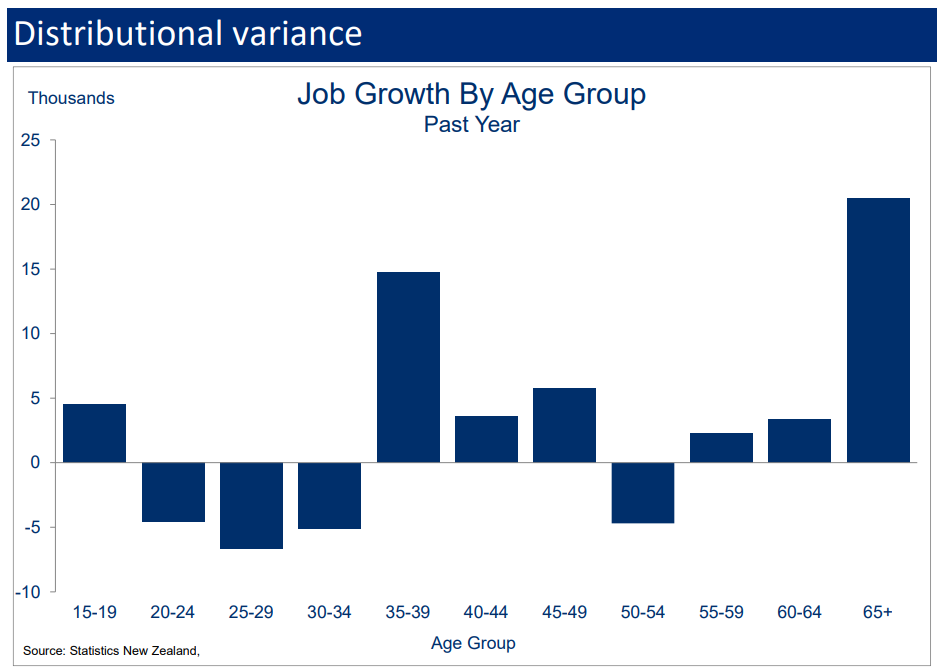
BNZ's head of research Stephen Toplis has pointed out that the age group with the strongest job growth in the latest labour market data are those over the age of 65.
“The winners here, by a significant margin, are those aged over 65 who accounted for 60% of the annual growth in total employment,” he says.
“In part this simply reflects demographics, i.e there are an increasing number of people who are aged over 65 in the economy. But, equally, the participation rate of those in the demographic is rising rapidly as more older folk decide to work. Some because they have to, but an increasing number, we suspect, because they simply want to.”
The underutilisation rate for those 65+ was at 8.3% in the June 2026 quarter, the same rate it was a year ago. The unemployment rate for this age group was at 1.4% in the June 2026 quarter, a decrease from 1.6% in the previous year.
There are currently 3,500 unemployed people in the 65+ age group, the same number that was reported in June 2025.
We welcome your comments below. If you are not already registered, please register to comment
Remember we welcome robust, respectful and insightful debate. We don't welcome abusive or defamatory comments and will de-register those repeatedly making such comments. Our current comment policy is here.