sign up log in
Want to go ad-free? Find out how, here.

A review of things you need to know before you sign off on Friday; Factories still expanding, migration modest, more winter visitors, consumer inflation expectations ease but stay elevated, swaps hold, NZX flat, NZD soft, & more

Economy / news
A review of things you need to know before you sign off on Friday; Factories still expanding, migration modest, more winter visitors, consumer inflation expectations ease but stay elevated, swaps hold, NZX flat, NZD soft, & more

Here are the key things you need to know before you leave work today (or if you work from home, before you shutdown your laptop).

MORTGAGE RATE CHANGES
SBS Bank has raised all its fixed rates today. All current mortgage rates are here. And note, you can compare mortgage offers with our unique calculator that takes into account other costs and cashback incentives, here.

TERM DEPOSIT/SAVINGS RATE CHANGES
SBS has raised many of its TD rates too. And this earlier update may be helpful. All updated term deposit rates less than 1 year are here, for 1-5 years, they are here.

STILL EXPANDING, JUST LESS SO
The BNZ/BusinessNZ Performance of Manufacturing Index (PMI) fell back in July, but still remains in expansionary territory. This returns the PMI close to its levels at the start of the year, before the onset of conflict in the Middle East and the subsequent oil price uncertainty. The June result was unusually strong and this July expansion validates the unusual June shift up. New orders fell back but are still expanding. The big influences are from production and deliveries. Canterbury held up strongly, Wellington and Otago are both in contraction now (Wellington never left it). Auckland's expansion fell back similarly to the national shift.

MODEST RISE
Net migration added +17,625 people to the population in the year to June (another Whakatāne), but that masks the fact that almost -64,000 left the country long-term in the same period.

POPULAR WITH OTHERS, TOUGHER FOR US TO TRAVEL
Overseas visitor arrivals in June were now back to 95% of their pre-pandemic levels. We welcomed 201,900 visitors in June, an increase of +15,100 from June 2025. The biggest changes were in arrivals from Australia (up +13,200), China (up +3,100), but there were fewer from the United States (down -1,200). The arrivals from Australia (108,200) and Singapore (6,200) were new record highs for a June. On the flip side, returning Kiwis who were on holiday were down -5.2% on the prior year (except to the Cook Islands/Avaiki Nui), suggesting that Kiwi travelers are suffering budget constraints.

A SMALL RETRACING
The RBNZ's survey of household expectations shows little change in the current very high perception of inflation (median 5.0%), but it is lower for expectations over the next year (4.5% from 5.0%) or the next two years (3.4% from 4.0%). From the RBNZ's point of view, these are still high but tracking in the 'right' direction. But clearly, households feel inflation is much higher than those in yesterday's quarterly survey of forecasters, economists and industry leaders. The household survey found a still-low expectation households would miss a mortgage payment, but a declining chance they could find a new job.

NO CHANGE
The Reserve Bank held loan-to-value-ratio restrictions on banks' home lending at current settings, seeing housing risks as 'contained' after an updated review.

MODEST INFLATION PRESSURE
The pace of supplier cost increases to Foodstuffs supermarkets in July was slower than the prior month, with the Infometrics-Foodstuffs Grocery Supplier Cost Index showing an average +1.9% increase in what suppliers charged in July 2026, compared with a year earlier. In July 2025 the increase then was +2.2%. “July’s result was the slowest annual increase since February 2025, driven by a number of cost decreases as some fuel adjustment factors reversed out, and as product cost increases haven’t been as intense as first feared when conflict in the Middle East sent various input costs soaring," Infometrics said.

NZX50 ENDS QUIETLY
As at 3pm, the overall NZX50 index was up +0.1% today but down -0.1% for the past 5 trading sessions. It is up +5.5% from six months ago. From a year ago it is now up +7.9%. Market heavyweight F&P Healthcare is essentially unchanged so far today. Gentrack, Stride Property, Napier Port and Vista Group lead today's gainers while EBOS, Tourism Holdings, SkyTV and Fletcher are the main decliners.

OFFENSIVE TRADING OK NOW ANYWHERE
As part of its war on unnecessary regulation, the Government has culled Schedule 3 from the Health Act. This require businesses undertaking "offensive trades" it get a license from the local authority to do so. Now any of these activities can be done anywhere. Good luck if you live nearby.

EYES ON ECONOMIC ACTIVITY
The RBNZ's latest Nowcast update shows that we can expect a tiny +0.1% economic expansion in Q2-2026 when it is reported mid-September. This comes after Q1-2026 delivered a +0.8% expansion. And that we are on track for possibly another +0.8% rise in Q3-2026. That suggests year-on-year growth of +2.3% in the year to June and +2.2% in the year to September 2026.

NO LONGER A ONE-WAY BET
Australia said the number of new home loans in Q2-2026 fell -5.4% and their value fell -5.2% following the three RBA rate increases in the year, and their May Budget announcement of changes to negative gearing and capital gains tax rules. The biggest pullback was by investors who were rorting the system under the old rules. This has had the salutary effect of capping the unbridled rise in house prices and giving them a chance to make housing affordable again. But they will need stamina to keep these rules in place for an extended period because the real estate and mortgage broking lobby is working hard to undermine them. At least some bankers see the pause as a necessary handbrake.

A WAY TO STAMP OUT MORTGAGE FRAUD
And staying in Australia, a parliamentary inquiry has recommended that "enabling banks to access data held by the Australian Tax Office when seeking to accurately assess income levels provided in loan applications would improve lending integrity". (See para 2.41, page 20.)

SWAP RATES HOLD
Wholesale swap rates will likely be little-changed today. Keep an eye on our chart below which will record the final positions closer to 5pm. The 90 day bank bill rate was up +1 bp at 2.96% on Thursday. Today, the Australian 10 year bond yield has dipped -1 bp to 4.96%. The China 10 year bond rate is down -2 bps at 1.68%. The Japanese 10 year bond is now at 2.86% today and unchanged. The NZ Government 10 year bond rate is now at 4.69% and also unchanged.. (The RBNZ data is now 'prior day' with the Thursday rate down -5 bps at 4.65%.) And the UST 10yr yield is down -3 bps at 4.64%.

EQUITIES MIXED
The NZX50 is now little-changed from yesterday. The ASX200 has opened its Friday trade down -0.8%. Tokyo has opened up +0.8%. Hong Kong has opened down -0.9% and Shanghai is down -0.4% at its open. Singapore is up +0.1% in early Friday trade today. Wall Street ended its Thursday trade with the S&P500 up +0.7% to a new record high, and the Nasdaq was up +0.8% and also near its record high.

OIL PRICES DIP
American oil prices have dipped -50 USc from this time yesterday with the WTI benchmark is now just under US$81.50/bbl, while the international Brent price is just on US$87/bbl and down -US$1.

CARBON PRICE QUIET & SOFT
There have been very few few trades today, but the price has dipped to $54/NZU. See our daily chart tracker of the NZU price for carbon, courtesy of emsTradepoint.

GOLD DROPS
In early Asian trade, gold is down -US$89/oz from this time yesterday, now at US$4317/oz. Silver is also lower, down more than -US1.50 at just under US$64/oz.

NZD RECOVERS SOME
The Kiwi dollar is up +20 bps against the USD from yesterday at this time, now just on 58.6 USc. Against the Aussie we are down -40 to 83.1 AUc. Against the euro we are up +10 bps at 50.8 euro cents. This all means the TWI-5 is now just under 62.3 and up +20 bps.

BITCOIN HOLDS
The bitcoin price is now at US$63,402 and off just -0.1% from this time yesterday. Volatility has been low at just on +/- 0.8%.

Daily exchange rates

Select chart tabs

Source: RBNZ
Source: RBNZ
Source: RBNZ
Source: RBNZ
Source: RBNZ
Source: RBNZ
Source: RBNZ
Source: CoinDesk

Daily swap rates

Select chart tabs

Source: NZFMA
Source: NZFMA
Source: NZFMA
Source: NZFMA
Source: NZFMA
Source: NZFMA
Source: NZFMA

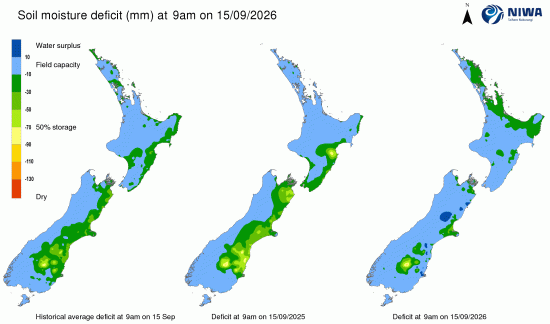
This soil moisture chart is animated here.

Keep abreast of upcoming events by following our Economic Calendar here ».

We welcome your comments below. If you are not already registered, please register to comment

Remember we welcome robust, respectful and insightful debate. We don't welcome abusive or defamatory comments and will de-register those repeatedly making such comments. Our current comment policy is here.

27 Comments

The U.S. deficit in July - $432.3 billion - was a record. But it's not the largest monthly U.S. deficit ever. It was the largest monthly shortfall since March 2021. The pandemic-era months in 2020 recorded larger deficits.

Interest expenses have officially surpassed both National Defense and Medicare spending. The US govt now spends more money just on interest than it does to fund the entire US Military or to provide healthcare for seniors.

Just my reckon, but there is no way the US can afford higher interest rates.

https://finance.yahoo.com/economy/policy/articles/u-budget-deficits-jus…

Up
7

Approaching NZ levels.

US Disabilities Hit an All-Time High of 37 Million In July: Up 23% Since Feb 2021

https://fred.stlouisfed.org/series/LNU00074597

https://eddowdbeyondthenarrative.substack.com/p/us-disabilities-hit-an-…


Up
0

Spot on, Phoenix. It is all looking incredibly dodgy, and the maths simply does not add up any longer.

That July figure pushes the Year-to-Date deficit for the 2026 fiscal year to a staggering $1.799 trillion.


That $432.3 billion monthly budget shortfall is a hard fact. The US Treasury knows down to the last cent what's left its accounts the second the month ends.

However, as bad as the government’s budget ledger is, it tells only half the crisis:


The Government Ledger (Budget Deficit): Deep in this $1.8 trillion hole.


The Commercial Ledger (Trade Deficit): Bleeding an average of $75 billion every single month.

When both of these balance sheets collapse at the same time, you arrive unceremoniously in a toxic Twin Deficit trap.


The trade deficit means the U.S. relies heavily on global supply chains for physical goods. Meanwhile, the budget deficit forces the U.S. to rely on Western-centric allies to aggressively scoop up Treasury debt.

Look at the latest Treasury International Capital (TIC) tracking data - the entities stepping up to absorb the endless supply of new paper are largely Western financial hubs who are desperately trying to help the US prop up a global fiat-Ponzi scheme that is sitting right on the cusp of collapse.


Outside that bubble, the rest of the world is actively jumping ship (kind of like some of the unfortunate sailors on board the US Aircraft Carrier Abraham Lincoln).


Look at what global central banks are doing with their reserves:


The Great Swap: For the first time in modern history, physical gold has officially toppled U.S. Treasuries as the world's largest reserve asset.


The Numbers: Physical gold's share of global reserves has surged to 27%, while U.S. Treasuries have slid down to just 22%. 

Sovereigns are quietly ditching weaponised paper for hard assets.


This triggers a brutal, inescapable debt-doom-loop: 


The Interest Trap: As you noted, interest costs now eat up more cash than National Defense or Medicare


No Monetary Tools Left: The Fed cannot raise interest rates to protect the collapsing dollar without completely bankrupting the Treasury with interest expenses.


The Ultimate Corner: If the Fed prints money to cover the government's interest bills, it triggers hyperinflation (a soft default). If they stop printing, the government cannot pay its bills (a hard default).


THE UNCOMFORTABLE VERDICT

The Fed and the Treasury have run completely out of ammo.


Interest flipping past Medicare and defense, is the canary in the coal mine that heralds the inevitable unwind of this fiat experiment, that was always mathematically predestined for collapse.


Up
3

You finished the portrait nicely there. At the same time, the White House releases a report claiming 40+ countries are helping China evade US tariffs through transshipment. 

 https://www.whitehouse.gov/releases/2026/08/the-great-transshipment-sca…

Up
0

Transshipments  have been availed, manipulated and exploited since before recorded time. For instance NZ coarse wool exports to Poland in the 1960s for carpet, produced instead, thousand and thousands of winter uniforms for Russian soldiers. The function has not become less sophisticated. Quite the opposite. The naivety of Trump and his administration is bordering on infantile.

Up
3

CLuxon  is now sounding  more as Klaxon. If he continues his run true to his current form, as far as campaigning, National will likely find itself in as much strife as they were in 2003 & 2020 and Labour in 2014 & 2023. That is given a good spanking by the electorate for being outright clots. 

Up
2

If that poll was the outcome, are we looking at a four way coalition either way? Unless Winnie crosses the divide? 

Up
0

Perhaps we could ask our MSM, to ascertain what we will be likely to live through, the next few years? 

Who knows, we may vote for whoever is (most) appropriate?

Rather than all this in-the-dark hype. 

Up
2

Yep, we can trust the MSM to know the future & tell the truth

...after all, its clear the MSM know the past & tell the truth about that, dont they?

Up
2

If the result of their efforts is folk thinking that society is stealing from them - then the MSM have failed. 

Mind you, that failure might be individual. 

Up
1

It's quite possible it's either nats nzf top and act, or lab, nzf and grn. I wonder if Winnie would change his tune. 

Up
0

Nat voters will move party vote to NZ First and Act, I suspect younger ones to ToP.

Up
2

Agree and within that I haven’t, in my experience, ever come across a Prime Minister with such embedded unpopularity amongst our womenfolk. Quite startling in some quarters, in fact. Lead on Lady MacBeth.

Up
3

That is interesting, and duplicated in the UK, in terms of the Right.  

Over the last ten years there has been a shift, especially amongst younger women to vote left/green, whilst it is clear that women now command a much larger share of high end corporate positions, and they tend to be woke/left leaning, and proudly so.  Meanwhile the UK Labour government cabinet is dominated by women, although no woman leader yet.   

It is noticeable in the UK that left-leaning demonstrations are dominated by women, and amongst those I talk with (all 'educated' and high up the income scale), the thought of voting Tory/ your National,  or Reform/ your ACT, is 'simply impossible'.

Where does this leave the UK, and possibly NZ?  In the UK we have a Labour government, and I think it could easily cobble together a Government in the next election - Labour/Greens/Muslim vote, with the womens' vote helping swing matters.  In NZ it would not surprise me if Labour cobble together a Government, all in the name of....be kind/anti right wing etc.  

Maybe nations like NZ etc need a socialist mindset Government for a while......to realise how bad things can get.  Then we can move on.


Up
1

Unfortunately NZ was in a much better place under the "socialist mindset". Gone to crap the last 3 years. 

We don't really have the Muslim vote. Left and right both love immigration in NZ 

Up
0

to realise how bad things can get

Always with the scare tactics but why? How bad, why bad and bad for whom?

It's boogie man stuff

Up
0

I will explain.

You are better placed in NZ (lower national debt) in some ways, but in the UK, and this relates to the Tories too,

the economy is broadly flat, national debt = 100% of GDP (hard to believe it was about 35% in 2005), taxes are approaching 40% of GDP (a level last seen in 1945), public services are declining, by that I mean seeing a GP is rare, NHS waiting lists are about 7 million, up from 4 million in 2019 (median wait time now 12 weeks, up from about 7 weeks in 2019), roads are full of potholes; youth unemployment is rising sharply (now 16% vs 9% in 2022), housebuilding has fallen sharply (now close to levels seen during the financial crisis), and the welfare system is 'out of control.  By that people mean welfare is now viewed by many as a career choice - it pays to go on benefits due to mental health, or whatever, vs working for the minimum wage, and so social benefits payments are now 55% up on 2019.  As a result the public deficit is stuck at around £150bn, or about 5% of GDP, up from £50bn in 2016-2019.

If you work for the state or are on benefits, life now may well be viewed as OK, or good, but if a tax payer, working outside the state system, life has typically gotten worse, especially since lockdown, as taxes have risen and public services have worsened in terms of delivery.  .  

As with all matters political and economic, many value judgements are involved - are you in favour of more or less state control for instance - but, the nations finances are in a terrible state, and the mood of the nation is not good.  


Up
1

The large female workforce that make up our health system have some well warranted grievances

Up
1

Interestingly National's "3x the tax" ads are now "4x the tax" with opportunity included. Maybe the big parties aren't writing them off like they were. 

Up
0

How can you add tops tax, without thei tax decreases? How can you add it to the labour side, and not the national side?

Up
0

Centuria Bass has frozen redemptions on two of its private funds after concerns about its exposure to troubled Sydney property developer Bathla prompted an influx of requests from investors to exit the fund.

It was already serious in Sydney.

https://archive.ph/n2XaK#selection-1667.0-1667.207

Up
0

Never gets old - https://www.youtube.com/watch?v=-DT7bX-B1Mg

KPMG is proving there is never one cock roach always dozens

Up
2

"There is a fundamental problem with the existence of mega partnerships with hundreds of partners but still limited personal liabilities (unlike traditional partnerships with unlimited individual liability).

In essence, these mega partnerships want to have their cake and eat it too.

The lower regulation of partnerships, as opposed to companies, but still with limited individual liabilities.

The partnership model was really designed for legal and accounting practices with a few partners, not multinational entities with hundreds or thousands of partners globally.

Parliament is seriously considering whether this form of partnership should be allowed to continue or be forced to move to a corporate structure."

https://www.abc.net.au/news/2026-08-14/asx-markets-business-live-news-a…


Up
2

Having entertained the idea of working with one of the Big 4 as an external consultant, I quickly saw the ROE (effort) was not worth it. And some of the stuff they do is dreadfully low quality. They think they're the cat's whiskers. The world would be better off with their reformation.   

Up
0

They've captured the regulators everywhere so everyone now has to play their games eg.  "independent" audit reports

Up
2

In China, the Big Four firms have historically held a powerful audit position: they audited 18 of China’s 20 largest SOEs by assets as of 2023 and handled 23 of the 25 largest A-share IPOs by end-2023. But Beijing has also pushed SOEs toward domestic auditors and sharply sanctioned PwC over Evergrande.

Up
0