

Here are the key things you need to know before you leave work today (or if you work from home, before you shutdown your laptop).
MORTGAGE RATE CHANGES
The Wairarapa Building Society (WBS) and the Police Credit Union both raised fixed rates today, so far. All current mortgage rates are here. And note, you can compare mortgage offers with our unique calculator that takes into account other costs and cashback incentives, here.
TERM DEPOSIT/SAVINGS RATE CHANGES
None here today. All updated term deposit rates less than 1 year are here, for 1-5 years, they are here.
MORE JOBS GROWTH IN MORE REGIONS & MORE INDUSTRIES
August brought the highest jobs growth since April 2024 with +20,800 more jobs that a year ago. But we should remember, the month-on-month data almost always gets revised lower. All the same, the upward track is remaining in place despite revisions. South Island provinces are leading the rises, Southland (+3.1% from a year ago), Canterbury (+1.9%), and Otago (+1.4%), but there are rises in the North Island too; Waikato (+1.3%), Manawatu-Whanganui (+1.3%) and Bay of Plenty (+1.2%). More jobs means more earnings, and these rose +3.8% from a year ago - but sadly not keeping up with inflation at 4.1%.
PAYING FOR EXPERIENCE?
But there are cohorts that are struggling. Not only is there essentially no gobs growth in Wellington, and only +0.6% growth in Auckland, but it is younger workers who are missing out. Jobs for those younger than 35 actually fell -1.7%. Those for those 65 and older were up +3.8% and the fastest of any other age cohort.
LEANER TIMES
New lending - that is new bank lending for housing that does not include borrowing shifting between banks - is on a downward slide. 2026 has become a zero-sum game for banks now and the market share losers are going to find it very difficult.
LESS CAPACITY
The RBNZ said that it had $26.1 bln in foreign currency intervention capacity as at the end of August 2026. Thile that may seem a lot, it is in fact its lowest level since January 2025, undermined in part by the declining NZD.
LUMINATE FINANCE IN LIQUIDATION
In their first report Luminate Finance's liquidators say they've been told the company failed because it was "unable to trade profitably due to the current market environment and a number of unrecoverable loans." The Newmarket, Auckland-based company primarily provided business loans. The report shows $1.68m owed to unsecured creditors, with almost $1.4m related party loans. Liquidators Steven Khov and Kieran Jones were appointed on September 21.
NZX50 RISES
As at 3pm, the overall NZX50 index is up +0.5% so far and up +0.4% for the past 5 trading sessions. It is up +8.8% from six months ago. From a year ago it is now up +5.6%. Market heavyweight F&P Healthcare is up +1.2& so far today and leads with Scales, Precinct Properties and Meridian rise while Gentrack, Briscoes, Sanford and Vulcan Steel fall.
GROWING SLOWER
China's industrial profits were up +4.2% in August to just over ¥690 bln from the same month in 2025. For the eight months of 2026 they are up +15.7% so this latest period is recording a notable slowing in their growth. But it is still growth. Most observers had expected the growth rate to pick up to +18% so there is a disappointment in this data, and reflected in today's Shanghai equity markets. (See below.)
SWAP RATES HOLD UP
Wholesale swap rates will likely be marginally firmer today. Keep an eye on our chart below which will record the final positions closer to 5pm. The RBNZ 90 day rate was up +2 bps at 3.23% on Friday. Today, the Australian 10 year bond yield is up +3 bps to 5.41% and its highest since 2011. The China 10 year bond rate is still at 1.67%. The Japanese 10 year bond is now at 3.10% and up +2 bps and back to a new 30 year high. The NZ Government 10 year bond rate is now at 5.16% and up +2 bps from this morning and its highest since November 2023. (The RBNZ 10 year rate is 'prior day' and was up +4 bps at 5.11% on Friday.) And the UST 10yr yield is now at 5.21% and up another +4 bps from this morning, its highest in 24 years.
EQUITIES MOSTLY POSITIVE BUT SOME BIG EXECPTIONS
The NZX50 is now up +0.3% from Friday's close. The ASX200 has opened up +0.3% as well. Tokyo is unchanged. The KOSPI is down -2.1% today. Hong Kong has opened up +0.6% while Shanghai is down -1.2% and heading towards a 12 month low. Singapore is up +0.4% in early Monday trade today. Wall Street is looking to open tomorrow positively with the S&P500 futures indicating a +0.5%..
OIL PRICES RISE
American oil prices have risen +US$1.50 from this morning with the WTI benchmark now at just under US$94/bbl, while the international Brent price is just over US$106.50/bbl and up +US$2/bbl. The US rejection of the Iranian peace proposal is behind these latest rises.
CARBON TRADING ACTIVE BUT LITTLE-CHANGED IN PRICE
There were a number of significant late trades on Friday and more today so far. The price is little-changed to slightly lower at $52/NZU. See our daily chart tracker of the NZU price for carbon, courtesy of emsTradepoint.
GOLD LOWER
In early Asian trade, gold is down -US$71/oz from this morning, now at US$4214. Silver is down -US$2 at just under US$62.50/oz.
NZD ON HOLD
The Kiwi dollar is still at at 56.7 USc and unchanged from this morning's open. Against the Aussie we are up +10 bps at 80.7 AUc. Against the euro we are unchanged at 49.7 euro cents. This all means the TWI-5 is remains just over 60.3 and little-chnaged as well.
BITCOIN SOFTISH
The bitcoin price is now at US$83,621 and down -0.9% from this morning. Volatility has been low at just on +/- 0.8%.
HOW THE GLOBAL ECONOMIC FORCES AFFECT US
If you want to catch up on what happened last night, try our Economy Watch podcast, here.
Daily exchange rates
Select chart tabs
Daily swap rates
Select chart tabs
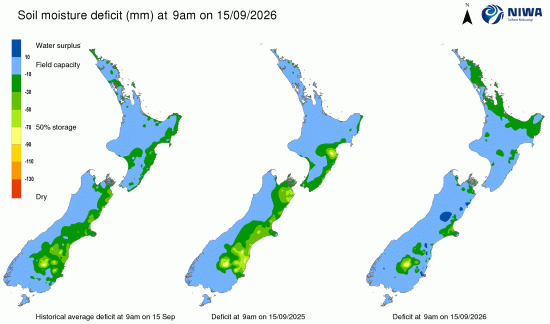
This soil moisture chart is animated here.
Keep abreast of upcoming events by following our Economic Calendar here ».
We welcome your comments below. If you are not already registered, please register to comment
Remember we welcome robust, respectful and insightful debate. We don't welcome abusive or defamatory comments and will de-register those repeatedly making such comments. Our current comment policy is here.