
sign up log in
Want to go ad-free? Find out how, here.

A review of things you need to know before you sign off on Monday; no retail rate changes, Barfoots reveals soft trading, S&P like Auckland Council, new lending falls, commodity prices turn up, we buy cars enthusiastically, swaps stable, NZD soft, & more

Economy / news
A review of things you need to know before you sign off on Monday; no retail rate changes, Barfoots reveals soft trading, S&P like Auckland Council, new lending falls, commodity prices turn up, we buy cars enthusiastically, swaps stable, NZD soft, & more

Here are the key things you need to know before you leave work today (or if you work from home, before you shutdown your laptop).

MORTGAGE RATE CHANGES
No changes to report today. All current mortgage rates are here. And note, you can compare mortgage offers with our unique calculator that takes into account other costs and cashback incentives, here.

TERM DEPOSIT/SAVINGS RATE CHANGES
No changes here either. All updated term deposit rates less than 1 year are here, for 1-5 years, they are here.

GROWING CHOICE DOESN'T TEMPT BUYERS
Auckland's dominant realtor recorded a jump in new listings but sluggish sales numbers. Barfoot & Thompson's September results saw them with -26% fewer sales than in the same month in 2025, slight higher median prices and slightly lower average prices.

"DOING BETTER"
S&P Global ratings has raised the outlook for Auckland Council from 'Stable' to 'Positive' for its AA overall credit rating. They say this council's financial position will meaningfully strengthen over the next few years."The fiscal deconsolidation of the council's water utility, Watercare, along with rising property rates, investment revenue, user fees and charges, and tight expense control will help narrow the council's deficits after capital accounts to less than 10% of total revenue from fiscal 2027 (ending June 30, 2027), from 19% of total revenue in fiscal 2025." They note "a strong, diversified economy, proven track record of prudent financial management, and very predictable institutional framework support Auckland's creditworthiness." and "Auckland's finances will improve and help lower its debt burden; liquidity remains exceptional."

NOT DOING BETTER
New lending fell sharply overall in August from July, according to RBNZ data out today, down almost -$1 bln (actual -$970 mln) on top of July's -$2.6 bln fall from June. We haven't seen two consecutive falls (apart from some minor ones over the holiday break) of this magnitude since mid 2023. Driving these retreats were both new residential lending, and non-property business lending. Confidence to take on new debt seems low.

SEPTEMBER RECOVERS AUGUST FALLS
The ANZ World Commodity Price Index rose +0.6% in September from August to be +1.0% higher than a year ago. Commodity prices rose across most categories, with only beef and milk fat prices falling. The NZD Commodity Price Index rose by 2.8% from August, to be up +2.5% from September 2025. The NZD weakened considerably throughout September, driven in part by higher interest rates in the US.

WE BUY NEW MORE ENTHUSIASTICALLY
There were 13,243 new cars sold in September, the best sales month since June 2023. The September level is +28% higher than the same 2025 month, which itself was +20% higher than in September 2024. The growth impetus is lower for used imports, which were up +13% to 8001 in September 2026 from 2025, up less (+10%) in 2026 from September 2024.

NZX50 SOFTER
As at 3pm, the overall NZX50 index is down -0.2% so far and down -1.3% for the past 5 trading sessions. It is up +4.5% from six months ago. From a year ago it is only up +1.2% now. Market heavyweight F&P Healthcare is up +0.5% so far today. Serko, Oceania, Argosy and Infratil gain while Hallensteins, Scales, Fletcher Building and Summerset retreat.

SHORTAGES DRIVE PROFITS
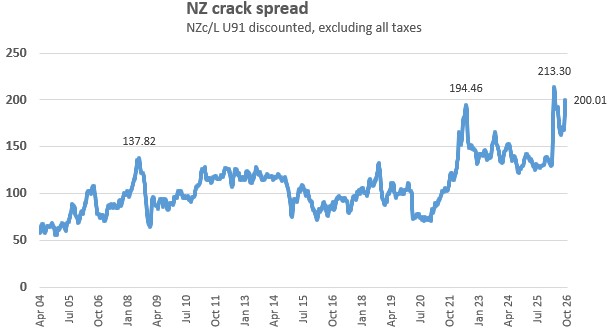
We have recorded today's changes in the crude oil price below. But some readers have noted the international chatter about the 'crack spread'. This is the "differential between the price of crude oil and petroleum products extracted from it. The spread approximates the profit margin that refiners can expect to make by "cracking" the long-chain hydrocarbons of crude oil into useful shorter-chain petroleum products." In USD it has been at near record highs since July. We have calculated the same for New Zealand, the difference between the Dubai crude price and the New Zealand discounted unleaded 91 price after excluding all taxes (so no excise, no GST, no regional taxes). That tracking is here.
A DIFFERENT SURVEY, & HIGHER
In Australia, the independent Melbourne Institute Monthly Inflation Gauge increased for a third consecutive month in September, after falling in May and June. The increase was primarily attributed to transport price rises, with annual headline inflation of 4.8%, unchanged from August. (The ABS said the August CPI was 4.0%.) The monthly cost of living also increased across a range of household types (age pensioners, other government transfer recipients, employees, pensioners and beneficiaries and self-funded retirees).

SWAP RATES HOLD
Wholesale swap rates will likely be little-changed today. Keep an eye on our chart below which will record the final positions closer to 5pm. The RBNZ 90 day rate was firmer by +1 bp at 3.23% on Friday. Today, the Australian 10 year bond yield is down -7 bps at 5.30%. The China 10 year bond rate is now at 1.68% and unchanged. The Japanese 10 year bond is now at 3.09% and also little-changed. The NZ Government 10 year bond rate is now at 5.08% and up +1 bp from this time Friday. (The RBNZ 10 year rate is 'prior day' and was down -1 bp at 5.09% on Friday.) And the UST 10yr yield is now at 5.25% and down -3 bps from this morning's open.

EQUITIES MIXED
The NZX50 has eased another -0.1% from Friday's close. The ASX200 has opened up +0.4%. Tokyo is up +2.6%. The KOSPI is on holiday today but will be back tomorrow. Hong Kong is back and down -0.3% in Monday trade while Shanghai is closed for their public holidays. Singapore is up +0.2% in early Monday trade today. Wall Street futures indicated they will open tomorrow with the S&P500 looking at a +0.9% gain.

OIL PRICES SOFTISH
American oil prices have eased -US$1 from this morning with the WTI benchmark now at just over US$90/bbl, while the international Brent price is just under US$101.50/bbl and down -50 USc despite the renewed Middle East uncertainties.

CARBON PRICE HOLDS
There have been many trades today but some have been on the small side. However the price remains little-changed at $52/NZU. See our daily chart tracker of the NZU price for carbon, courtesy of emsTradepoint.

GOLD FIRMISH
In early Asian trade, gold has risen +US$20/oz from this morning, now at US$4160/oz. Silver is up +US$1 at just on US$61.50/oz.

NZD SOFTER
The Kiwi dollar is now just under 56.1 USc and down -10 bps from where we opened this morning. Against the Aussie we are also down -10 bps at 80.6 AUc. Against the euro we are unchanged at 49.9 euro cents. This all means the TWI-5 is is now just under 59.9 and down -10 bps.

BITCOIN FIRMER
The bitcoin price is now at US$86.590 and up +1.4% from this morning. Volatility has been modest at just under +/- 1.3% again.

HOW THE GLOBAL ECONOMIC FORCES AFFECT US
If you want to catch up on what happened last night, try our Economy Watch podcast, here.

Daily exchange rates

Select chart tabs

Source: RBNZ
Source: RBNZ
Source: RBNZ
Source: RBNZ
Source: RBNZ
Source: RBNZ
Source: RBNZ
Source: CoinDesk

Daily swap rates

Select chart tabs

Source: NZFMA
Source: NZFMA
Source: NZFMA
Source: NZFMA
Source: NZFMA
Source: NZFMA
Source: NZFMA

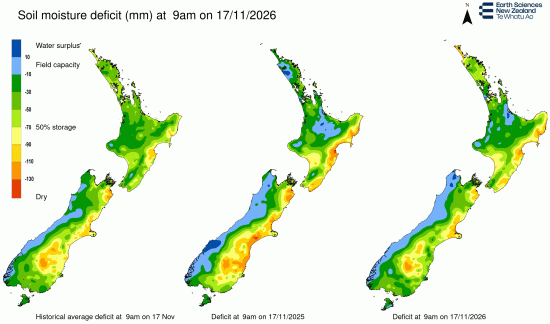
This soil moisture chart is animated here.

Keep abreast of upcoming events by following our Economic Calendar here ».

We welcome your comments below. If you are not already registered, please register to comment

Remember we welcome robust, respectful and insightful debate. We don't welcome abusive or defamatory comments and will de-register those repeatedly making such comments. Our current comment policy is here.

35 Comments

Costco closed fiscal 2026 last week. $297.2B net sales, up 10.1%. But you need to watch their private label Kirkland Signature. ~$90B in sales last year, up ~20% - almost double the company's overall growth. Close to 28% of everything Costco sells. 

Kirkland is 15–20% cheaper than national brands, same or better quality. The entire private label pitch. Private label isn't just margin protection here. It's what pulls people into the warehouse, justifies the card, and keeps the whole membership flywheel spinning.

Stock price past 5 years: +109%

Past 10 years: +523%

Since listing in 1986: +55,000% [split-adjusted basis]

https://investor.costco.com/news/news-details/2026/Costco-Wholesale-Cor…

Up
3

And just think, every purchase you make at Costco NZ is a donation to Making America Great Again. 

Up
4

Costco requires companies like P&G, Unilever to manufacture for Kirkland. If they don't, they cannot sit on Costco shelves. And if they do, they sit at a higher price point than Kirkland. Who are the winners? The shopper and Costco.

At the end of the day, shoppers are going to buy what they perceive as best value for them - not out of patriotic duty. Can you blame them? They're not the well paid central bankers who probably wouldn't be seen dead at Costco anyway. 

Aotearoans need to take a good hard look at our own ruling elite before complaining about the unfairness of it all.     

Up
3

"shoppers are going to buy what they perceive as best value for them" 

"Perceive"? Perhaps if shoppers realised their bleeding NZ of it's wealth means their kids can't afford a house and shift to Australia, patriotic duty would look more like personal life enrichment? 

The wisdom of sending cash to the United Fascist State of America is also questionable. 

Up
5

"The wisdom of sending cash to the United Fascist State of America is also questionable".
We do it with every single subscription of Microsoft's MS365 service and literally everyone (every business) considers it as normal - apart from the few ones who have an idea what open source software means.

Up
2

"every single subscription of Microsoft"

This is true, but that doesn't make it somehow great for NZ. With a bit of thoughtfulness some of this outflow of wealth could be staunched. After signing all these free trade deals government can no longer legally give NZ citizens preferential treatment. That doesn't mean individuals can't use spending power to support NZ business, if there's any left?

Europe has seen the light of maintaining its digital sovereignty by shifting to Linux. 

Up
2

The wisdom of sending cash to the United Fascist State of America is also questionable.

For those on the breadline, they don't care. Morality goes out the window when prices go up, and there;s a cheaper alternative that allows folk to maintain their standard of living still.

Perhaps if you feel this strongly you ought try not to purchase anything made in China given their treatment of the Uyghurs, however I'd be of the opinion that isn't feasibly possible given how ubiquitous Chinese goods are in our society.

Up
1

Our biggest private label Pams will be split in two if National / NZF get in. I can't see that making it cheaper...

Up
2

If only the know all government hadn't foisted the ETS on Marsden Point some of that sweet, sweet crack spread could have spread it's love through NZ. Not to mention the side benefits of elemental sulfur, bitumen, food grade CO2 etc. One of only six countries in the OECD without refining capacity and we all our import diesel from countries that don't have an ETS...

Time for these virtue signallers to admit their performative climate changing vanity and back a topping plant in the Naki so we can make our own diesel in our isolated isles.

https://rcr.media/episodes/dave-bennett-oil-gas-exploration-veteran-expert-nz-could-be-refining-diesel-in-a-year/

https://environment.govt.nz/assets/Publications/Regulatory-Impact-State…


Up
3

Building a topping plant and refining NZs small crude production wont change the price at NZ pumps if the owners of that plant can export the resulting product unconstrained....and somehow I doubt you (or those proposing such a plant) are advocating any form of restriction on exporting the resulting product.

Up
4

Depends on the circumstance chap. Perhaps NZ should stop bludging and do some work for a change, just in case.

Paul Brennan speaks with David Bennett, an experienced oil and gas geophysicist, about New Zealand’s vulnerability at the end of global fuel supply chains. David explains that while current reserves may cover several weeks, future access is uncertain, with diesel posing the greatest risk to the economy. However, a topping refinery in Taranaki could be made a reality to refine local crude in about a year if the political will could be found.

Up
0

LOL...thought not

Up
4

What circumstance are you LOLing about? 

Up
0

You are the same Profile that advocates private investment and a useless state?

Up
2

The one where 'the economy' is irrelevant (I'm guessing).

Where we appear to be headed, where the next meal is coming from might be a more urgent question. 

Some of have given a lot of thought as to how we feed 5 million ex fossil energy. It is coming, no question. 


Up
1

It could bring it down slightly as there wouldn't be the shipping cost. It could also provide an emergency supply (the free market gets overridden by even the most right wing parties if needed) 

Up
0

Only if it was restricted to domestic sale...otherwise it is subject to international pricing.

The capability may be useful if the need to seize its output in an emergency was available but other than that , nothing.

What would you be prepared to pay for that?

Up
2

a lot when the emergency came along....


Up
4

Lol...yep, everyone would, but heres the thing...those advocating its construction claim it would cost as little as 15 million and take less than a year to build.....where are the private investors?

Up
2

Would definitely help our balance of trade, and require less selling of nzd, so strengthen the currency as well 

Up
1

Only if the resulting product (and dividends) were retained onshore....what chance that under current settings?

Up
2

Nice turn of phrase - 'current settings'. 

Ain't that the kicker. 

The US hegemon is crumbling so fast it's hard to keep pace with it all. Out of Iraq. Bombers out of the UK. Out of s-load of bases within range of Iran. Out of favour with - everyone. 

And all the fights are becoming about energy - targeting refineries and power plants. Current settings....

Up
1

My father in law used to work at the refinery. He's advised me they already filled in the pipelines with concrete when the sale was confirmed, meaning that any attempt to revive them would be far more costly, and this was done deliberately for this reason. He also advised they sold off the hydrocrackers to get the heavier molecules processed down to the likes of petrol, so the reality is that any new refinery, even with second hand parts, would be incredibly costly to design, build and commission. Soon as the hydrocrackers were sold, it scuppered the possibility of a reasonable rebuild.

Up
1

They are a 3.5x more valuable company now than when shareholders overwhelmingly voted to close refining operations.

There was a time in 2021 where the market cap of the company was hovering around $200 million. An entire refining operation worth the equivalent of 1.5km of expressway now.

If nothing else, it says a lot about how valuable their services were considered by everyone, at the time (not very).

Up
1

we should have bought it cheap


Up
0

You could have! it's a publicly traded company.

Up
2

Why would you buy it when the ETS costs were gutting competitive returns? Government ETS policy achieved worse outcome environmentally while killing the business case. Did the investors not act rationally under the onslaught of do gooder, counter productive government intervention?

"...Hale & Twomey noted that on average over the period assessed, the refinery needed to
be able to invest $27 million per year to stay in business:
While the capital investment is shown as split between stay in business and
expansion spend, it is critical that a refinery continues to invest as the average
quality and efficiency of refineries is improving all the time. Without investment a
refinery will gradually become uncompetitive against the competition. This trend
has been highlighted in refinery closure decisions in Australia.

...Overall full exposure to the cost of ETS obligations would nearly
halve the current profitability of the refining business, and could significantly reduce its
ability to re-invest to remain competitive over time.

...While the closure of the refinery would
reduce New Zealand’s emissions by over 1 million tonnes of CO2-equivalent per year,
increased refining activity would occur offshore. This could increase or marginally reduce
global emissions. However, as Refining NZ’s energy intensity (reported under the NGA)
ranks well below average in the world, and as the increase in activity would occur in
countries without the incentive of emissions pricing, there is a greater chance that it
would lead to a net increase in global emissions.
25. The closure of Refining NZ, which employs approximately 300 people, would have a
significant negative impact on the Northland economy and would leave New Zealand
dependent on the supply of refined petroleum products sourced from overseas refineries
that may choose to prioritise supply to other nations ahead of New Zealand at times of
shortages."

https://environment.govt.nz/assets/Publications/Regulatory-Impact-State…

Up
0

Wasn't possible. As soon as the shareholders voted to close it, any attempt by govt to approach nationalising it would have had the owners bending us over a proverbial barrel knowing the taxpayer is a bottomless money pit. We'd have needed to pay the cost they'd incur to decommission, plus cost of resale of certain sellable components, plus massive margin. I think govt would have said no and they would have decommissioned anyway given the likely insane asking price. 

Up
2

Oil is a finite and very useful resource. 

Properly valued on a long-term basis, we cannot afford it. 

Proxy, on the other hand, can be keystroked or printed into existence, with no limits. 

Yes, it was stupidity (not dropping the refinery - valuing real resources in money) there is a lot of it about. 40 trillion dollars of stupidity in one failing country alone...

Up
1

"40 trillion"

This situation could be simply resolved by writing a $40 000 000 000 000 cheque!

Up
1

Did you ever read Cannery Row?

Mack and the boys haggled for 3 days, then gave the fellow an IOU that he still has...

Steinbeck got a lot of this stuff...

Up
2

"If nothing else, it says a lot about how valuable their services were considered by everyone, at the time (not very)."

It says a lot about how deeply our leaders think about things and a lot about what drives investment.

Up
1

"If only the know all government hadn't foisted the ETS"

Trying to steal my stored carbon again huh profile. How very freeloading communist of you!

Up
1

If the government had understood the 2nd Law of Thermodynamics - the Entropy Law - they'd have understood an ETS couldn't work. 

Exergy is required to do work; work is required to extract/create/process/deliver... everything. 

Trading that far down the entropy track, there is no margin. So you'd have to be displacing someone earlier in the trend. And guess what? they all either want to dodge the cost, or are unviable if it was incurred. 

Key and Co were stupid enough to think it was another market opportunity - but then, Merril Lynch need bailed out by the public (as I recall...)

Up
1

LET THEM EAT CAKE - THE FRENCH CONNECTION

France is beginning to look decidedly uncomfortable.

Not because one economic indicator has suddenly gone bad, another government has fallen, or another ratings agency has belatedly discovered that Paris has been spending rather more than it collects - the problem runs much deeper.

France has spent decades building an enormous financial superstructure on top of an increasingly diminished productive economy. Now the bond market appears to be testing the foundations.

FOLLOW THE MONEY

Years ago I did some work with Toulouse-based neuroscientist Simon Thorpe on the possibility of replacing conventional taxation with a tiny Financial Transaction Tax. Thorpe isn't a trained economist - which may have been one of his greatest advantages.

Instead of starting with the accumulated doctrine of the economics profession, he asked an extraordinarily simple question - how much money actually moves through the financial system?

His early work using BIS payment and settlement data produced an astonishing result. Across 13 countries he examined, annual financial transactions approached US$9,000 trillion - US$9 quadrillion - against less than US$9 trillion of tax revenue.

Those gross transaction figures obviously include settlement flows, intermediated transactions and substantial double counting. But that wasn't really the point - the point was the sheer scale of the financial machine.

France was particularly interesting because even then it was becoming obvious how financialised its economy had become while the productive economy underneath it steadily lost relative importance.

That process has continued. Manufacturing has fallen to only around 11% of French value added, while services account for close to 80%. GDP counts all of it, of course.

But GDP doesn't ask the question that increasingly interests me - what does the economy actually produce? - that is why I prefer the yardstick that I call Productive GDP - PGDP.

France still possesses some outstanding productive companies and industries - Airbus alone makes that obvious. But there is a fundamental difference between an economy producing food, energy, machinery, chemicals, aircraft, vehicles and exportable goods, and one increasingly dominated by finance, property, asset trading and rent extraction.

€22 SITTING ON €1

Now look at what sits on top of that economy. BNP Paribas has roughly €3.08 trillion of assets supported by only around €138 billion of accounting equity. That is approximately €22 of assets for every €1 of shareholders' money.

Société Générale isn't vastly different, with equity amounting to only around 4-5% of assets.

We can bury all of this beneath CET1 ratios, risk-weighted assets, AT1 securities, CoCo bonds, Tier 2 capital, TLAC, MREL and the rest of modern banking's alphabet soup. But none of it makes that basic arithmetic disappear.

There isn't much actual shareholders' money sitting underneath these colossal balance sheets. Which wouldn't be quite so interesting if the market underneath those balance sheets were behaving itself - it isn't.

FRANCE IS STARTING TO TRADE LIKE ITALY - ONLY WORSE

For decades, whenever anyone went looking for the large sick man of European sovereign debt, the finger normally pointed south - Italy.

Something extraordinary has now happened - French 5-year sovereign CDS - effectively the market price of insuring French government debt against a credit event - have exploded from roughly 34 basis points in early September to around 80-87. Italy is around 66.

France's 10-year government bond yield has climbed to around 4.86%, against Italy at roughly 4.61%.

France's 30-year is around 5.42%, against Italy at about 5.16%.

And the French 10-year spread over German Bunds has blown out towards 150 basis points, compared with roughly 120 for Italy.

Read that again - markets are now demanding more compensation to lend money to France than to Italy across important parts of the sovereign yield curve.

Italy hasn't suddenly become Switzerland. France has deteriorated. And this is where the French Connection becomes decidedly scary.

NOW MARK THE BANKS TO MARKET

French banks inevitably hold enormous quantities of bonds, loans and other interest-sensitive financial assets. When yields rise, bond prices fall.

So imagine for a moment that these enormous French banking balance sheets were genuinely marked to market.

Forget regulatory risk weights.

Forget convenient accounting classifications.

Forget models.

Simply ask the wonderfully old-fashioned question - what would somebody actually pay for these assets today? With roughly €22 of assets sitting above every €1 of BNP equity, it doesn't require an enormous percentage impairment across the balance sheet before the arithmetic becomes uncomfortable.

A hypothetical 1% loss across those assets would consume roughly 22% of the equity.

Two percent - 44%.

Around 4.5% - essentially all of it.

Obviously a real bank balance sheet isn't that simple. Different assets have different durations, hedges offset exposures and many loans wouldn't suffer anything approaching those losses.

But that qualification doesn't make the leverage disappear - but it tells us where to look.

THE DOOM LOOP

France potentially contains the ingredients of the same sovereign-bank doom loop that nearly tore Europe apart during the euro crisis.

French sovereign risk rises - French bonds fall - Bank balance sheets weaken - Bank funding costs rise.

The potential liability sitting behind the French state grows. Markets demand an even larger premium for holding French sovereign debt. Around we go.

And after taxpayers were forced to rescue banks during the GFC, we were presented with another ingenious solution - bail-ins. No more putting taxpayers on the hook. Wonderful!

Except losses don't disappear because regulators change the vocabulary. Someone still wears them.

So we constructed an elaborate waterfall involving shareholders, AT1s and CoCo bonds, Tier 2 capital, unsecured creditors and, under some resolution regimes and circumstances, uninsured depositors.

The taxpayer hadn't necessarily escaped the room. We had simply developed a more sophisticated system for deciding whose pocket gets emptied first.

THE FTT IRONY

Which brings me back to Simon Thorpe. France actually introduced an FTT in 2012 and eventually increased it to 0.4%. But it bears little resemblance to the universal model Simon and I were examining.

The French tax principally targets purchases of shares in large French-listed companies and contains substantial exemptions. Despite that comparatively hefty 0.4% rate, it raises only a few billion euros.

Thorpe's proposition turned the whole thing upside down.

France - tiny base × comparatively high rate = modest revenue.

Thorpe - enormous base × microscopic rate = potentially enormous revenue.

The French experiment nevertheless demonstrates something interesting.

An FTT has operated there for fourteen years. The financial heavens didn't fall in.

What France has never seriously tested is the much more radical proposition - stop hammering wages, productive enterprise and everyday consumption while largely ignoring the colossal financial flows coursing through an increasingly financialised economy.

Thorpe simply looked at those flows and asked why. It was a very good question then. It is an even better one now.

LET THEM EAT CAKE

France therefore isn't merely facing a government debt problem.

It potentially faces something much more dangerous - a heavily financialised economy, a diminished productive base, enormous leveraged banks and a deteriorating sovereign balance sheet sitting directly on top of one another. Each feeds into the others.

None of this means France collapses next Tuesday. The ECB possesses enormous firepower. France remains wealthy, possesses excellent infrastructure, skilled people and some world-class industries. But markets have an unpleasant habit of discovering vulnerabilities before politicians acknowledge them.

Right now the warning lights are beginning to flash together - sovereign CDS, 10-year spreads, 30-year yields, a steepening yield curve and the broader currency environment. Now add the extraordinary leverage sitting inside the French banking system.

Perhaps the bond market settles down. Perhaps the ECB rides over the hill again. Perhaps Brussels invents another acronym and applies another regulatory sticking plaster.

But there is a wonderful historical irony in all this - France gave the world the most famous expression ever attributed to an elite hopelessly detached from the economic reality beneath it.

Whether Marie Antoinette actually said it hardly matters. Two-and-a-half centuries later, the metaphor remains perfect. France has built an enormous financial cake on top of a shrinking productive base.

And the bond market has finally started asking who is going to pay for it.

Up
1