
Reading Susan Harris’s article last week left me little perplexed. While she quoted facts that on the surface seemed to reinforce her view that farmers were shouting about a storm in a tea cup over the conversion of good land into forestry somehow, I was still left feeling something wasn’t quite right with the picture she was painting.
There were probably three things that didn’t quite add up to me;
- that there was far more land in the ETS back in 2008 and therefore what’s the problem now.
- that it’s is only marginal land going into trees so what’s the problem
- that as well as carbon farming, bee keepers in the form of Manuka honey gatherers will also be looking at their farmland to purchase so farmers should be pleased and what’s the problem.
Looking at the land going into forestry I’m not sure farmers would be overly concerned whether it was going to be carbon farmed plantations or production forestry (which can also join the ETS) it’s largely that productive farmland is going into forestry that is the problem. Real estate agents, off the record, have also told me that what appears on the OIO document I.e. The forest is going be logged, eventually, doesn’t always match what they are hearing from the purchasers. This aside, the areas of land Susan Harris mentions do not seem to line up with data I can find. Ignoring forestry outside the ETS she states that (only) 140,000ha of land has been added to the ETS stock in the last 10 years and at that rate (14,000ha annually) it will take until 2579 before all of New Zealand is covered (now that is something to look forward to).
MPI data shows that they estimate new plantation plantings (Note, not necessarily Carbon Farming but then those numbers are in doubt) for 2020 were 34,000ha, and anecdotally it has been more since then with the rate held up by the ability of nurseries to supply seedlings. At that rate we will see the last blade of grass disappear in 223 years’ time. In the Orme report it actually says over 52,000ha of pasture land was purchased for forestry and while only 39% was earmarked as carbon farming that still comes to over 20,000ha. It probably isn’t important about how much land was registered with the ETS back in 2008 but despite spending the better part of an evening searching I couldn’t find the 750,00 ha mentioned by Susan Harris as that number. The best I could come up with was:
Between 1990 and 2019 it is estimated 769,702 hectares of that farmland was converted to forest, as follows:
- 1990-1999 – 490,101ha
- 2000-2009 – 167,989ha
- 2010-2019 – 111,612ha
So, between 1990 and 2009 potentially 658,090ha but not all of that was in the ETS. It should also be remembered that in 1988 the East Coast had Cyclone Bola and as a result of that one estimate of 141,581ha of Gisborne /East Coast land was planted in pines. In addition, parts of Northern Hawke's Bay and even the Manawatu had additional soil conservation plantings. So, the high rates of planting over that period can at least in part be explained. Also, there was a lot more land crying out for trees (still are). Also, the conversions from forestry in the Central N.I. and Canterbury Plains to dairy in and around 2013 (Gov’t policy to allow dodgy foreign units to be used) to dairying also impacted upon numbers. Although it could be said that this land has been shown it was (with improved technologies, arguably) too good for forestry. Another interesting collection of government numbers’ shows that land in forestry registered for ETS was:
- 2018 325,307ha
- 2022 419,699ha
- 2023 540,000ha
An average of nearly 43,000ha increase annually over the latest five year period.
The comment regarding that it is marginal land I.e. Classes 6,7, and 8. Classes 7 and 8 certainly could meet that description but be wary about using hard and Class 6 in the same sentence. Some may be but most is where our sheep and beef farming is done. There are even vineyards on class 6. As the accompanying map shows a large part of Hawke's Bay would disappear under trees if all Class 6 was to be planted.
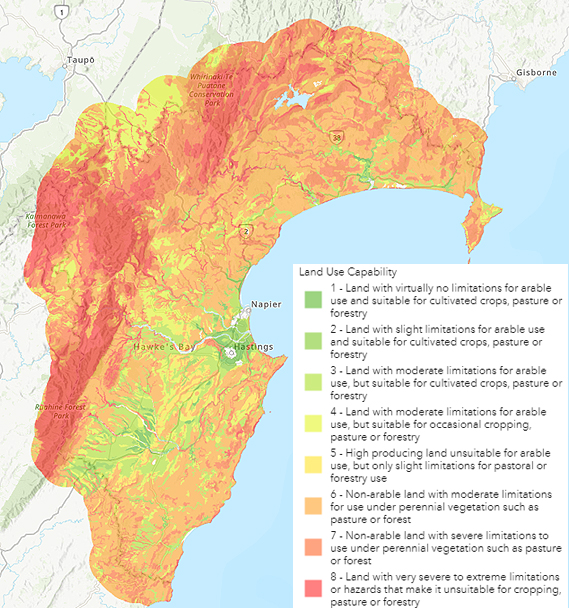
Source: https://gis.hbrc.govt.nz/ (Hawkes Bay Regional Council)
The Orme report makes the point that carbon farming plantings have moved onto more productive land. “LUC Classes 2-5 (identified as highly productive for pastoral or horticultural farming) have grown from 9.5 percent of purchases with the intention to transition into (carbon) forestry from 2017-2019 to 15.5 percent of purchases from 2020-2022. While more than 50 percent of conversions took place on Land Use Class (LUC) 6 land1, this land is still highly productive for food and fibre production via sheep and beef farming.”
Finally, if these farmers are not happy about selling to carbon farmers then apiarists will likely come calling. Well it could be a long wait. Certainly, there have been plantings of manuka for the purposes of honey production but these are limited. Manuka seedling sales have gone back from a high of 9.2m in 2016 to 6.1m in 2021. Pine seedlings conversely have gone from 32.2m in 2008 to 91.8m in 2021 and likely cannot meet demand. Industry reports are that the honey industry in New Zealand is over supplied and needs to “pare(s) back production to a more sustainable level” but profitability will not reach the previous heights.
Perhaps rural schools have not closed yet although Mata school at Huiarua Station must be due to close soon as a result of the station's purchase and imminent planting. However small country schools run on a knife edge and even a single family leaving can have consequences which result in the school closing or a teacher leaving.
I’m not against farmland going into forestry but in my ideal world it should be because it’s not suitable for food production, not because an overseas investor sees a buck to be made.
Perhaps something to consider is that New Zealand feeds approximately 0.51% of the world’s population (40m) but (only) produces 0.17% of world GHG emissions. Emissions need to come done but we need to be aware of what the consequences are.
We welcome your comments below. If you are not already registered, please register to comment
Remember we welcome robust, respectful and insightful debate. We don't welcome abusive or defamatory comments and will de-register those repeatedly making such comments. Our current comment policy is here.