
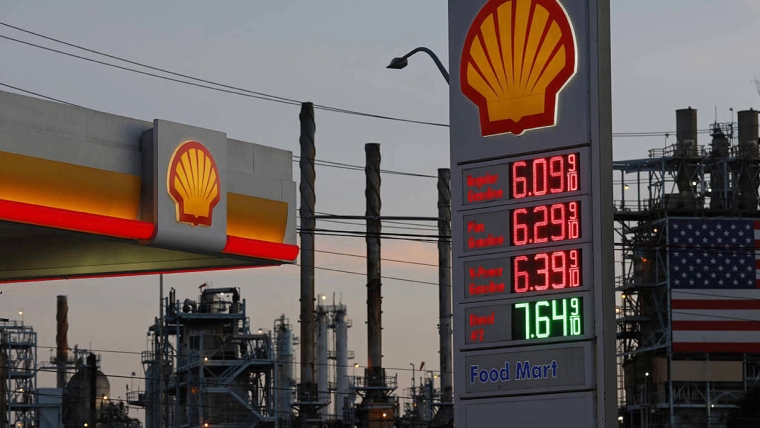
We are living through a rare moment in which two powerful forces are pulling prices in opposite directions. Markets must grapple with both the immediate threat of higher inflation from geopolitical tensions and conflagrations, as well as the longer-term risk of AI-driven deflation.
At the start of this year, many forecasters expected oil prices to hover around US$50 per barrel, owing to what looked like relatively large inventories and flat global demand. Yet now, Brent futures have breached US$100, with some predicting prices as high as US$150.
The US-Israeli war with Iran has disrupted transit through the Strait of Hormuz, which generally accounts for around 20% of the world’s 100 million barrels in daily demand. That makes this the largest oil-supply shock in the history of the global oil market. By comparison, the 1973 Arab oil embargo, the 1990 Gulf War, and the 2022 Russian invasion of Ukraine cut global supply by 7%, 6.5%, and 3%, respectively.
Not only have oil and natural gas prices risen well over 30% since the war began, but the shock has extended across the commodity complex, hitting everything from fertiliser (30% of which passes through the Strait) and the polyethylene (50%) used in plastics to helium (about 33%), a critical input for semiconductors, and thus for the AI revolution. Global shipping and insurance costs have also spiked, making the Iran war the biggest threat to maritime trade and supply chains since COVID-19. And because physical infrastructure is being destroyed, the effects could prove more persistent. Qatar estimates that rebuilding certain liquefied natural gas facilities could take as long as five years.
The longer-term ramifications of such losses are already showing up in revisions to the inflation and interest-rate outlook. The OECD is now forecasting 4.2% inflation in the US—more than 200 basis points above the Federal Reserve’s 2% target. Higher inflation has obvious negative implications for businesses, whose margins will be compressed, and for consumers, whose real (inflation-adjusted) wages will be eroded.
Meanwhile, the market has gone from pricing in one or two Fed rate cuts this year to anticipating a possible hike. Of course, the Fed may treat the current energy-price shock as “transitory” and avoid tightening its policy; but it will also recognise that the broader disruption to commodity supplies could be prolonged.
In any case, a rate hike would affect corporate capital-allocation decisions, debt issuances, and portfolio structures. The United States already has a debt-to-GDP ratio above 100%, and since its government bonds have relatively shorter maturities, it is more vulnerable to a fiscal crunch from higher interest rates.
Moreover, US 30-year mortgage rates have risen to over 6%, implying that the housing market could be severely affected in a higher-inflation scenario. Bond yields have risen and stock prices have fallen, though it remains to be seen how far these price adjustments will go (much depends on the length of the conflict and degree of infrastructure damage).
Ultimately, short-term price increases and concomitant rate hikes would fuel additional demand destruction (lower spending), possibly leading to a recession. Of course, the degree of pain would depend on how governments respond to the commodity shock, and how willing policymakers are to accept a fall in aggregate demand and the macroeconomic downturn that comes with it.
That brings us to the potentially deflationary medium- and longer-term outlook. As AI and related technologies advance, they could push down the prices of labour, commodities, and possibly even public goods such as education and health care. In fact, the prices of goods ranging from household furnishings and televisions to software and telecommunications services were already declining rapidly well before the arrival of large language models (as Mark J. Perry of the American Enterprise Institute showed in 2018). Now, AI promises to accelerate the trend.
Specifically, AI and AI-powered robotics could materially reduce the need for human workers. A recent Goldman Sachs report suggests that while the coming AI era may create new kinds of jobs, some 300 million full-time roles will be vulnerable in the meantime. Similarly, the venture capitalist Vinod Khosla (an investor in OpenAI) argues that AI will be capable of doing 80% of jobs by 2030, effectively automating a large portion of the US$15 trillion US labour market.
Even if the effect is nowhere close to that large, the second-order effects spurred by AI will be essentially deflationary. Higher technology-driven productivity and more labour-replacing robots will mean less disposable income and demand, and perhaps lower tolerance for massive corporate margins as governments face an expanding welfare bill.
Still, if AI can handle a greater share of production and services in agriculture, manufacturing, health care, and education, the cost of living would drop significantly. That is why Khosla asks us to imagine a substantial increase in purchasing power, where an income of $10,000–$30,000 in 2040 would enable the same standard of living as $100,000 does today.
In such a deflationary environment, however, private and public debt burdens would explode. This points to a larger problem: other than the COVID-era supply-chain shocks, most investors and business leaders simply have not had a reason to think much about inflation or deflation. If we are indeed entering an era with fundamentally different conditions, we may not be prepared.
Faced with such extraordinarily rapid and widespread changes, business leaders, CEOs, and investors need to improve their understanding of not only short- and long-term price dynamics, but also of how these may interact. We must begin to grapple with the combined risk of considerably higher inflation in the near term, followed by persistent deflation in the coming years.
Dambisa Moyo, an international economist, is the author of four New York Times bestselling books, including Edge of Chaos: Why Democracy Is Failing to Deliver Economic Growth – and How to Fix It. This content is © Project Syndicate, 2026, and is here with permission.
We welcome your comments below. If you are not already registered, please register to comment
Remember we welcome robust, respectful and insightful debate. We don't welcome abusive or defamatory comments and will de-register those repeatedly making such comments. Our current comment policy is here.