
By Alex Tarrant
The government-appointed Savings Working Group (SWG) has recommended the creation of a single, low-cost default Kiwisaver scheme, to be managed by an entity similar to the Guardians of the New Zealand Superannuation Fund.
As expected, it did not recommend compulsory Kiwisaver membership, but did recommend so-called 'soft complusion'. This is where all employees over a certain age are automatically enrolled in KiwiSaver but have the ability to quit.
In its submission to the government on how to improve the country's national savings rate, the SWG made a range of recommendations on Kiwisaver, fiscal policy and tax policy, saying the tax based needed to be broadened further.
Finance Minister Bill English said the only recommendation in the report government would not consider was raising GST from 15% to 17.5%.
“Otherwise, we are not ruling anything in or out at this stage," English said. Any immediate policy decisions were likely to be included in the Budget in May, English said.
When setting the Group's terms of reference, the government excluded possible recommendations on New Zealand Superannuation, which it has said it would not change, and broad taxation of capital gains or a land tax, which it had previously ruled out.
When asked about the SWG's comments in its report that "the tax base should continue to be broadened and tax rates kept low," - for which a capital gains tax and land tax would be lead contenders for - SWG chair Kerry McDonald said the Group did not have a view on those type of taxes because of its terms of reference.
"But you could imply a view within the framework of our overall recommendations. End of story," McDonald said at a media conference for the release of the report.
Later on Tuesday Green Party co-leader Russel Norman said a capital gains tax would be necessary to tackle New Zealand's savings problem.
“A tax on capital gains would remove the bias in our tax system making homes more affordable and help make the dream of home ownership a reality for more Kiwis,” Norman said.
"The Savings Working Group report found that without substantial tax increases, total government spending will have to decline each year in real terms for the next 30 years to return debt to sustainable levels, he said.
“Treasury and the Inland Revenue Department estimate that an additional NZ$4.5 billion could be raised from a comprehensive capital gains tax with an exclusion for owner-occupied housing. The additional NZ$4.5 billion will broaden the tax base, enhance its resilience, and be used to lower government debt to sustainable levels," Norman said.
'Urgent need to increase savings'
The SWG said there was need for an "urgent increase in national saving of 2%-3% of GDP annually" (NZ$3 billion to NZ$5 billion).
"[New Zealand] has borowed too much overseas. Net Foreign Liabilities (NFL), mainly debt, are 85% of gross domestic product (GDP), which is a similar level to the troubled countries of Europe. Australia is at 58% NFL," the SWG said in a media release.
The SWG recomended government create a single default Kiwisaver scheme comprising five funds for different age groups of investors. The manager of the default scheme would be similar to the Guardians of the NZ Super Fund, colloquially known as the 'Cullen Fund'. There are currently six default funds - see them in our new Kiwisaver section here.
The new low-cost default scheme would only invest in indexed-based shares and bonds, and would offer a limited number of of basic combinations for such investments, the SWG said in its 160 page submission to Finance Minister Bill English.
As reported earlier this week, the SWG did not recommend compulsory Kiwisaver membership, like in Australia but did recommend auto-enrollment of all new employees aged 18 or over who were not currenty enrolled in Kiwisaver, but with the ability for people to opt out.
It also recommended reducing the starting age of full Kiwisaver membership from 18 to 16.
Other Kiwisaver recommendations include:
- Spreading the kick-start payment (currently NZ$1,000) over a five-year period, and making payments contingent on ongoing contributions.
- Keeping the minimum employee contribution at 2% of earnings, but increasing the default contribution rate to 4%, with the ability to opt down to 2%.
- Not allowing employers to give non-KiwiSaver employees pay increases to compensate for not receiving KiwiSaver contributions. In other words, not allowing a "total remuneration" approach.
- Creation of an additional, low fee, ultra-low risk fund that invests only in short term government securities
Another option to be considered would be to increase the rate of member tax credits to NZ$2 for every NZ$1 contributed - either with no change to the current maximum annual credit limit (currently NZ$1,042), or in conjunction with a reduction in the current limit.
See the SWG's full report here.
Increase GST?
The SWG made a number of recommendations on tax policy "to remove serious distortions that favour housing and penalise interest income from basic savings products."
The Group said there should be a further shift away from income tax and towards expenditure tax (GST), with full compensation for people on low incomes.
An increase in the GST rate from 15% currently (up from 12.5% in October last year) to 17.5% should also be considered, the SWG said. However Bill English said later on Tuesday that National would not consider raising GST any higher than it is now. See English's full comments below.
In boosting interest income, the SWG said at a minimum interest income and expenses should be indexed at a notified standard rate for tax purposes that reflected the rate of inflation (eg. 2% per annum), and that asset cost bases for depreciation and, potentially, trading stock opening balances, also be indexed.
'Slash budget deficit much faster' - Govt savings first
In improving the national savings rate, the Group said the focus should be first on the government sector and shifting it from deficit to fiscal surplus of no less than 2% of GDP faster than the projected date of 2016. Raising the public sector's produactivity and productivity growth rate, from 0.3% to 2% per annum over the next five years and 1% per annum thereafter, would improve the country's savings situation and ability to handle financial shocks, the Group said.
"Government sector saving is an important component of national saving, particularly as government has more direct policy control over it and the ability to determine outcomes over a short time period. With significant productivity gains, the government has the option of either increasing government services or increasing government saving and thereby national saving," it said in the report.
"Given the merit of a quick and significant increase in national saving to mitigate New Zealand’s vulnerability, it would be logical to maximise government saving in the short term (as the area with the greatest opportunity for quick results) with a growing contribution from private saving complementing it in the medium term," it said.
English defends govt debt levels
Finance Minister Bill English later defended the government's debt levels, saying the absolute level of New Zealand government debt was relatively low by international standards, but the size of the government's deficit was now large by international standards, particularly this year.
"So we’re not overly concerned about the absolute level of the government’s debt – that’s in reasonable shape – but we are adding to it very rapidly. Our finance costs could double over the next three or four years from where we are now," English told media at Parliament.
The problem - taxes and house prices
One of the Group's key recommendations was that serious distortions in the tax system must be addressed quickly, McDonald said.
"Really it’s no surprise that we’ve invested a lot in housing and that our overall saving performance and investment in simple savings products – term deposits and so on – has been very much on the light side," he said.
Half of the growth in the price of houses from 2001 to 2007 was due to the tax distortion from the favourable treatment of property investment, he said.
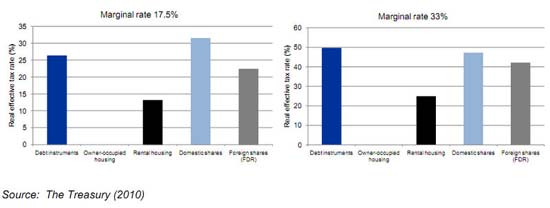
"If you put your money in [a] savings bank term deposit, something like that, your effective marginal tax rate was 50%. If you invested in a rental house, your effective marginal tax rate was 25%, and the return on your owner-occupied houses, which isn’t a matter of contention, was free of tax - so the real comparison is between investment in a rental house and putting your money in a simple savings product," McDonald said.
"You wouldn’t lie awake at night wondering why people are putting so much into housing investments," he said.
The chart below is from the SWG's report.
Here is the reaction from Finance Minister Bill English.
The Government will carefully consider the Savings Working Group’s final report issued today and any immediate policy decisions are likely to be included in the Budget later this year, Finance Minister Bill English says.
“This report will not only assist ministers in considering the Government’s next steps in building a stronger economy, it will also help an informed and open public debate on the national savings challenge facing New Zealand.
“The Working Group points out that New Zealand’s national savings problem has developed over a long period and it is unreasonable to expect it to be solved overnight. But it is a serious problem, requiring urgent attention.
"As a country, our reliance on foreign borrowing leaves us vulnerable to external shocks and means New Zealanders face higher interest rates – holding back our economy.
"Improving national savings is central to the Government's economic programme, which is designed to tilt the economy towards savings, exports and investment and away from excessive borrowing and government spending.
“As we said when the Working Group was set up last year, the Government has an open mind about what might be required to improve New Zealand’s level of national savings.
“Ministers will carefully look at the Working Group’s report over coming weeks with a view to picking up practical ideas that can feed into the Government’s economic programme and Budget 2011.”
Mr English thanked Working Group chairman Kerry McDonald and group members for their excellent work in providing a comprehensive report within a tight deadline.
The Government had deliberately set wide terms of reference for the Working Group. The only exclusions were New Zealand Superannuation, which the Government will not change, and broad taxation of capital gains or a land tax, which it has previously said it will not introduce.
“We are also not interested in considering another increase in GST, which the Working Group has suggested,” Mr English says. “Otherwise, we are not ruling anything in or out at this stage.
"The Prime Minister signalled last week that the Government is prepared to lift its own savings by taking decisions that reduce borrowing and get us back to meaningful surplus by 2014/15 – a year earlier than forecast.
“We are also considering options – such as the viability of the mixed-ownership model for four energy SOEs – that would reduce the amount we would need to borrow to pay for substantial increases in Government assets like schools, faster broadband and better transport infrastructure.
"They are just some of the steps the Government is considering to boost New Zealand’s national savings performance. The Working Group has provided a wide range of other practical options worth considering.
“By playing its part in lifting national savings, this Government will help to keep interest rates low and build faster, ongoing economic growth.
Here are comments from Green Party co-leader Russel Norman:
A tax on capital gains is one of the necessary components to addressing New Zealand’s savings crisis, Green Party Co-Leader Dr Russel Norman said today.
Dr Norman was responding to the Savings Working Group report which found that changes were essential to remove tax distortions that favour housing and penalise interest income from savings.
“A comprehensive tax on all capital gains except for the family home is the fairest, most effective way to encourage private saving and strengthen the Government’s books,” said Dr Norman.
The Savings Working Group report found that the tax system bias in favour of housing caused about half of the increase in house prices over the last decade.
“A tax on capital gains would remove the bias in our tax system making homes more affordable and help make the dream of home ownership a reality for more Kiwis,” said Dr Norman.
The Savings Working Group report found that without substantial tax increases, total government spending will have to decline each year in real terms for the next 30 years to return debt to sustainable levels.
“Treasury and the Inland Revenue Department estimate that an additional $4.5 billion could be raised from a comprehensive capital gains tax with an exclusion for owner-occupied housing,” said Dr Norman.
“The additional $4.5 billion will broaden the tax base, enhance its resilience, and be used to lower government debt to sustainable levels.
In addition, the Savings Working Group has drawn attention to the fact that our productive sector has suffered at the expense of the property sector due to this investment bias.
“A capital gains tax would address the unsustainable investment bias towards property, helping the New Zealand economy to return to earning its living from productive enterprise rather than speculative property investment,” said Dr Norman.
“Nearly every other country in the OECD has a capital gains tax. Australia has one. America has one. Until we address the property investment bias built in to our tax system, our productive sector will struggle and our savings levels will remain recklessly low.”
Here is the reaction from Labour finance spokesman David Cunliffe:
The Savings Working Group report released today makes a useful contribution to the urgent savings debate, but wrongly places too much emphasis on government debt and not enough on a sustainable and equitable path to higher private savings, Labour’s Finance spokesperson David Cunliffe said today.
“The report over-emphasises the role of public debt, and ignores any discussion of the impact of dramatically cutting public services further,’ David Cunliffe said. “Slashing billions of dollars from government spending and raising GST to 17.5 percent, as recommended by the SWG, would make the recession worse and would be unfair to Kiwis who are struggling the most.
“Labour notes National has quickly ruled out lifting GST again --- if it can be believed this time. Labour certainly won’t, and will actually be cutting GST to zero on fresh fruit and vegetables,” David Cunliffe said.
“Labour has also committed to making the first $5,000 of income tax free over time, and to closing tax loopholes and lifting the top tax rate above a comfortable six-figure threshold,” David Cunliffe said. “Any sustainable new savings policy must take account of the ability of Kiwis to participate. When Labour develops a comprehensive savings policy this year, it will do just that.
“Labour agrees that KiwiSaver should be broadened and strengthened, and notes the SWG is critical of Government moves to cut matching contributions to 2 percent and suggests resumption of a 4 percent option. Labour is carefully considering measures to strengthen KiwiSaver, including those covered by the SWG report.
“Labour also agrees with SWG calls to resume prefunding of New Zealand superannuation, which makes a vital contribution to building long term financial assets to cover future retirement costs.
“Labour in government used the economic growth to pay off debt and increase net worth,” David Cunliffe said. “Throughout that period National lobbied for tax cuts for the wealthy, which would have added upwards of five percent to gross debt.
“The SWG has also re-opened an important debate about removing tax incentives for property investment and improving the tax treatment of other forms of saving. Labour will carefully consider options in this area to ensure they are equitable, credible and sustainable.
“Labour will release its own savings package in the near future after careful study of the report and aims to lead the savings debate into the 2011 election.”
(Updated with English defending govt debt levels, second video, Cunliffe comments, McDonald comments on taxes and housing, Green Party comments on CGT, video of McDonald comments on capital gains and land taxes, English comment, link to full report)
We welcome your comments below. If you are not already registered, please register to comment
Remember we welcome robust, respectful and insightful debate. We don't welcome abusive or defamatory comments and will de-register those repeatedly making such comments. Our current comment policy is here.