
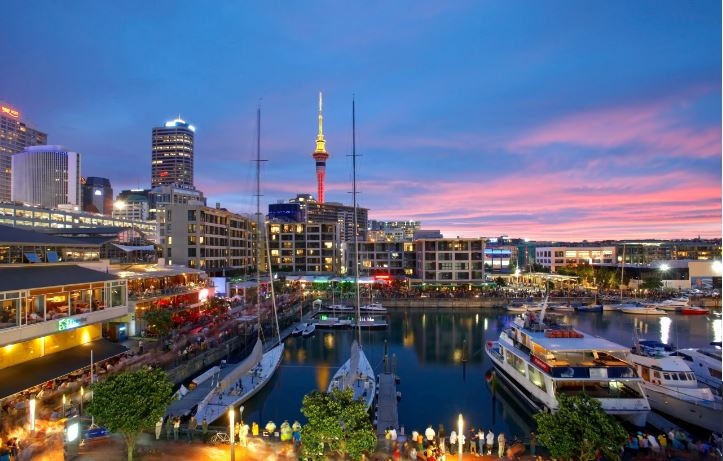
The Auckland Council is set to go public with a draft framework on how it plans to battle climate change in the City of Sails.
Since last year the Auckland Council’s Research and Evaluation Unit has produced a series of eight climate change risk assessment reports looking at what the key issues are facing the city. The papers were designed to help the council create a climate change plan.
And a report to this week’s Environment and Community Committee includes the preliminary result. The Draft Auckland Climate Action Framework which will go out for public consultation next month.
Committee chairwoman Penny Hulse says it's the first step towards creating a final plan which she expects to come back to the council early next year for sign-off.
“That will include more detailed costings and timeframes. The final action plan is when we get right down to the details of who is going to fund it and when. So when we start developing our next Long Term Plan (2021-2031) we will know how we are going to financially address climate change,” Hulse says.
But she says the draft framework raises a number of questions the council is seeking answers to.
“We’re going out to the community [with the draft climate action framework] to say these are the critical issues and we’re going to have change as a city,” Hulse says.
“But are we going to spend money on keeping the sea at bay, or are we going to change where we locate our infrastructure? How do we protect people's property rights? How do we deal with the insurance companies?”
She says in the process of coming up with the draft action plan framework the council has already spoken to a lot of people from academia and the business world who are involved in the climate change debate. But she says now they want to go out to the people of Auckland for their feedback.
The Council says the framework is designed to address both the rising emissions in the region and the impacts of climate change and is consistent with the Paris Agreement's goal of limiting the rise of global temperatures to a maximum of 1.5°C. The agreement was first adopted in 2015 at the end of the United Nations Climate Change Conference and is the world's first universal and legally binding agreement on climate change.
The council agenda report says the new framework is underpinned by extensive research and analysis, including emissions modelling, climate projections through to 2110 and the Climate Change Risk Assessment Technical Report Series and states:
“Auckland Council has been compiling annual region-wide greenhouse gas inventories since 2009. Between 2009 and 2016, overall emissions increased by 5.6 %. If we continue this trend, Auckland’s emissions will increase by 27.7% by 2050.
“The analysis shows that to reach net zero by 2050, Auckland needs to sharply decrease emissions over the next 10 years.”
It says in 2018 the National Institute of Water and Atmospheric Research (NIWA) was commissioned to carry out climate change projections for the Auckland region until 2110.
“This work and the Climate Change Risk Assessment reports that followed it, show Auckland’s mean annual temperature is rising, our coastlines are and will be impacted by ongoing sea level rise, and rainfall patterns and extremes are changing.”
The draft framework says that transport is Auckland’s biggest source of emissions and outlines how the city can reduce them.
“The switch to electric and zero emissions vehicles (passenger, commercial and freight) would have a major impact in reducing emissions. A shift to public and active transport, increased fuel efficiency and transit oriented development would also have major impacts – and would likely deliver other benefits like greater health and equity."
And other industries were also highlighted.
“The industrial sector – including both process emissions and energy used in industry – is another significant source of emissions. Reducing industrial emissions through efficiencies and switching fuel sources requires the adoption of new technologies. But it would contribute substantially to reducing emissions.”
It says the ability to make reductions within the building sector is limited largely due to the high use of electricity.
“However, reducing emissions from buildings often provides a range of other desired benefits set out in this framework. The modelling identifies more reduction potential from residential buildings than commercial buildings. This is due to the potential of new homes to meet zero carbon standards, as well as emissions reductions possible through retrofitting existing inefficient homes.
“Agriculture, forestry and land use emissions are relatively small in our current emissions profile. The opportunities to reduce emissions into the future, however, will be far greater. Like the building sector, actions need to be considered alongside the range of other desired benefits.”
The council report says that there will also be financial implications involved with implementing the new plan.
“Taking climate action will require a range of finance and/or funding mechanisms. For instance, green bonds have been a useful tool for financing council-owned assets such as electric trains but investment in clean tech may require crowd-sourcing, grants or venture capital.
“To support this, a climate finance work package is underway to identify partnerships and broader funding mechanisms across actions such as bonds, grants, equity instruments and public/private partnerships."
But not all the proposals come at a cost.
"Some actions can result in long-term cost avoidance – for example electrifying fleets can reduce fuel and maintenance costs. Some actions could require existing funds to be redirected if priorities change."
But it says the burden of climate change can’t be left to local authorities to do deal with alone and the input of central Government will be vital.
In 2018 the Government announced its plans to introduce legislation to set a national emissions reduction target by 2050 in line with the Paris Agreement New Zealand signed in 2016.
The new Climate Change Response (Zero Carbon) Amendment Bill passed its first reading in Parliament last month. The bill received cross party support, including from the opposition National Party. It has set the target of net zero greenhouse gases by 2050 (excluding biogenic methane which has a separate target) with a series of emissions budgets set over the next few years.
Under the Bill the Government will be required to develop policies for climate change mitigation and adaptation and to establish an independent climate change commission to monitor how future governments perform.
A recent paper by the Australian think-tank, Breakthrough National Center for Climate Restoration, painted a bleak picture on what things will look like if urgent action isn’t taken to address climate change in the next 10 years. Titled Existential climate-related security risk: A scenario approach, it states:
“Climate change now represents a near-to mid-term existential threat to human civilisation. To reduce such risks and to sustain human civilisation, it is essential to build a zero emissions industrial system very quickly. This requires the global mobilisation of resources on an emergency basis, akin to a wartime level of response.”
The public submission process for the Auckland Council’s Draft Auckland Climate Action Framework will run from July 9 to August 9.
16 Comments
Auckland Council blocks development on land adjacent to the existing suburbs and opens up endless growth in exurban areas. Auckland is committed to ensuring people are forced into long and polluting commutes.
From what I've read the council have huge financial impetus to allow urban development over greenfield. Biggest barrier seems to be NIMBYs
https://ourauckland.aucklandcouncil.govt.nz/articles/news/2018/3/the-br…
Don't listen to unaha.
He still doesn't realise what the AUP actually does. Has so many superior ideas of his own. My favourite are the ones where he argues that releasing the RUB wouldn't increase low density sprawl and quash high density central city redevelopment, or that we should zone Tram valley rd in Swanson for substantial intensification. The list goes on - there are some real bangers that he comes up with.
By his logic here, Waikato and Hauraki TLAs are in on the big conspiracy to increase Auckland exurban development also. Because, ya know, everyone that lives in a regional satellite actually both works in, and drives to, their antipodean area of Auckland.
Interestingly, though, it is only an Auckland Council issue.
Ah nymad, the self proclaimed economist who is certain that by reducing the cost of construction in Auckland City we would somehow"quash high density central city redevelopment". nymad is an economist who believes that by creating lots of jobs far removed from the CBD (his theory is people in satellite towns will work in those towns) we shall somehow increase the demand for apartments in the CBD - a location made remote from these new jobs.
I feel that reducing the spread of jobs away from the CBD and reducing the cost of building in the CBD would increase the amount of intensification. I think that by increasing demand and increasing supply we would end up with more.
Nymad disagrees and he is an economist apparently.
The council has consistently delivered a housing policy that makes Auckland brownfield residential land the most proportionally expensive in Australasia. So it is not just the NIMBYs, it is also stupidly expensive to obtain Auckland land on which to build.
add to that 50 odd thousand immigrants to the population each year and their transport needs...
Surely any consideration to Climate Change would go against the previous National governments only
strategy in 9 years to open the gates to massive immigration numbers & allow as much foreign speculation as possible in domestic housing stock as possible to help keep the $NZ up
and keep the National voting amateur landlords happy with inflated property values
What’s been achieved ? Change to an even more polluted Auckland
" the burden of climate change can’t be left to local authorities to do deal with alone and the input of central Government will be vital"
Translation: AC to Gubmint (and thence to all taxpayers, with an added mark-up) - Send Munny......
Very true. The AC have no money whatsoever for any of this. Except perhaps through financial gymnastics. Which I would class as criminal.
1/3rd of taxpayers are Aucklanders. I take it you will have no objection Auckland gets 1/3rd of total climate mitigation funding?
We have central government to coordinate efforts on big stuff for the whole country. Local councils need to FOCUS ON CORE SERVICES, and perhaps be more tightly constrained by central govt to stop this endless parade of expensive left-wing fashion mission creep.
Well put!
There's not one 'core service' which isn't delivered by, or made of, fossilised sunlight.
Have a wee think about that
It's nothing to do with left wing or right wing or - shock horror - money. It's all to do with physics. And it needs a co-ordinated approach, the 'free market' being what brought us to this impasse.
Too late, Foyle. The Four Well-beings are back (see text of Sec 10 LG Act 2002 below and note the date of the amendments) and as any human activity under the sun can be neatly slotted into either or both of 'social' or 'cultural', the gate is once again wide open for the TLA spending madness to gather pace once more.......
Hide yer wallets, youse ratepayers. Enjoy those Events, Soft Spends, Endless new staff to Interact with - you're gonna be paying regardless.....
10 Purpose of local government
(1) The purpose of local government is—
(a) to enable democratic local decision-making and action by, and on behalf of, communities; and
(b) to promote the social, economic, environmental, and cultural well-being of communities in the present and for the future.(2) [Repealed]
Section 10(1)(b): replaced, on 14 May 2019, by section 6(1) of the Local Government (Community Well-being) Amendment Act 2019 (2019 No 17).
Section 10(2): repealed, on 14 May 2019, by section 6(2) of the Local Government (Community Well-being) Amendment Act 2019 (2019 No 17).
whats interesting is all these articles make out that New Zealand had no humans and no cows then all our climates problems are solved. When it would actually make no difference at all to the world. China India, America make up 60% of so called global warming and are not changing.
Are insurance companies still insuring property close to sea level?
Lyall Bay, Kilburnie, Mission Bay and the hundreds (thousands) of other places around the country "at risk"of imminent sea level rise within 12 years? They sure are.
We welcome your comments below. If you are not already registered, please register to comment
Remember we welcome robust, respectful and insightful debate. We don't welcome abusive or defamatory comments and will de-register those repeatedly making such comments. Our current comment policy is here.