
People who have lost their jobs due to the COVID-19 crisis will soon be able to apply for a 12-week government payment that could put more money in their pockets than if they went on Jobseeker Support.
Those who became unemployed between March 1 and October 30, 2020 may be eligible for a new COVID Income Relief Payment.
People who lost full-time work will receive a weekly payment of $490, while those who lost part-time work will receive $250.
To put these figures in context, single people over the age of 25 on Jobseeker Support receive $250.74 a week. Couples with children receive $428.06, meaning those who lose part-time work might be better off on Jobseeker Support.
The payment won’t be taxed, whereas Jobseeker Support payments are taxed.
People won’t be eligible if they have a partner who earns more than $2000 a week (gross).
People who receive redundancy payments of more than $30,000 won’t be eligible either, nor will those who get income protection insurance payments or earnings-related ACC payments.
Recipients need to be able to show they're actively seeking work/training opportunities.
Applications open on June 8 and close on November 13.
Those already on main benefits will be able to apply to receive the COVID Income Relief Payment instead.
However the payment won't be paid retrospectively. So someone who's been on Jobseeker Support since March might be able to switch to the COVID payment from June 8, but won't be able to get back paid the difference between Jobseeker Support and the COVID payment.
COVID payment recipients may be eligible to receive supplementary and hardship assistance from the Ministry of Social Development. The income payment will be treated as income when assessing entitlement to these supports, which include public housing and rent payment support.
Recipients must be New Zealand citizens or residents who normally work and live in New Zealand.
The scheme is forecast to cost about $570 million. This incorporates $1.2 billion of payments offset by $635 million of saved benefit payments, with small administrative costs.
Treasury estimates around 230,000 people could end up receiving the payment.
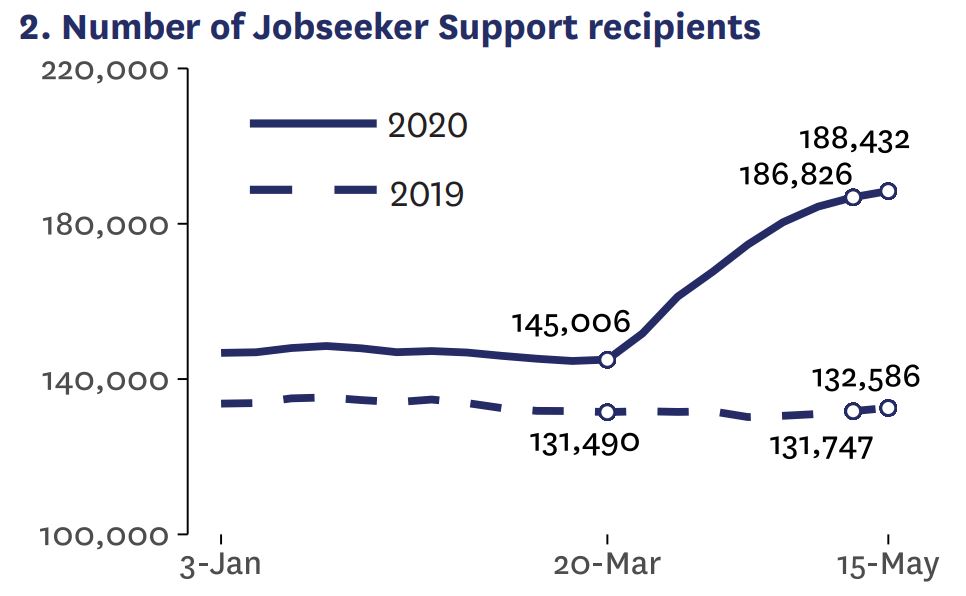
The number of people on Jobseeker Support increased by 30%, or 43,426 people, in the two months to May 15.
See this sheet for more information on the COVID Income Relief Payment.
Here's a press release from the Government:
The Government today announced a new temporary payment to support New Zealanders who lose their jobs due to the global COVID-19 pandemic to adjust and find new employment or retrain
A new COVID Income Relief Payment is being introduced, alongside a wider work programme on possible future employment insurance as we rebuild our economy in a way that supports workers and businesses together.
The payment will be available for 12 weeks from 8 June for anyone who has lost their job due to the impact of COVID-19 since March 1. It will pay $490 a week to those who lost full-time work and $250 for part-time. The payment will not be taxed.
Finance Minister Grant Robertson said the payment acknowledges that the global economy is facing a 1-in-100 year recession, which is impacting on New Zealand, and supports the Governments priority of protecting jobs where possible and supporting workers back into jobs where necessary.
“The Government’s priority is making sure people are in work and able to find new work if their job has been impacted by COVID. That’s why we made a $1.6 billion investment in the Budget to help people retrain. The Budget also invested to create practical jobs for New Zealanders through environmental work, construction and infrastructure. This payment will help Kiwis as they make these transitions.
“We’ve always acknowledged that we won’t be able to save every job or every business and we have not hidden the fact that this is a global economic crisis and things are likely to get worse. But the Government is investing to cushion the blow on households and businesses to make sure we’re in the best position to respond, recover and rebuild,” Grant Robertson said.
The scheme announced today is very similar to the Job Loss Cover payment introduced by the previous Government during the Canterbury earthquakes, and has a number of similarities to the ReStart package for workers who lost their jobs in the Global Financial Crisis.
“We know these schemes reduced the impact on people who lost their jobs due to those shocks. They show how important it is for people to have a safety net to support themselves and their families as they look for new work or retrain,” Grant Robertson said.
Grant Robertson confirmed that work is underway on the possibility of a more permanent unemployment insurance scheme in New Zealand. The Future of Work Ministers group has commissioned the work following a request from Business New Zealand and the Council of Trade Unions.
“As we move from the respond and recover phases of our COVID response, and towards rebuilding the economy, we have an opportunity to reset some of the foundations of the safety net for working New Zealanders.
“Around the world there are many examples of countries that created strong systems to cushion the blow of job loss through both income protection and retraining. These schemes ensure workers don’t suffer large income drops if they’re made redundant through no fault of their own, and save on redundancy costs for businesses going through restructuring.”
Social Development Minister Carmel Sepuloni said today’s announcement of extra support for those hit hard by redundancy will help cushion the blow for people who are looking for work, or taking the time to retrain.
“New Zealand is in a better position than many because we went hard and early to put support in place through the wage subsidy. Internationally countries are facing increased unemployment due to COVID19 and NZ is not immune. As a response to this MSD will not only be delivering the COVID-19 income relief payment but have significantly bolstered employment support.”
People with partners who are still working may be eligible for this payment, as long as their partner is earning under $2000 per week.
Receipt of the payment comes with expectations from the Government, and responsibilities. People who receive the COVID payment will be required to:
· Be available for, and actively seeking, suitable work opportunities while they receive the payment
· Take appropriate steps towards gaining new employment; and
· Identify and take opportunities for employment, re-deployment and training.
Students who have lost part-time work as a result of COVID-19 may also be eligible for the part-time rate.
The 12-week scheme is forecast to cost about $570 million. This incorporates $1.2 billion of payments offset by $635 million of saved benefit payments, with small administrative costs. This fits with the Government’s intention for COVID response spending to be targeted, temporary and timely. It will be funded from the COVID Response and Recovery Fund.
“New Zealand is in a good position to use the Government’s strong balance sheet to invest to create jobs and support the private sector as we cushion the blow of COVID-19 on households and businesses,” Grant Robertson said.
“Last week, international credit ratings agency Moody’s reaffirmed our world-leading Aaa rating. Moody’s said the investments made in the Budget were affordable, and that New Zealand would continue to have some of the lowest debt and interest costs in the developed world due to our careful management of the Government books.
“We went hard and early with support to cushion the blow of COVID-19 on workers and the economy, through the wage subsidy, business tax refunds and interest-free loans for small businesses. Now we’re taking the next step in our plan to respond, recover and rebuild the economy,” Grant Robertson said.
We welcome your comments below. If you are not already registered, please register to comment
Remember we welcome robust, respectful and insightful debate. We don't welcome abusive or defamatory comments and will de-register those repeatedly making such comments. Our current comment policy is here.