
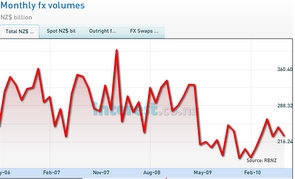
The free floating and free trading New Zealand dollar is still punching well above its weight in international currency markets.
It is the world's 10th most traded currency despite being just the 28th largest economy in the OECD, which does not include China, India, Brazil or Russia.
That's despite a 31% drop in volume over the last three years as New Zealand bank borrowing from 'hot' wholesale financial markets has slumped in the wake of the Global Financial Crisis.
The New Zealand dollar was the world's 10th most traded in the world in 2010 with an average 1.6% of total daily turnover, a Bank of Institutional Settlements (BIS) survey of global currency trading has found. The full spreadsheet of currency trading stats is attached here.
The report (table 3) shows New Zealand's ranking is up from 11th in the last triennial BIS survey in 2007, when New Zealand was behind Norway on 10th. Back in 2007 New Zealand dollar turnover represented 1.9% of the total.
New Zealand’s foreign exchange market handled an average of US$9.5 billion per day in April 2010, down from US$13 billion in 2007, but up from US$7.5 billion in 2004 and US$4.2 billion in 2001, the Reserve Bank reported as part of the BIS survey, which is carried out every 3 years by 53 central banks.
The New Zealand part of the survey included data from the five major banks participating in the wholesale financial market.
“Since 2007, foreign exchange turnover in New Zealand has decreased by almost 31%," said the Reserve Bank's Head of Financial Markets Simon Tyler.
"Much of the decline is due to a fall in foreign exchange swap transaction volume, only a modest 3% is due to a fall in the New Zealand dollar versus the United States Dollar since April 2007. This contrasts sharply with international data which show a 20% increase in global foreign exchange turnover (including spot transactions, outright forwards and foreign exchange swaps) to US$4.0 trillion per day from U$3.3 trillion in April 2007," Tyler said.
“Overall, the falls in transaction volumes in New Zealand and the New Zealand dollar have been mainly driven by less overseas interest in the New Zealand dollar and a shift from short to longer-term funding by New Zealand’s banks.”
Punching above our weight, but not as much as Australia
New Zealand's daily foreign exchange turnover represents about 8.3% of annual GDP, whereas US turnover represents about 7.6% of GDP. New Zealand's currency was also traded more than the Chinese renminbi, which remains very controlled, the Indian Rupee, the Korean Won, the Singapore dollar and the Mexican Peso.
The report showed however that the economy and foreign exchange market that punched the most above its weight was Australia, which generated daily foreign exchange turnover of US$192.1 billion or 23% of annual GDP. It jumped up the rankings to be the fifth most traded currency in the world behind the US dollar, the Euro, the Yen and Pound Sterling. It is now more traded than the Swiss Franc, the Canadian dollar, the Hong Kong dollar and the Swedish Krona.
The BIS preliminary global report can be found here

We welcome your comments below. If you are not already registered, please register to comment
Remember we welcome robust, respectful and insightful debate. We don't welcome abusive or defamatory comments and will de-register those repeatedly making such comments. Our current comment policy is here.