
By Alex Tarrant
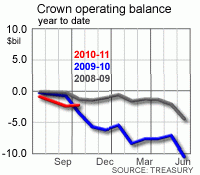
Finance Minister Bill English has foreshadowed a New Year review of government spending following news the government ran a NZ$4.4 billion operating deficit before investment gains and loses (OBEGAL) in the four months to October 31. This was NZ$1.9 billion higher than expected, Treasury said this morning.
This means the government has been running a deficit equivalent to NZ$275 million a week for the last four months and faces an election year budget weighed down by deficits and the potential for a sovereign credit rating downgrade.
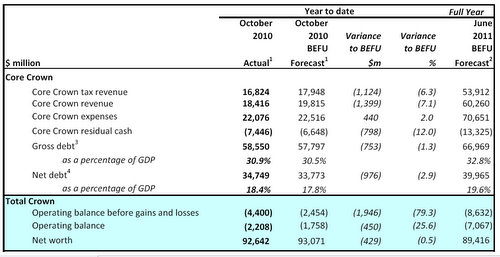
The higher-than-expected deficit came as tax revenue was NZ$1.1 billion, or 6.3%, lower than forecast in the May 2010 budget.
"In the New Year the Government will consider further decisions around how to increase efficiency in the public sector and how it manages some of its large and growing expenses," English said in a media release on Monday morning.
"This will be assisted by report of the Welfare Working Group, the Government's review of spending on policy and the ongoing response to the report of the Housing Shareholders Advisory Group," English said.
Tax take down
The tax take was hit by lower corporate tax and lower GST receipts than expected, showing a weak economic recovery as households and businesses try to reduce the amount of debt their balance sheets.
"Overall, an underlying weakness remains in private consumption, with households exercising greater than expected spending constraint," Treasury said.
The deficit was partly reversed by a stronger-than-expected performance of the government's investment portfolios, Treasury said.
New Zealand Super Fund gains were NZ$1.1 billion higher than expected during the four months to October, while net gains made by the ACC fund were NZ$287 million above forecast. Overall, the Crown’s operating balance deficit was NZ$450 million higher than forecast, at NZ$2.2 billion, Treasury said.
Hard times ahead?
The government is facing calls for a tough budget in 2011 as its deficit blows out due to the lower-than-expected tax take. Prime Minister John Key has said the next budget will be focussed on "savings and investment" although there are so far not many indications on what the government will do to get its balance sheet back to surplus. There were suggestions last week that one measure could be to cut government Kiwisaver contributions, while Treasury has also done research on government spending caps.
This comes after Standard and Poor's last month warned the government that New Zealand needed to improve its savings record by placing its AA+ credit rating on negative outlook, suggesting a 30% chance of a downgrade in the next few years.
The government-appointed Savings Working Group is due to report back in the New Year on ways New Zealand can improve its savings performances. It has previously said the earliest gains would be made from Public Sector savings, although has warned that corrective measures were likely to be challenging.
The government last week came under further pressure from former National Party leader Don Brash, who is gaining traction with his calls for government to sell state owned assets and cut expenditure.
Household, business credit weak
Later on Monday Treasury released its November economic indicators paper, saying consumer spending rose before the October 1 GST increase, but then likely fell back once GST was hiked to 15% from 12.5%.
"Household credit growth was flat in October and house prices edged lower, suggesting that household spending remains conservative and that the economy will need to rely on other sources of expenditure to drive growth in the period ahead," Treasury said.
"Businesses remain reluctant to increase their exposure to debt, although there are encouraging signs of a lift in credit growth and rising business confidence points to a more vibrant economy over 2011," it said.
"Commodity exports are benefiting from rapid price growth and have helped push the merchandise trade surplus to its highest level in sixteen years. Maintaining that surplus will be challenging as there is limited capacity to increase agricultural volumes in the short-term and imports are likely to increase as consumption and investment strengthen over the year ahead.
"In addition, a number of risks to export volumes emerged over the month including drought and the kiwifruit vine disease, psa. Concerns about the sustainability of commodity prices also intensified over the month as China acted to curb rising inflation and the stability of the Euro area came under question." Treasury said.
Labour hits out, but with what?
Labour Finance spokesman David Cunliffe said he thought Bill English had got himself in a hole.
“He’s got himself in a hole because his solutions so far [for] New Zealand’s structural problems have been to trim around the edges of fiscal spending and undertake very little structural reform,” Cunliffe said.
That had caused confidence and domestic demand to soften, he said.
“That has fed through into an enormous falloff in corporate taxation, low levels of confidence and low levels of business investment and we look to be getting a vicious cycle of [a] spiralling downturn. These numbers are quite serious I think,” Cunliffe said.
“What they’ve got to do is discover a growth strategy, plus deal with some of the structural impediments in the economy,” he said.
“We need to get a sense of confidence back so that businesses can invest and hire people. That will mean lower unemployment cheques paid out by the government, more people in work, and we’ve got to start turning a downward spiral into an upward spiral.”
Wait till next year
However Cunliffe would not indicate any detailed policies from Labour, saying it would be “rolling out a full set of plans between now and the next election”.
“The first thing I’d say is it’s the Minister of Finance and the government that have the armies of bureaucrats at their disposal to come up with some answers,” Cunliffe said.
“They wanted to be in government and they’ve done nothing constructive with it. I don’t think it’s a fair question at one level to ask the opposition to shoulder a burden that the government has been unwilling or unable to manage itself,” he said.
Labour to look at tax policy?
Broadly speaking government needed “a combination of fiscal prudence, and very aggressive and progressive government action to get growth back into the economy,” Cunliffe said, pointing to his speech two weeks ago in which he said Labour was considering more Private Public Partnerships and private involvement in new subsidiaries of State Owned Enterprises.
“That means working with different regions and sectors to exploit growth opportunities, it means monetary reform, it means protecting land assets, and it means, probably some review of tax policy down the track,” he said.
English’s comments that government would look to review spending in the New Year meant another razor gang, Cunliffe said.
“The problem that he [English] has got is that is probably going to weaken household confidence further, as well as making a liar of the government saying ‘you can have everything that you had under Labour under us and a smiley face too’.
“He’s not going to be able to deliver all those expectations,” Cunliffe said.
More to come
Cunliffe said said there were a “whole bunch of things” that had not shown up in the government’s accounts yet.
“We’ve only got NZ$1.5 billion of Canterbury earthquake costs, we haven’t yet taken to book the full costs of the retail deposit guarantee scheme – you’ve got NZ$190 million extra on Equitable Finance announced in the last week,” Cunliffe said.
“A little dicki-bird tells me they [government] are in no hurry to finalise the receivership sale of South Canterbury Finance assets, because they don’t want to take that to book too soon,” he said.
“I’ll bet you a good bottle of wine that is going to be way higher than early estimates.
“I also am advised that the fiscal risks include as yet unquantified additional Treaty settlement costs, and additional unquantified ETS costs, all of which mean this picture could be a lot worse by election time,” CUnliffe said.
“Ironically, offsetting the worst news were strong gains from the New Zealand superannuation fund and ACC’s assets. Ironic because those were precisely the asset funds the government was keen to run down,” he said.
Here is the release from the New Zealand Treasury
The Financial Statements of the Government of New Zealand for the four months ended 31 October 2010 were released by the Treasury today.
The monthly financial statements are compared against monthly forecast tracks based on the 2010 Budget Economic and Fiscal Update published in May 2010.
The October results are consistent with the general picture outlined in the recently published financial statements for the first three months of the fiscal year.
Tax revenue in the four months to 31 October was $1.1 billion (6.3%) lower than forecast.
Corporate tax and goods and services tax (GST) were again the key contributors to the lower-than-forecast tax revenue result.
- Corporate tax revenue was $784 million (28.0%) lower than forecast mostly due to a slower economic recovery than expected.
- GST revenue also continues to be below forecast, by $190 million (4.2%), a significantly lower shortfall than recorded in the three months to 30 September.
Overall, an underlying weakness remains in private consumption, with households exercising greater than expected spending constraint.
The net expenses for settling claims for damage arising from the Canterbury earthquake were recorded by The Earthquake Commission (EQC) at an estimated net cost of $1.5 billion. The Government’s commitment to reimburse a proportion of the restoration costs of critical local government infrastructure, and certain other costs remains unquantified as reliable estimates of the amounts concerned have not yet been established.
The combined impact of all of these factors was that the deficit in the operating balance before gains and losses was $1.9 billion higher than expected at $4.4 billion.
This result was partly softened by gains made on investment portfolios. The NZS Fund gains were $1.1 billion higher than expected while net gains made by ACC were $287 million above forecast. Overall, the Crown’s operating balance deficit was $450 million higher than forecast, at $2.2 billion.
Lower-than-forecast tax receipts contributed to the residual cash deficit being $798 million higher than forecast at $7.4 billion. This variance flowed into debt indicators, with net debt being $1.0 billion higher than expected at $34.7 billion (18.4% of GDP).
Here is the release from Finance Minister Bill English:
Larger than forecast deficits in the Crown's financial statements reinforces the need for tight fiscal discipline alongside the Government's ongoing efforts to move resources to frontline services, Finance Minister Bill English says.
Lower than forecast tax revenue combined with the fiscal impact of the Canterbury earthquake have contributed to a $4.4 billion operating deficit before gains and losses in the four months to 30 October.
"The $1.1 billion lower-than-forecast tax take is largely the result of lower than expected business profits and lower GST as New Zealanders spend less and save more," Mr English says.
The drop in revenue is partly offset by $440 million lower than forecast government spending.
"While the Government's books have taken a hit from the effects of lower consumption and increased household saving, this trend creates a strong platform for faster growth in the medium and longer term as we rebalance the economy towards savings, productive investment and exports.
"However lower consumption, a weaker global outlook and the fiscal impacts of the Canterbury earthquake will mean slightly lower growth and slightly higher deficits in the short term before improvements show through.
"This reinforces the need for sound financial management and ongoing discipline in Government spending if we are to getback to surplus by 2016. That is why the Government is committed to spending restraint for the foreseeable future.
"In the New Year the Government will consider further decisions around how to increase efficiency in the public sector and how it manages some of its large and growing expenses.
"This will be assisted by report of the Welfare Working Group, the Government's review of spending on policy and the ongoing response to the report of the Housing Shareholders Advisory Group," Mr English says.
(Updates with Monthly economic indicators, comments from Labour's Cunliffe, statement from Bill English, monthly chart, background)
No chart with that title exists.
We welcome your comments below. If you are not already registered, please register to comment
Remember we welcome robust, respectful and insightful debate. We don't welcome abusive or defamatory comments and will de-register those repeatedly making such comments. Our current comment policy is here.