
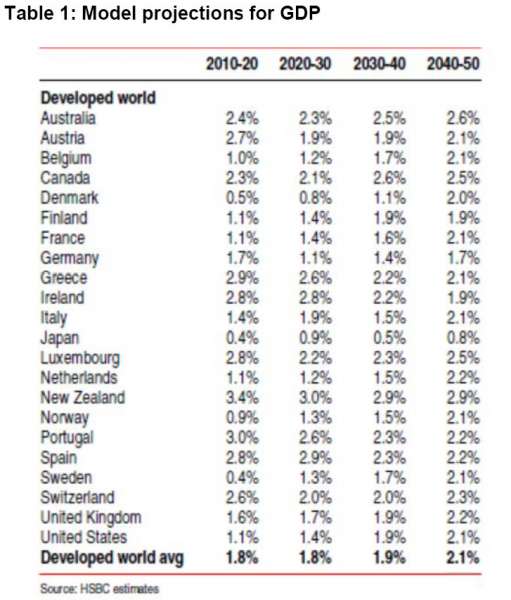
New Zealand's economy is expected to grow at an average of 3.1% a year over the next four decades, and will have the highest growth rate of any developed economy in 2050, according to estimates from HSBC.
However, the size of New Zealand's economy relative to its peers is set to fall over the next 40 years, from 50th currently to 60th in 2050, HSBC says.
"New Zealand will top the league table of ‘developed countries’ with predictions of GDP growth of 2.9% in 2050, according to the newly released HSBC Report The World in 2050. This result for New Zealand outshines predictions for GDP growth of other developed countries including Australia (2.6%), Canada (2.5%), Luxembourg (2.5%) and Switzerland (2.3%)," HSBC's New Zealand arm said in a media release.
"In addition, New Zealand is expected to have an average rate of growth of 3.1% over the next four decades, meaning that we are the only developed country to be labelled a ‘growth’ country (those with anticipated annual growth of between 3-5% between now and 2050) - the remainder of the developed world is instead labelled with a ‘stable’ outlook," HSBC New Zealand said.
Paul Bloxham, HSBC chief economist for New Zealand, said the country’s population growth, investment in education, tools and technology would help propel the country to stronger growth.
"Whereas in comparison, many of the other developed world countries are instead faced with increasing debt problems, a falling taxpayer base and weak demographics – all of which will limit their growth,” Bloxham said.
However, the report wasn’t all rosy for New Zealand, he said. When it came to looking at the size of the economy, by 2050 New Zealand would have fallen 10 places from its current ranking of 50th, to 60th place.
The year 2050 would also bring about a marked shift from West to East as the emerging markets continued to outperform the developed world, HSBC said.
"China will overtake the US as the largest economy and countries such as the Philippines will rocket 27 places into 16th overall, Peru up 20 places to 26th, Ukraine up 19 places to 40th and Malaysia up 17 places to 21st. In fact, 19 of the top 30 countries in 2050 are currently considered ‘emerging’," it said.
Increasingly attention would shift to the new countries as the world economy underwent a seismic shift, Karen Ward, author of the report and Senior Global Economist for HSBC said.
"Over the next four decades it won’t just be BRICs that will be powering global growth; it will be countries as varied as Nigeria, Peru, the Philippines, Malaysia, Ukraine and Chile,” Ward said.
Despite New Zealand falling even further down the economic league table, it was not all bad news as the country's top five trading partners will all be within the top 20 countries in 2050 – including Australia (18th), China (1st), USA (2nd), Japan (4th) and South Korea (13th) highlighting the opportunities that trading with these countries could provide, Bloxham said.
“With the growth of the middle classes in emerging markets set to explode, at the same time the demand for commodities will also rocket suggesting that New Zealand is well placed to take advantage of the growth in the world’s fastest growing markets of Asia and Latin America,” he said.
We welcome your comments below. If you are not already registered, please register to comment
Remember we welcome robust, respectful and insightful debate. We don't welcome abusive or defamatory comments and will de-register those repeatedly making such comments. Our current comment policy is here.