

This article was first published in our email for paid subscribers this morning. See here for more details and to subscribe.
By Gareth Vaughan
New Zealand's surge in private debt last decade ate into the country's productivity growth, according to the Swiss-based Bank for International Settlements (BIS), the central banks' bank.
The problems caused by New Zealand's high private debt level is an example given in a BIS working paper entitled Reassessing the impact of finance on growth. The paper suggests big and fast-growing financial sectors can come at a cost to the rest of a country's economy. The paper concludes financial sector size has an inverted U-shaped effect on productivity growth in that a point is reached where continued growth of the financial system can reduce real growth. It also concludes that financial sector growth is a drag on productivity growth.
The paper's conclusion that over-sized financial sectors slow growth will add further political pressure on 'Too Big To Fail banks' in the wake of the Libor scandal and a US Senate report outlining a decade of compliance failures at HSBC enabling drug lords to launder money in Mexico and terrorists to open bank accounts.
"Overall, the lesson is that big and fast-growing financial sectors can be very costly for the rest of the economy. They draw in essential resources in a way that is detrimental to growth at the aggregate level," the reports authors, Stephen Cecchetti and Enisse Kharroubi say.
Cecchetti is Economic Adviser at BIS and Head of its Monetary and Economic Department, and Kharroubi is economist at the BIS. Their paper examines the impact of financial system size on productivity growth across 50 advanced and emerging market economies over the past three decades and the financial sector's share in the economy's total employment across 21 OECD countries. They measure financial sector size through output measures such as private debt/credit to Gross Domestic Product (GDP) and input measures such as the financial sector's share of employment.
When private debt exceeds GDP it becomes a drag on productivity
The authors find when private debt grows to the point where it exceeds GDP, it becomes a drag on productivity growth, and when the financial sector represents more than 3.5% of total employment, further increases in financial sector size tend to be detrimental to growth.
New Zealand is cited as an example of a country where a surge in private debt levels caused a drag on trend productivity growth.
"To see what these numbers mean, we can look at a few examples. Starting with New Zealand, in the first half of the 1990s, private credit was below 90% of GDP. Credit then rose steadily, reaching nearly 150% of GDP by the time of the crisis," Cecchetti and Kharroubi say.
"This increase created a drag of nearly one half of 1 percentage point on trend productivity growth."
New Zealand's household debt as a percentage of nominal disposable income was at 142.6% at the end of March this year, down from a high of 154.2% in the second quarter of 2009. Cecchetti and Kharroubi suggest keeping debt "well below" 90% of GDP provides the room needed to respond in the event of a severe shock.
"Otherwise, should a crisis arise, the additional accumulation of debt would result in a drag on growth that would make recovery even more difficult than it already is."
They point out by the time of the financial crisis, private credit in the United States had grown to more than 200% of GDP, 160% in Portugal and 180% in Britain.
Reserve Bank of New Zealand sector credit data shows double digit year-on-year growth in housing debt between 2003 and 2008, peaking above 17% during 2004. In contrast the most recent figures show growth of just 1.5% in the year to May. It also shows consumer debt mostly rose at a double digit rate between 2000 and 2004 with high single digit increases through to 2006. The most recent figure shows a 0.6% rise in the year to May. Double digit rises in agriculture debt levels, peaking as high as 25%, ran from 2001 to 2009, compared with 2.6% growth in the year to May.
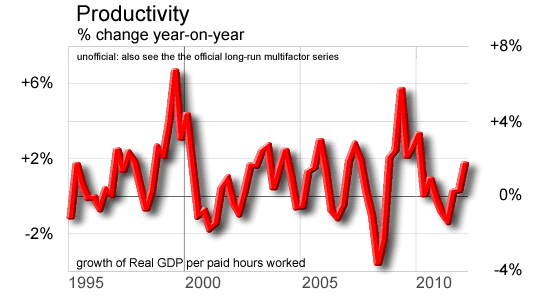
And here's an interest.co.nz chart showing movement in New Zealand's productivity.
How growth in financial sector employment hit Ireland
In an extreme example they note that in Ireland, hard hit by property, bank and debt woes over recent years, the financial sector's share of total employment rose to more than 5%, growing at an average rate of 4.1% in the five years from 2005 while output per worker fell by 2.7%.
"Our estimates imply that if financial sector employment had been constant, it would have shaved 1.4 percentage points from the decline in Ireland. In other words, by our reckoning financial sector growth accounts for one third of the decline in Irish output per worker."
Cecchetti and Kharroubi say that because the financial sector competes with the rest of the economy for scarce resources, financial booms aren't, in general, growth enhancing.
"This evidence, together with recent experience during the financial crisis, leads us to conclude that there is a pressing need to reassess the relationship of finance and real growth in modern economic systems. More finance is definitely not always better."
The authors point out the financial industry competes for resources with all other industries making up the economy, requiring not merely physical capital like buildings and computers, but also highly skilled workers.
"Finance literally bids rocket scientists away from the satellite industry. The result is that people who might have become scientists, who in another age dreamt of curing cancer or flying to Mars, today dream of becoming hedge fund managers," Cecchetti and Kharroubi say.
"Booming industries draw in resources at a phenomenal rate. It is only when they crash, after the bust, that we realise the extent of the over investment that occurred. Too many companies were formed, with too much capital invested and too many people employed."
"Importantly, after the fact, we can see that many of these resources should have gone elsewhere," say Cecchetti and Kharroubi.
Too much of a good thing
As with many things in life, they argue that with finance you can have too much of a good thing.
"At low levels, a larger financial system goes hand in hand with higher productivity growth. But there comes a point - one that many advanced economies passed long ago - where more banking and more credit are associated with lower growth," say Cecchetti and Kharroubi.
Secondly, they say that after looking at the impact of growth in the financial system - measured as growth in either employment or value added - on real productivity growth, there's evidence that faster growth in finance is bad for aggregate real growth.
"One interpretation of this finding is that financial booms are inherently bad for trend growth."
9 Comments
And we spend to much time talking finance rather than business. Look at the telly news breathlessly telling us about todays exchange rate. Whereas the watchers are more likely to be working in or owning small businesses.
I was please to see this site run a business story a day or two ago. Refreshing.
http://www.interest.co.nz/business/60313/australasia%E2%80%99s-largest-…
Ask any banker : "debt is good" For them
oxymoron?
Good debt! llololoolollol. C'mon, Being in someones elses pocket is never good longterm
Saying "debt is good" is like saying "I strive to be poor"
I think you mean "surplus"
But the PM is doing all he can to ease us into even more debt., not realising the unattainable budget surplus will be further removed in time and reality. It can only be a vicious circle as more debt will be required to sustain his or at least the back benchers' re-election hopes.
Rt Hon JOHN KEY: I think if you went and spoke to any generation of New Zealanders, they would say that it is always quite difficult to purchase one’s first home. That is the case for most New Zealanders. They struggle and they save. But fortunately this generation of New Zealanders has the economic leadership of a National Government that is ensuring that interest rates are on their lows, that there has been a reform of the Resource Management Act, and that Maurice Williamson’s great work around licensed building practitioners, etc., etc, are all making the Kiwi dream of buying a home possible.
Obviously the ex- FX dealer's economic understanding is not the same as academics from the central banks' banker. Nevertheless, one has to be mindful that these enlightened revelations are always presented after the fact - not an ideal trader's dream.
No argument from me
It's not only finance stifling growth - As Ayn Rand perceived:
When you see that trading is done, not by consent, but by compulsion - when you see that in order to produce, you need to obtain permission from men who produce nothing - when you see that money is flowing to those who deal, not in goods, but in favors - when you see that men get richer by graft and by pull than by work, and your laws don't protect you against them, but protect them against you - when you see corruption being rewarded and honesty becoming a self-sacrifice - you may know that your society is doomed.
In their Ten Thousand Commandments 2012 report which was released in June, the CEI estimates the cost of US government regulation at $US 1.75 TRILLION. That is just under half (48 percent) of the budget of the federal government. It is almost ten times the total of all corporate taxes collected and almost double the total collected from individual income taxes. It is also one-third higher than the total of all pre-tax corporate profits. It is the hidden cost of doing business in an interventionist economy. The fact that the cost of complying with these regulations is substantially higher than the total of corporate profits is a stark illustration of the end result of economic intervention. That end result is capital consumption. Read Article
No surprises here. How much longer before the parasite kills its host?
Productivity is a reduction in labour cost, coupled with real efficiencies, yes?
The first falters when your system needs them to consume too.
The second can only peak somewhere short of 100%.
What they should have really looked at, was Soddy's Negative Pigs analogy.
www.energybulletin.net/stories/2012-04.../capital-debt-and-alchemy
We welcome your comments below. If you are not already registered, please register to comment
Remember we welcome robust, respectful and insightful debate. We don't welcome abusive or defamatory comments and will de-register those repeatedly making such comments. Our current comment policy is here.