
By Bernard Hickey
The Reserve Bank of New Zealand has held the Official Cash Rate (OCR) at 2.5% as expected and given no guidance on when or in what direction it might next move the OCR.
Economists expect the OCR will remain on hold at its record low until the end of 2013 or early 2014, before rising to around 4-5% in the following couple of years. The Reserve Bank itself forecast at its last full Monetary Policy Statement (MPS) on December 6 it expected the 90 day bill rate (a proxy for the OCR) to start rising from the March quarter of 2014 and rise around half a percentage point by early 2015.
However, new Reserve Bank Governor Graeme Wheeler noted that house price inflation had increased and the bank was watching both house prices and household credit growth closely. He also said the New Zealand dollar was over-valued and hitting exporters. But he gave no guidance on what the Reserve Bank would do if housing inflation rose too high or the New Zealand dollar rose too high. He has previously indicated he is relucant to intervene to bring the currency lower and that even if he had alternative so-called 'macro-prudential tools' to control house price inflation he didn't think they should be used just yet.
"The bank does not want to see financial stability or inflation risks accentuated by housing demand getting too far ahead of supply," Wheeler said in a statement on the bank's monetary policy decision, which is made every six weeks or so. He said in his November Financial Stability report that house price inflation was not so high that the bank needed to intervene with macro-prudential tools such as loan to value ratio limits on mortgage lending.
The bank said inflation remained subdued and was currently below the bottom of the Reserve Bank's inflation target range.
"This mainly reflects the impact of the overvalued New Zealand dollar. The high currency is directly suppressing inflation on traded goods, and is undermining profitability in export and import competing industries. At the same time, the labour market remains weak and fiscal consolidation is dampening growth."
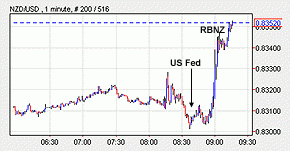
The New Zealand dollar rose round half a cent to around 83.6 USc in the first hour of trade after the 9 am announcement of the decision. Wholesale interest rates rose around 2-3 basis points.
The bank also noted lower bank funding costs and that retail interest rates for households and firms had fallen somewhat.
The bank made no comment about its potential use of macro-prudential tools such as loan to value ratio (LVR) limits. The bank plans to issue a discussion paper by the end of March on the potential use, targets and governance for these tools.
Elsewhere, the bank said global growth was set to recover in 2013 with economic indicators improving in many of New Zealand's trading partners.
"Consistent with this, global financial market sentiment is positive, contributing to lower bank funding costs and some reduction in interest rates faced by households and firms," Wheeler said.
"Domestically, recent data on business confidence and construction activity suggest GDP growth is recovering from the softness seen through the middle of last year. The Canterbury rebuild is gathering momentum and its impact will be felt more broadly in incomes and domestic demand," he said.
"House price inflation has increased and we are watching this and household credit growth closely," it said.
The bank said the high New Zealand dollar wa directly suppressing inflation on traded goods and was hitting profitability in the traded sector. It made no comment about its preferred level for the currency or what it would do to contain the currency. Yesterday the Reserve Bank disclosed it had sold around a quarter of a billion New Zealand dollars in November and December, the biggest sale since its more overt intervention back in 2007 and 2008. See more here in David Chaston's article.
"At the same time, the labour market remains weak and fiscal consolidation is dampening growth."
"Overall, we expect economic growth to strengthen over the coming year, reducing spare capacity and bringing inflation slowly back towards the 2 percent target midpoint. On balance, it remains appropriate for the OCR to be held at 2.5%."
Economist reaction
ASB Economist Nick Tuffley said the statement was reasonably balanced and had a more 'upbeat tone' on the international economic outlook.
We expect the RBNZ to remain on hold until March 2014, given the weak starting point for inflation pressures and that inflation is likely to remain in the bottom half of the target band for another 18 months. The statement does suggest recent housing market developments and credit growth are pushing the RBNZ out of its comfort zone, and that tension will build over the course of this year. We see the risks around our call as balanced. Although the OCR is the most effective tool for dealing with housing and credit, we see a small (and growing) possibility that the RBNZ uses macro-prudential tools if the divergence between housing/credit and broader inflation pressures remains wide.
Westpac Economist Dominick Stephens described the statement as slightly more hawkish than the markets expected.
The RBNZ delivered a slightly more hawkish OCR review than we or markets expected. Two-year swap rates rose 3bp and the NZD rose nearly half a cent. The central bank has shifted slightly in the direction of our long-held views that rising house prices and the Canterbury rebuild will provoke inflation pressure. the really hawkish part of this OCR review was the interpretation of the housing market situation: "House price inflation has increased and we are watching this and household credit growth closely. The Bank does not want to see financial stability or inflation risks accentuated by housing demand getting too far ahead of supply."
The Reserve Bank is now expressing concern that rising house prices are set to unbalance the economy and could provoke inflation pressure (something we agree with strongly).
The reference to financial stability was a direct invocation of the RBNZ's new Policy Targets Agreement. The RBNZ is reminding markets that it has the right to keep interest rates higher than inflation targeting alone would warrant, in order to prevent excessive lending from imperilling financial stability.
We welcome the RBNZ's slight change in view. Our key view over the past year has been that so long as interest rates remain low, house prices would rise aggressively. We have long expressed concern about the potential for rising house prices to unbalance the economy. And we have long been concerned that the Canterbury rebuild would provoke inflation pressure, necessitating higher interest rates.
We continue to forecast an OCR hiking cycle that begins in December 2013 and extends far further than markets are currently pricing. The market was poised for a slightly dovish outcome, hence the initial reactions: 3bp higher in the 2yr swap yield and a 45 pip rise in the NZD/USD exchange rate.
ANZ's Economist Mark Smith described the statement as 'business as usual', but noted the Reserve Bank seemed closer to using its prudential tools.
Business as usual for the RBNZ, with mixed economic nuances keeping the central bank focused on its bread and butter – namely OCR settings aimed at delivering future inflation close to the target midpoint. There are the obvious warning shots (housing), watch factors (credit growth), and hooks (a weak labour market).
We note the explicit reference to financial stability within the text, which on the face of it flags that we may be somewhat closer to the inevitable turn to prudential policy: you’d typically keep financial stability and monetary policy distinct, though they do overlap. All up, there seemed more positive nuances, though this is now manifesting in tighter financial conditions, with the NZD lifting.
We maintain our view that the next move in the OCR is up, but that OCR hikes are a long way off (2014).
Harbour Asset Management's Christian Hawkesby said the Reserve Bank seemed to have resumed 'open mouth operations'.
What we learnt today is that, in the meantime, the new Governor is not afraid of attempting to implement policy through ‘Open Mouth Operations’ targeted at the NZD dollar and NZ house prices. Traditionally central banks have moved interest rates and exchange rate using so-called ‘Open Markets Operations’ (OMOs), injecting or withdrawing liquidity from the market. The term ‘Open Mouth Operations’ was coined by a couple of top New Zealand economists in the 1990s to explain how central banks deliberately talk asset prices up or down.
We saw this strategy in action today, applied to the NZ dollar and NZ house prices. After previous attempts to talk down the currency through 2012, the RBNZ had remained relatively silent in recent Monetary Policy Statements and OCR reviews. That changed today with an explicit reference to “the high currency... undermining profitability in export and import competing industries.”
This comes closely on the heels of the disclosure yesterday that the RBNZ sold NZ$250m in the FX market in recent months. The RBNZ would clearly like to see the NZD lower.
There was also a comment that “the Bank does not want to see financial stability…risks accentuated by housing demand getting too far ahead of supply”. Outside of an acute financial crisis, it is extremely unusual for the Bank to refer to its financial stability objectives in a statement designed to explain its monetary policy decision.
We expect a framework for macro-prudential tools will be introduced this year, starting with a Memorandum of Understanding (MoU) with the NZ Treasury and public consultation in March. In the meantime, the RBNZ would clearly like to see the housing market cooling off.
For all the talk in today’s statement about the RBNZ’s preferences, the reality is that they left the OCR unchanged, and concluded that they project “(inflation to come) slowly back towards the 2 percent target” from its current decade low. We think today’s statement was designed to stop the market pricing in rate cuts. In our view, the prospects of a rate hike or introducing macro-prudential tools that actually bite are some way off.
BNZ's Stephen Toplis said the Reserve Bank now had a modest tightening bias and he saw the first OCR hike coming on December 12.
The Reserve Bank is getting increasingly worried about excess demand in the housing market and its implications for both monetary and prudential policy. The Bank could not be blunter than when it notes “house price inflation has increased and we are watching this and household credit growth closely”. In our opinion, the excesses in this market will build further.
Accordingly, this will keep the central bank firmly on a tightening bias resulting in an eventual increase in the cash rate later this year. It is important to note that not only is the Bank worried about the inflationary impact of an overheating housing market but it is also increasingly concerned by the risk that this poses to financial stability.
In short, it is believed that house prices are becoming increasingly overvalued and that in the event that they correct, to more sustainable levels, this might put pressure on bank balance sheets. It is for this reason that the Bank is, in consultation with New Zealand Treasury, investigating alternative methods of “controlling” the housing market. Of course, in the current environment, where a paucity of supply seems to be the driving force of the excess demand, it is highly unlikely that even prudential policy would contain the inflation that is building in the sector. Housing inflation, unto itself, may not be problematic for more generalised inflation but it will become so if households again start to leverage against the increased value of the housing stock. We think housing related issues will be the number one consideration to monitor over the course of 2013.
We will stick with our pick for the first rate hike in December of this year with the risks evenly weighted between sooner and later. At the same time, we think the probability that rates will remain unchanged in March is around 80%. If there was a surprise it is more likely to be to the upside than the down. This is a view that is now not dissimilar to the market with almost no chance of a change priced for the next meeting and a 20% chance of a rate hike by September. Market reaction to today’s statement suggests that it was a modest surprise on the hawkish side.
The NZD rose around half a cent against both the AUD and USD immediately after the OCR release. Given the combination of the RBNZ’s stance here and the ailing Australian economy, we believe there is a very real risk of substantial further appreciation in the NZD/AUD in the coming months. For the record, short-dated swaps (one to two years) also backed up around four basis points in recognition of the modest tightening bias.
Greens co-leader Russel Norman said the Reserve Bank had chosen ideology over jobs by not cutting the Official Cash Rate and by not using the alternative tools it had been investigating since May last year.
The Reserve Bank decision to keep the Official Cash Rate (OCR) unchanged today will hurt the productive economy and result in further job losses, the Green Party said today. In its statement today, the Reserve Bank admitted that inflation remained subdued and was below the bottom of the Bank’s inflation target range. The Bank also admitted that the overvalued currency is “undermining profitability in export and import competing industries”.
“By not cutting the OCR today, Graeme Wheeler is helping to wreck our export and manufacturing sectors and the valuable jobs they create,” Green Party Co-leader Dr Russel Norman said.
“A lower OCR would have taken pressure off our overvalued exchange rate, helping exporters and manufacturers who compete with imports. “Graeme Wheeler needs to roll up his sleeves and start fighting for New Zealand’s productive economy. “Simply talking about our overvalued dollar is no longer enough. In fact, the dollar rose even further after his announcement today.” Dr Norman today released a Reserve Bank paper that shows that the Bank has been discussing complementary tools to the OCR since at least May last year.
The Bank believes introducing loan-to-value ratios would reduce house price inflation.
“The Reserve Bank has known since at least the middle of last year that complementary tools, like loan-to-value ratios, could be used to control house price inflation which then give the Bank greater room to cut the OCR to help re-balance the economy and create jobs,” Dr Norman said. “The Reserve Bank can use the multiple tools at its disposal to control house price inflation while lowering interest rates to bring down the dollar and give exporters a break.
“Other central banks are following such smart policies, but New Zealand seems to have one of the most ideologically rigid central banks in the world, costing our economy exports and, most importantly, jobs.”
(Updated with detail from statement, NZ$ spike, link to currency 'intervention article', ASB, ANZ, BNZ and Westpac economists' reactions, Harbour Asset Management's comments, Greens comments background)
We welcome your comments below. If you are not already registered, please register to comment
Remember we welcome robust, respectful and insightful debate. We don't welcome abusive or defamatory comments and will de-register those repeatedly making such comments. Our current comment policy is here.