
By Bernard Hickey
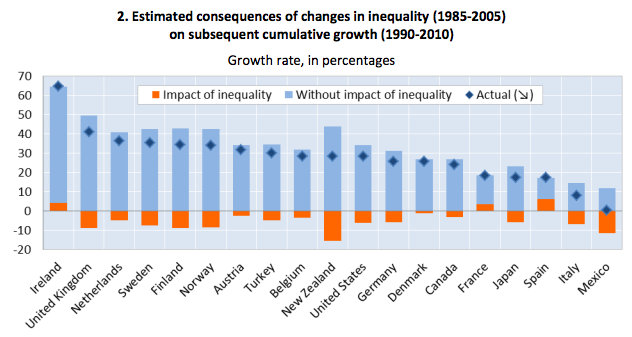
An OECD report has estimated New Zealand's economic growth rate would have been 15.5 percentage points higher between 1990 and 2010 if income inequality had not surged in the Rogernomics and Ruthanasia years after 1985.
The report essentially argues that the 'trickle down' theory used for much of the last half century by most developed countries does not work and that the best method of improving economic growth is to reduce income inequality.
The OECD argued that widening gaps between those in the bottom four quartiles and rest handicapped the development of "human capital" through education as poorer income groups did not get the same educational and health opportunities as those on higher incomes. It said reducing those gaps and improving those opportunities would lift economic growth.
Finance Minister Bill English rejected the report, describing the theory as controversial and based on decade old data from a "bunch of econometricians doing their magic."
The OECD released a research paper overnight titled "Does Income Inequality hurt economic growth?" that found that when income inequality rises, economic growth falls because poorer groups failed to improve their education and skills to lift output.
"Education is the key: a lack of investment in education by the poor is the main factor behind inequality hurting growth," the OECD said.
"Rising inequality is estimated to have knocked more than 10 percentage points off growth in Mexico and New Zealand, nearly 9 points in the United Kingdom, Finland and Norway and between 6 and 7 points in the United States, Italy and Sweden," the OECD said. The OECD chart above shows the impact of inequality on economic growth across the OECD through 1985 to 2005.
The data tables attached to the paper showed the subtraction to New Zealand's economic growth potential due to widening inequality was 15.5 percentage points, which was the biggest impact in the OECD and well worse than Mexico on 11.3%. Without the rise in inequality, New Zealand's economy would have been the second fastest growing in the OECD behind Ireland over that period (pre-GFC). Instead it was the tenth-fastest growing. See chart below.
'Mind the gap'
The OECD found that the biggest impact on economic growth from widening inequality was the gap between the bottom four deciles of the income distribution and the rest of the population.
"These findings imply that policy must not (just) be about tackling poverty, it also needs to be about addressing lower incomes more generally," it said.
It noted that redistributing incomes didn't necessarily reduce economic growth.
The OECD said widening income inequality may hinder economic growth by undermining education opportunities for disadvantaged groups, which lowered social mobility and hampered skills development.
The OECD said its findings had significant policy implications.
'Trickle down doesn't work'
"In particular, it challenges the view that policy makers necessarily have to address the trade-off between promoting growth and addressing inequality," the OECD said.
"While previous work by the OECD has clearly shown that the benefits of growth do not automatically trickle down across society, the new evidence closes the circle by suggesting that inequality also matters for growth. Policies that help to limit or reverse inequality may not only make societies less unfair, but also wealthier," it said.
The OECD said anti-poverty programmes would not be enough to address the issue.
"Not only cash transfers but also increasing access to public services, such as high-quality education, training and healthcare, constitute long-term social investment to create greater equality of opportunities in the long run," it said.
"Policy also needs to confront the historical legacy of under investment by low income groups in formal education. Strategies to foster skills development must include improved job- related training and education for the low- skilled, over the whole working life."
'Controversial econometric magic'
Finance Minister Bill English disputed the report's finding in this Morning Report interview, describing the finding that inequality lowered growth as "controversial" and based on decade-old data from a "bunch of econometricians doing their magic".
"It's not at all clear how they've come to that conclusion," he said. "It may be true, but in an economy that's not going growing -- and New Zealand grew poorly for quite a stretch up until the mid 1990s -- everyone gets worse off and the people at the bottom are affected the most."
English did however talk up the paper's focus on improving education for those on lower incomes, pointing to the supervising adults now working with teen parents to improve their education.
"We're putting in practice one by one interventions with people who's life course we can change, focused on the types of drivers mentioned in that report," English said.
"We believe that over time with a focus on education and on work we can break some of those cycles of long term persistent poverty. That's what we're most concerned about. We're less concerned about whether people are on a lower income. Of course in a stronger economy they can get on a better income," he said.
"Regardless of what you think about their method of what they've calculated, a stronger growing economy gives you more opportunity for lifting incomes than a weak economy. I would argue with the OECD with their contention that somehow growth doesn't matter. The reason we had more inequality through to the mid 1990s was to a large extent was because of poor economic performance.
Key blames Greens and Labour
Green Co-Leader Russel Norman asked Prime Minister John Key about the report in Parliamentary Question Time. See the video above.
Key said inequality had improved since National was elected in 2008 and he pointed to the report's documentation of a rise in inequality from 1985 to 2005 when a Labour Government was in place with support from the Greens "for a reasonable period of time."
"Shame on Labour I say," Key said.
(Updated with video and Key's reaction)
We welcome your comments below. If you are not already registered, please register to comment
Remember we welcome robust, respectful and insightful debate. We don't welcome abusive or defamatory comments and will de-register those repeatedly making such comments. Our current comment policy is here.