

All mortgages are long term commitments.
You enter into a legal contract to repay the borrowed funds, plus the interest.
But it is the term over which you repay the loan that really determines your total cost, much more than the interest rate you pay. Take a look at the table below. A 7% interest rate over 20 years is much less expensive than a 5% rate over 30 years, on a whole-of-contract basis.
So it makes sense to first decide over how long you want to repay your mortgage, and if you are not someone who constantly looks back with regret, long term interest rate deals may be for you.
Some borrowers like the game of negotiating short term interest rates; some mistakenly think that is the key to a sustainable mortgage.
But for others, a set-and-forget arrangement is a lot calmer way to live, eliminating the recurring rounds of 'rate stress' that resurface every one or two years.
Looking back over the past 10 years, rates for all mortgage terms have ranged from a high of 9.45% to a low of 4.85%. History shows a very wide band of rate risk and uncertainty. In that timeframe, current rates are low and five year fixed rates are currently only 5.85%. There is little to suggest that the next ten years won't show a similarly wide range and inherent uncertainty.
Fixing your payments for a long time is attractive. In fact, new options have opened up that may mean you only have to think about an interest rate reset two or three times over the whole life of the loan.
Over twenty years, choosing a seven year fixed interest rate means you will only have to worry about it twice more.
And the new 10 year option from TSB Bank opens up the possibility of only having one extra rate reset to worry about.
| Borrowing $300,000 | average interest rate | ||
| Total interest paid over ... | 5% | 6% | 7% |
| $ | $ | $ | |
| 15 years | 127,029 | 155,683 | 185,367 |
| 20 year | 175,168 | 215,830 | 258,215 |
| 25 years | 226,131 | 279,871 | 336,101 |
| 30 years | 279,767 | 347,515 | 418,527 |
So, what are the plusses and minuses of going long?
Let's look at it from different borrower perspectives.
1. First home buyer
These buyers make up about 6% of all new borrowers committing to 10% of all new borrowing according to the latest RBNZ data.
Around the initial stressful period of taking up such a big obligation, the option for long term certainty will appeal to many people, eliminating unpleasant upside interest rate risks. True, you may give up the possibility of some 'gains' from falling rates over the term, but risk-aversion and regret-avoidance may seem a better approach than playing the uncertain interest-rate game.
And the prospect of selling up and moving to a more family-friendly house may seem an inhibition with the prospect of break fees if you shift before the end of the interest rate contract ends. But that is unlikely to be a real risk because most institutions will allow you to shift the loan and its fixed rate to any new home you move to without cost or penalty. (Costs for recording the variation in security will probably apply however.)
2. Young family
Having moved from your first home, and now with your family income probably somewhat less, costs will be at the forefront of your thinking still. Lower payments will look enticing and both a longer borrowing period and a lower interest rate may seem options. But remember, your new young family is the ultimate long term plan. Minimising risks and staying with paying off the mortgage as early as you can will likely be a better idea. Lower weekly payments as a benefit are a myth from the perspective of a grown up family. Family life will have many bumps in the journey; suffering a potential rate-hike squeeze probably shouldn't be one of them.
3. Second rung buyer
Now you have brought up the kids to lead life pretty independently, you find they are still at home. You need a larger place! With a transferable long-term mortgage with a transferable long-term interest rate, that transition will go more seamlessly in the financial component.
4. Investor
These buyers make up about 18% of all new borrowers taking up an impressive 31% of all new borrowing commitments.
A long term interest rate commitment would likely be clear proof that the investor is not buying for short term capital gain, clearing away an uncertainty of taxes due.
And property investment should be about locking in as many of your costs that you can so all of the benefits of rising rents flow though to your cash-flow. Yes, you can 'actively' manage your mortgage costs by regularly shopping around. That will add redocumentation and legal cost, but it can be worthwhile. But it can also be a trap especially when rates are rising. The fundamental basis of residential property investment is to receive a long-term stream of income that is steadily rising and that works best when you can fixed as many costs as possible. Borrowing costs are often the largest uncertainty with most new investments starting with 65% or 70% of the purchase price borrowed. The option to fix the interest rate for seven or preferably ten years is something more investors should consider as part of their long term strategy.
5. Trusts
Trustees may find low long term rates attractive if they have a situation where there are decades ahead before the beneficiaries need access to the Trust's capital. Both the elimination of risk and the lower need to manage regular refixing may seem attractive aspects in some situations.
Some myths
There are many real estate myths and one is that chasing the lowest mortgage interest rate (or the lowest home loan payment) is a way to get the overall lowest cost. Another myth is that interest rates will always go down. Yet another is that people who 'know for certain' which way interest rates are going in the future have some special insight; they don't. The future will always be uncertain.
And while we are looking at myths, it is also not correct you will always be involved in break fees if you want to move house. You could be in some arrangements, but your existing loan and interest rate arrangements can follow you to a new property as you trade up. TSB Bank offers this facility as do other banks. But changed arrangements or new drawdowns can often involve redocumentation fees. Break fees only involve costs to banks when rates are lower 'now' than the loan you want to break. If you change banks in that situation, you most certainly will face such fees.
The long term mortgage market
Floating rates are on the decline jerked lower by last week's RBNZ reduction in the Official Cash Rate (OCR).
Wholesale swap rates are also falling, especially at short end. And at the long end they are now also falling, but slower. That means the slope of the rate curve is getting steeper.
But it doesn't follow that long term rates are going up at present. They are not.
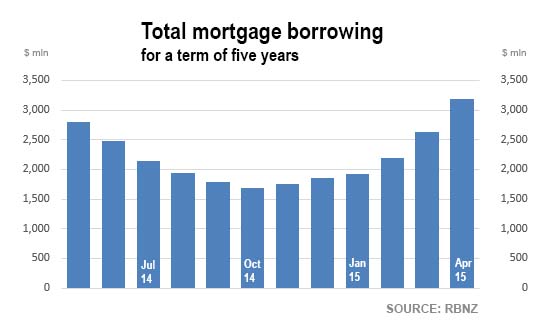
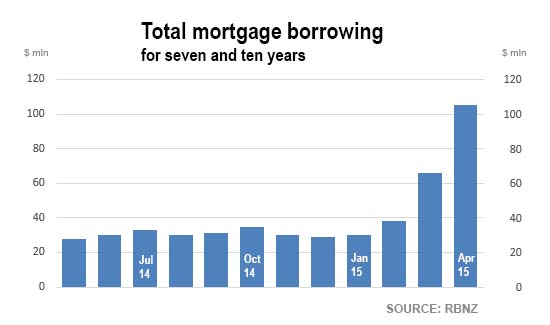
RBNZ data shows that long end fixed borrowing is suddenly springing to life. For the past two years it has averaged only $30 mln in total, and for the previous two years it averaged only $20 mln in an overall mortgage industry book of almost $200 bln. But the data doubled in March, and almost doubled again in April. May data is due at the end of this month and will no doubt show another strong rise.
Despite the relentless focus on the short end, the long end is on the move as well, rapidly gaining in popularity
These are the interest rates borrowers with an eye for long term fixing are looking at:
| Long term fixed rates | 5 years | 7 years | 10 years |
| % | % | % | |
 |
5.79 | ||
 |
5.65 | ||
 |
5.75 | 5.99 | |
 |
5.69 | ||
 |
5.60 | ||
 |
5.60 | ||
| SBS Bank | 5.35 | ||
 |
5.85 | 5.95 | |
 |
5.79 |
(These rates are correct as at Monday, June 22, 2015.)
We welcome your comments below. If you are not already registered, please register to comment
Remember we welcome robust, respectful and insightful debate. We don't welcome abusive or defamatory comments and will de-register those repeatedly making such comments. Our current comment policy is here.