
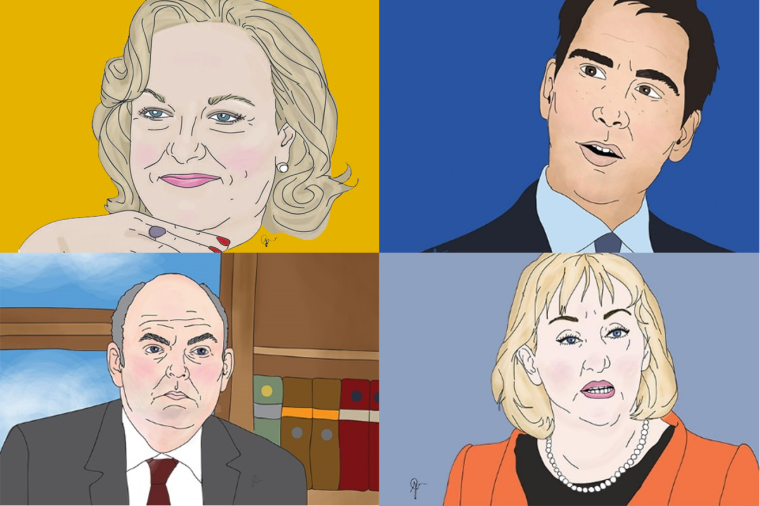
As the wheeling and dealing within the National Party kicks into action, interest.co.nz talks to political insiders about who will replace Bill English as Leader, and where they see the party going.
Former Reserve Bank Governor, National Party Leader and ACT Party Leader, Don Brash, has his money on Judith Collins.
He has confidence in Collins’ ability and maintains a woman is best placed to take on Prime Minister Jacinda Ardern.
National Party pollster, David Farrar, and former National Party President and public relations specialist, Michelle Boag, won’t name names.
Yet Boag emphasises the new leader needs experience, while Farrar says they will be elected on the quality of their relationships with those in Caucus, more so than on the way they position themselves politically.
Neither believes the party will make any drastic changes of tack, coming out of the election with the support of 44% of the country.
THE CONTEST
Boag and Farrar highlight the fact there is an “open contest” for National’s leadership, with a number of contenders, for the first time in years.
They maintain the caucus could wait until English’s resignation takes effect on February 27 to elect a new leader, or make a move earlier.
Farrar believes it’s possible for a decision to be reached next week.
“If the numbers become clear early on, then like you had when English became Leader, people drop out and you actually have a fairly early vote on it.”
Asked how tidy he sees the race being, Farrar says: “There will be tensions during the period the leadership contest is on… But people are aware that everyone needs to work together afterwards.
“So I suspect people will be campaigning more on their strengths rather than against others. But it will be quite tense.”
Boag says: “I think it will be clean and tidy, because that’s the way we do things. But I think it will be more competitive this time…
“There are any number of scenarios, which may or may not include people who are currently in positions staying in positions, or going for new ones.”
Boag says the process may prompt those considering leaving the party to actually do so; something that would be “helpful”.
“If I was David Carter or Chris Finlayson and contemplating resigning in the next little while, I’d wait until I cast my vote for leader before I did that,” she says.
“I should imagine that after that new leadership has bedded itself in, there will be a bit of a sorting out of who’s staying, who’s going, what the shape of the new shadow cabinet would look like.”
THE CONTENDERS
Brash is firmly of the view that Collins - who he worked with from the time he entered parliament - is best placed to be leader.
“Judith is a conviction politician. She knows what she stands for and what she doesn’t stand for. She’s highly intelligent, she’s analytical, she’s got a good legal background, she’s been in parliament since 2002, so she’s had 16 years in parliament. She certainly takes no prisoners in house…
“One of the benefits of having a woman as leader of the National Party is that she could more readily take the fight to the Government in a way that perhaps a man might hesitate to attack a leader who’s a woman…
“National is not likely to win government by trying to emulate Jacinda. In reality, they can’t emulate Jacinda…
“People talk about Nikki Kaye. I think Nikki Kaye is a very able person, but I don’t think at this point she’s ready to be leader.”
Asked about Steven Joyce, Brash says: “Steven is a very able person… a very good organiser, ran very good campaigns… I don’t see Steven as Bill’s successor… I just haven’t seen him as the leader of the National Party."
Brash admits he doesn’t know Simon Bridges as well as Collins, but sees him as another good contender for the job.
“He’s articulate, intelligent.”
Asked about whether Bridges is too much of a populist politician, Brash says: “In my experience, Simon’s got some pretty clear views on things. I think he made a good fist of the transport portfolio when he was running that.
“He has been of course a Crown prosecutor for a number of years prior to coming to parliament. He’s got some pretty strong views.”
Brash can see Collins and Bridges working together in leadership.
“You don’t want a leader and deputy who are both sort of clones of each other. You do want people who are different, have different skills and bring different constituencies to the party if you like. I think a Judith Collins, Simon Bridges duo would be a very powerful one.”
Farrar is less direct, yet says: “MPs are like everyone else, they have friendships with people in Caucus that they’ve built up over many years. For some it’s not a purely political decision on who’s maximising our chance to win the election. It is [an attitude of], ‘I believe in this person, I’ve worked with them over many years’.”
He recognises Caucus should be asking what problem it is trying to solve by who it elects as leader, but ultimately: “I wouldn’t read too much into who they vote for and what it means.”
Farrar says: “In an ideal world, it would’ve been better for National (but not better for Bill English) if he’d stayed on another six months.
“It’s hard at this stage to work out what’s going to be your best strategy. You haven’t yet seen where the Government’s weaknesses will be, if the economy’s going to get tight and they might get blamed for that.
“So it would probably be a more informed choice if it was later this year.”
Boag says: “I think it’s highly likely that whoever it’s going to be will have been a cabinet minister…
“I don’t think they’ll be looking to put someone in who’s not experienced. I think the Labour Party were in a situation where they had no other place to go really - except for Jacinda - and that worked out very well.”
Asked whether she believes National will jump on the rhetoric that people want generational change, she says this is a line Labour would like the party to adopt.
“I think the Labour Party is looking at the fact the first poll under Bill English had him losing no support whatsoever, and they’d quite like the National Party to come up with somebody who’s completely unknown, because they think Jacinda will do better against them.
“I don’t think that’s going to happen.”
THE DIRECTION
Boag goes on to say: “I don’t think there’s any need for any radical departure from where they’ve been, because they’re still the biggest party in parliament. So why would you depart from that?
“The formula’s working. It’s just that the coalition process didn’t have the integrity that we all assumed.”
Farrar agrees the party has to keep its current voter based happy, but doesn’t believe there’s much value in it leaning further to the right of the political spectrum.
Being able to “quite aggressively” hold NZ First to account, especially on behalf of regional New Zealand, is where the party’s focus should lie.
Farrar believes the party’s brand will largely stem from its leader.
“There’s strategy and there’s brand. Whoever becomes leader has their own brand and the brand of the leader can become the brand of the party.”
He says this was part of National’s success under both John Key and Bill English’s leadership. While they were different, they were both moderate and compassionate.
“I’ve seen Labour leader after Labour leader in Opposition blow that opportunity [to create a brand], where they’ve just got straight down to being aggressive in the House, rather than telling the story about their values and beliefs.”
Coming back to Brash, asked about where he believes National should position itself on the political spectrum, he says: “I would think that for National to move further to the left would be a mistake. There are plenty of people around who say, ‘For goodness sake, we want a centre-right party and if National moves further to the left, we haven’t got one’…
“Logically ACT should be covering that end of the spectrum, but for some reason it isn’t doing so effectively, and I don’t quite understand why that’s the case…
“Judith would be more inclined to be a centre-right politician, rather than a centre politician.”
23 Comments
Judith Collins as opposition leader
YES
no other person garners so much contempt from the non-right-wing electorate
perfect choice
she'll lead her party/coalition through 2 terms of labour and then she'll be dumped before the second general election
everybody wins!
she gets to be Leader
Labour gets to stay in
National gets to bring forth a moderate with no tainting
oh cleva cleva National
except they are not - they have not learned how to use MMP yet - the current mob in power have
Quite honestly any she or he that wants this role now is a self ordained mug, insufficient brains to comprehend it’s too early & they will not be leading National at the next election. That was the fate after all of Marshall, McLay, English, Shipley sort of & from the other side Rowling, Goff, Shearer more or less. Mind you probably a good thing for National at least, that an identity with that ack of nous is culled reasonably early on.
i too expect a new leader for the 2020 election, the polls will slowly fall for national as the incumbent government makes some progress and people see things being done after 9 years of very little progress.
so whomever takes the job will be seen as the reason the polls are falling and once the realization comes that the election may not be won the knives will emerge
Not sure... Amy Adams is a player. She's had public support from MPs already on the front lawn of Parliament already. That's massive signal to the new MPs to fall in step. Not bad stuff sister. And I would say she's capable of leading through to next election. Easy. I reckon she's the goods. Needs to lighten up and get the plum out of hrr mouth though. Has the intellectual advantage over Bridges and they know it.
Policy expectations by the public has shifted left. Even Newsboy has replaced Hosking on TV. No one can unsee that.
Interesting comment. Makes you wonder how much politics plays in the selection of a presenter.
I’d love to see the viewer figures. I watched news boy tonight for the first time. Yawn. I lasted five minutes. He’s like a marionette. I then turned over to the Project because Mark Richardson was on. The hip young lefties were taking the piss out of him so I ended up on the Maori channel watching a documentary on the Middle aeast for 20 minutes. Can’t watch TV1 breakfast as the new presenter was a Green candidate. AM is only worth it when Mark is on and Taxinda isn’t. I can see why my kids watch YouTube. Good luck to the channels, as I’m watching as little as possible of their dribble. We need a local Fox equivalent so my entitled bubble is complete.
It certainly seems to now. Ardern really has tapped into something bigger than her own gig. No one what's to be seen as old hat, TVNZ have finally found their muse in Jacinda and what she could represent to the viewers of next generation. Times change. This is it.
National need to learn that economic growth isn’t about closing your cheque book, destroying the environment, shady back room deals with corporations or housing ponzi schemes. These might give short term gains but not much else. They need to reinvent themselves as a modern economically conservative party without all the other baby boomer ideals.
I would like to hear a single new idea from any of these contenders or the party. In a reversal of the usual characterisation, I have come to see this as the party of entitlement - the party most determined particularly to protect the private wealth enhancement and tax advantages involved in property. National's MPs are overwhelmingly the greatest property investors, and (Bridges was newsworthy in this) have been adept at claiming every taxpayer subsidy for their portfolios. (In my experience, the sense of entitlement is top-down. Those at the bottom of society have very little of this - they lack the necessary self-assurance.)
National, admittedly following Labour's lead, has centred its policies on property (asset inflation) and immigration (again asset inflation at one end; low cost production at the other). Neither of these strategies has the least engagement for a new generation without the likelihood of property ownership or the desire to live in a low income society.
Reinvention means just that. New ideas. Not new faces representing the same property entitlement culture, and the same drive for low cost/low value production.
Boag's worried about her own relevance.
Life's too short to worry about stuff you haven't got
You're right. Term Deposits weren't as fun as I thought.
Who do you think Key will back ? That may be more relevant than these three ?
Amy Adams.
I wonder what Steven Joyce is thinking, he effectively saved the National party from decimation by spouting some alternative facts. But in the process he has gone from a credible front runner to being a nobody.
Joyce, I reckon, will be a surprise departure, soon. Adams will clear him out.
I think that since Labour has established it'self in government, there has been a sea-change in public opinion. These commentators are very much of the old guard and I suspect totally out of touch with the new reality. From my perspective Collins would be a great choice. She would polarise a lot of moderate voters away from National into the welcoming, "lets get stuck into this", arms of Labour.
http://www.newshub.co.nz/home/politics/2018/01/newshub-poll-labour-soar…
Looks good for PM Jacinda Ardern. Her approval rating is as good as Keys ever was.
My Dream team is Collins & Bridges as leader & deputy in either order as Collins would rip the Labour front bench to shreds, Bridges could be Mr Nice and Steven Joyce left to rip Robertson apart weekly and would be a match for Peters when Taxinda is enjoying motherhood and morning sickness.
Dream? More like a nightmare!
Joyce says nothing in Parliament other than quoting "the latest" business and bank surveys, and what the NZs would think about a 0.2% dip what side the election the respondents got out on.
Joyce will be leaving a spot opem on the list in a couple of weeks.
National aren't the strong opposition people assume. They actually don't have anything of substance to use on Labour. Smoke and mirrors are up.
Has Don Brash taken to prophesying?
"Judith is a conviction politician."
We welcome your comments below. If you are not already registered, please register to comment
Remember we welcome robust, respectful and insightful debate. We don't welcome abusive or defamatory comments and will de-register those repeatedly making such comments. Our current comment policy is here.