
19 July 2010
A monthly assessment of home loan affordability for a first-home buyer*. (This is a companion report to the Roost standard home loan affordability report for typical buyers.)
To find where you can buy and still keep your mortgage payments affordable, see our calculator here >> To assess Rent-or-Buy affordability, see this Report here >>
The Roost first-home buyer index for June 2010:
.gif) It now takes 53.8% of one median income of a person in the 25-29 age group to pay the mortgage on the lower-quartile priced house in June, up from May’s 52.9%.
It now takes 53.8% of one median income of a person in the 25-29 age group to pay the mortgage on the lower-quartile priced house in June, up from May’s 52.9%.
This index was 48.9% a year ago and 59.8% three years ago. This affordability index reached its highest point of 74.6% in June 2007.
Essentially a single median income for a first-home buyer is not high enough to buy a lower-quartile priced house, even with a deposit around 10% of the house’s value. However, a couple/family with more than one income may find the lower-quartile house price is affordable. (See household income section below.)
For comparison, it takes 48.9% of one median income for the 30-34 year old age group to pay the mortgage on the lower-quartile house price, up from May’s 48.1%.
This index was 44.5% a year ago and 55.0% three years ago.
Deposit
The first-home buyer index is calculated assuming that the house buyer has been saving for four years, and that amount saved in the four years is then used as a deposit. Based on current income and house prices it will take an individual 3.4 years to save a 10% deposit, and 6.9 years to save a 20% deposit as now required by most banks.
Key drivers of home loan affordability:
House prices
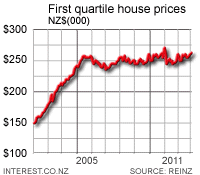 The lower-quartile house price was $249,000 in May, down from $251,675 last month. Annual growth was 1.6%, from the $245,000 lower-quartile house price in May 2009.
| New Zealand house prices in June |
Month (ch) |
Year (ch) |
|
|
Median |
$352,500 |
0.7% |
3.7% |
|
Lower Quartile |
$253,000 |
1.6% |
3.3% |


After-tax income
The median weekly take-home pay for a first-home buyer was $687.56 in June, up from the $686.81 last month and up from $670.93 in June 2009.
Five years ago, median weekly take-hom,e pay was $571.00.
Disposable Income (wages minus mortgage payment)
Weekly disposable income was $317.53 in June, $125.25 lower than the $342.77 in June 2009 (and compares with $323.62 one month earlier). This measure shows why current property prices exclude so many potential buyers.
|
Take-home pay (wkly) |
A month ago (ch) |
A year ago (ch) |
|||
|
Wages |
$687.56 |
$686.81 |
|
$670.93 |
|
|
Disposable Income |
$317.53 |
$323.62 |
|
$342.77 |
|


Interest rates and mortgage payments
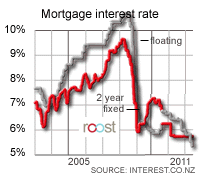 Interest rates have risen. The average bank interest rate for a 2-year fixed rate mortgage was 7.19% for May, 94 basis points higher than the 6.25% twelve months earlier.
|
Mortgage rate and payment (wkly) |
A month ago (ch) |
A year ago (ch) |
|||
|
2 year fixed-rate |
7.194% |
7.185% |
|
6.252% |
|
|
Mortgage payment |
$370.04 |
$364319 |
|
$328.16 |
|
Household affordability:
Household income is a key criteria for lending institutions. We have established a set of standardised household profiles, and these can be used to check affordability.
Based on our first-home buyer household profile, it now takes 26.0% of the median take-home pay to service a mortgage of a lower quartile home purchased in June. Lower quartile housing is affordable for families in New Zealand when both adults work.
This is up from 25.5% in the previous month, May. A year ago, it was 23.5%.
The profile we use for a first-home buyer household is one adult male working full-time, one adult female working full time, with no children.
Refer to our Median Multiple reports for a reconciliation of this report to the internationally comparable benchmarks, by city.
Details of our household profiles, the data sources, and the methods used, are set out in the Notes section of this report.
Full regional reports are available below:
- New Zealand (159kb .pdf)
- Northland (159kb .pdf)
- Auckland (159kb .pdf)
- Auckland Central (159kb .pdf)
- Auckland North Shore (159kb .pdf)
- Auckland South (159kb .pdf)
- Auckland West(159kb .pdf)
- Waikato and Bay of Plenty (159kb .pdf)
- Hawkes Bay and Gisborne (159kb .pdf)
- Tauranga (159kb .pdf)
- Taranaki (159kb .pdf)
- Manawatu and Wanganui(159kb .pdf)
- Wellington region (159kb .pdf)
- Wellington City (159kb .pdf)
- Wellington Hutt Valley(159kb .pdf)
- Nelson and Marlborough (159kb .pdf)
- Canterbury (156kb .pdf)
- Christchurch (156kb .pdf)
- Central Otago Lakes (159kb .pdf)
- Otago (159kb .pdf)
- Southland (159kb .pdf)
| Regional home loan affordability comparison: | ||||||
| mortgage payment as a % of weekly take-home pay | ||||||
| Jun-2010 | Jun-2009 | Jun-2008 | Jun-2007 | Jun-2006 | Jun-2005 | |
| New Zealand | 48.9% | 44.5% | 61.8% | 68.2% | 55.0% | 48.6% |
| Northland | 44.6% | 47.5% | 66.7% | 66.8% | 55.5% | 52.2% |
| Auckland | 61.6% | 58.4% | 80.0% | 84.9% | 72.7% | 65.4% |
| Auckland Central | 62.9% | 60.4% | 78.3% | 84.0% | 72.0% | 61.7% |
| Auckland North Shore | 80.2% | 70.4% | 96.1% | 99.7% | 85.3% | 74.3% |
| Aucklandl South | 66.9% | 66.0% | 83.2% | 95.0% | 77.1% | 65.0% |
| Auckland West | 62.2% | 55.6% | 79.7% | 83.8% | 67.2% | 65.6% |
| Waikato/BOP | 50.3% | 46.4% | 64.4% | 68.1% | 53.5% | 44.4% |
| Hawkes Bay | 48.1% | 39.6% | 51.9% | 56.5% | 54.3% | 47.6% |
| Manawatu/Wanganui | 31.2% | 32.4% | 41.4% | 52.9% | 40.8% | 30.9% |
| Tauranga | 59.1% | 58.3% | 80.0% | 92.0% | 76.1% | 66.9% |
| Taranaki | 44.2% | 39.5% | 55.4% | 60.1% | 48.3% | 36.9% |
| Wellington region | 52.5% | 46.1% | 62.7% | 71.6% | 56.0% | 47.2% |
| Wellington City | 66.3% | 59.1% | 77.0% | 80.9% | 67.0% | 60.0% |
| Wellington Hutt Valley | 42.9% | 42.4% | 58.2% | 68.9% | 53.7% | 42.2% |
| Nelson/Marlborough | 54.5% | 52.9% | 74.6% | 80.7% | 62.7% | 57.5% |
| Canterbury/Westland | 47.8% | 42.8% | 62.8% | 68.8% | 55.2% | 50.0% |
| Christchurch | 59.9% | 50.2% | 71.7% | 78.4% | 64.6% | 59.6% |
| Central Otago Lakes | 65.6% | 63.5% | 111.7% | 88.0% | 74.2% | 73.2% |
| Otago | 32.5% | 31.6% | 47.3% | 50.9% | 43.6% | 41.3% |
| Southland | 26.2% | 26.1% | 35.0% | 35.6% | 21.1% | 19.8% |
r = Revised, following Statsitics NZ LEEDS database update. See 'weekly income' note below.
Note to Editors
This work must be referred to as The Roost first-home buyer home loan affordability series. There are two related components – the Standard home loan affordability series, and the First-home buyer home loan affordability series. They have both been produced by www.interest.co.nz. Please direct queries via email to info@interest.co.nz, or see our contact information below.
This research has been sponsored by Roost since July 2010. Roost, owned by AMP, is one of New Zealand’s largest independent home loan and investment property brokers with 16 franchisees nationwide. Roost offers to source the perfect loan for its customers from a panel of lenders, and insurance advice from Roost insurance specialists. Roost was established in 1996. For more information please visit www.roost.co.nz
Sources / Definitions / Methodology
*a first-home buyer: An individual in the 25-29 year old age group that buys the lower-quartile priced house with a deposit as calculated below.
Interpreting this Index:
These affordability indexes measure the proportion a weekly mortgage payment is of weekly take-home pay. A separate measure is generated for each region, plus a national one, and for other various mortgage interest rate terms.
Weekly Income (source change):
From the July 2007 Report onward, the source on which we base our estimates of weekly income, is now the LEEDS (Linked employer-employee data survey) data from Statistics New Zealand.
The first-home-buyer home loan affordability report is based on the LEEDS data for the 25-29 age group.
Income tax rates from IRD are used to calculate a take-home pay (which is the LEEDS-based data net of the specific income tax rate).
Deposit - First home buyer index:
As house prices vary by region to a larger extent than wages, we refrained from using a simple 10% deposit-90% mortgage rule to emulate a first home buyer. Instead, to capture the disparity between incomes and house prices we estimate the deposit as a function of savings – that is 20% of weekly income saved for 4 years, plus interest earned at a 90 day deposit interest rate.
Home Loan: (Lower quartile house price less the deposit)
Mortgage repayments are based on the value of the home loan, paid weekly for 25 years, using the 2 year bank average interest rate. The home loan is assumed to be a standard table mortgage, where both interest and principal is repaid in a fixed weekly payment made in arrears. The repayment is calculated using the tools at https://www.interest.co.nz/calculators/mortgage-calculator.
Mortgage Rates:
Average mortgage interest rates are sourced from www.interest.co.nz. These averages are for banks only as banks have 90%+ of the mortgage market. Affordability calculations are done for mortgages at the floating rate and one year through to the five fixed-rate terms. In this report, the two-year fixed mortgage interest rate is used. This is, and has been the most popular term. However, the market is shifting to variable rates, and the index reviews allow for keeping track of affordability issues as this shift happens.
House price data:
Median house prices are as reported by the Real Estate Institute of New Zealand. Although the REINZ series is more volatile than the QV equivalent, there is a highly positive correlation between the two series. The REINZ series is more current and offers an earlier indication of market trends.
Saving Rates:
Average savings interest rates are sourced from www.interest.co.nz. These averages are for banks only, and use the 90 day term deposit rate. Saving calculations take into account the individuals marginal tax rates as defined by IRD.
Household affordability:
Household affordability is calculated in the same way as individual affordability except instead of individual income, a household income is used. The household income for a first-home buyer household is made from 1 full time male median income, and 1 full time female median income (from LEEDS data) both in the 25-29 age range. Our first-home buyer household profile does not have any children.
Disclaimer
IMPORTANT – PLEASE READ
No reader should rely on the contents of this report for making a specific investment or purchase decision. The information in this report is supplied strictly on the basis that only overall market trends are being reported on, and that all data, conclusions and opinions expressed are provisional and subject to revision.
If you are making a specific investment or purchase decision, you are strongly advised to seek independent advice from a qualified professional you trust.
The conditions and disclaimers set out in our https://www.interest.co.nz/terms-conditions are applicable to this report as well.
This report is made available on these terms only, and JDJL Limited or www.interest.co.nz or Roost is not responsible for any actions taken on the basis of information in this report, or for any error in or omission from this report.
Contact
For more information, contact
|
Bernard Hickey |
Phone: (09) 360-9618 |