

Today's Top 5 is a guest post from Mary Jo Vergara, economist at Kiwibank.
As always, we welcome your additions in the comments below or via email to david.chaston@interest.co.nz.
And if you're interested in contributing the occasional Top 10 yourself, contact gareth.vaughan@interest.co.nz.

Substantial gains in education. Greater labour market participation. Rising incomes. Women’s economic status has unequivocally improved since the 1970s. Of course, we could debate on how ‘economic status’ should be measured (and I’m sure some of you will in the comments below). But the reality is, we live in a market economy governed by these three pillars. Besides, the last half century proves that women can thrive in this environment.
There’s no denying it. The female presence in the New Zealand economy is growing. And there’s no stopping it. In 1971, the female labour force participation rate was 39%. Fast forward five decades and two thirds of working age women (65.6%) are active in the labour force.
Much has happened since the 1970s. And not just the fashion. Thankfully.
Preferences have changed, and young women are leading the charge. Our grandmothers would be proud.
Here are the top 5 trends in women’s economic involvement.
1. Rebel without a cause.
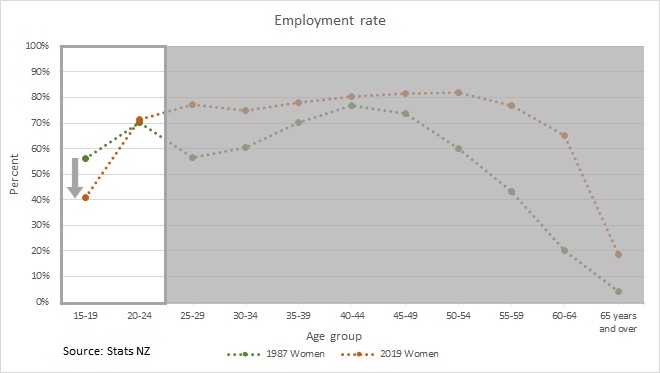
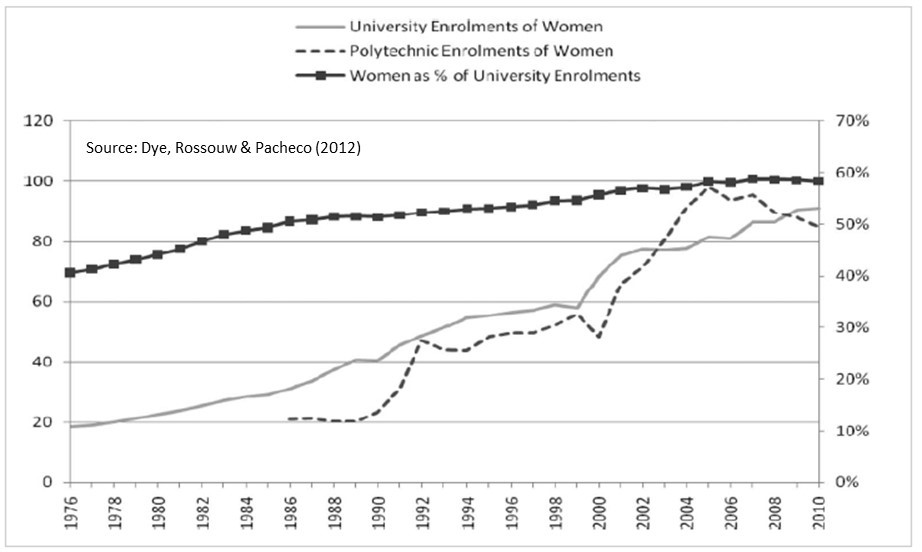
Any parent would agree, teenagers are an angsty bunch. Young people generally don’t do well with authority and are constantly working to beat the system. But unlike James Dean, young girls are rebels with a cause.
In the days of greased lightning, the number one destination for young women leaving school was for clerical-and sales-type employment. With time, the pendulum has swung. Today, more women pursue higher education. The first chart shows a welcome rise in the employment rate of young women. The second chart shows the rise in tertiary enrolments. Admittedly, institutions have helped. In 1991, science, maths and technology were made compulsory in secondary school – subjects in which females have traditionally been absent. The exposure to a wider range of subjects encouraged more young women into advanced study, and broadened their employment options.
Female participation in education may have skyrocketed, but the pigeonholing of students is still evident. Young girls are generally presented with more ‘female-friendly’ opportunities. They’re told they’ll make great caregivers, nurses and teachers. To be a Silver Fern is the be-all and end-all. Young boys are given the same treatment. They’re seen as better tradies, pilots and engineers; they dream of their name across the back of an All Black jersey. But what it means to ‘run like a girl’ is changing. And young girls are running fast. We need to ensure they don’t lose momentum.
2. Converging occupations and smashing the glass ceiling.


For most (abstracting from the ‘Branson’s, ‘Gates’s, and ‘Chanel’s of the world), education precedes occupation. And the field of study is chosen with intent.
Case in point – the entry of women into traditionally male-dominated occupations follows the entry of women into traditionally male-dominated disciplines. For example, the rapid rise of the female scientist links back to compulsory study in school. The same goes for law, medicine and commerce. Men were once the incumbents, but women have swarmed onto the scene. We cannot prove the link between ‘Legally Blonde’ and law school enrolments, but surely there is one. Come to think about it, ‘A Beautiful Mind’ was influential in my decision to pursue economics. (But after seeing the ‘Wolf of Wall Street’, I’m beginning to have second thoughts.)
It’s also more common today to see women on the boardroom invite list. In 2008, women held 8.7% of directorships among NZ’s top 100 listed companies. A decade later, women constitute 24.1% (we can’t find the percentage for the 1970s-80s as it was a rounding error). The rising popularity of postgraduate study has boosted women to higher rungs on the career ladder. But we shouldn’t pop champagne just yet. 24.1% tells us that there’s room for a plus-one. The proportion of women in more senior roles may be rising, but the climb is proving to be a hike. And we’re moving at a snail’s pace.
3. Delayed motherhood.


In the 70s and 80s, male and female employment rates were closest in the youngest age groups, but diverged thereafter. The age-old narrative continues today. Family formation was, and remains, highly influential on a woman’s employment status. But the recent shallowing out of the dip suggests a new trend: delayed motherhood. And it’s gone viral. More women are postponing having children to their mid- to late-30s.
Along with ‘staches, bell-bottoms and discos, the 1970s saw the rise of the women’s liberation movement. The 19th century ideology that largely dictated the extent of women’s involvement in the economy quickly became antiquated. Women challenged the notion that their economic value was inextricably linked to their ability to bear children. It was seen as important for women to finish their education, step outside the secondary sector, and establish a career. Unfortunately, there’s no such thing as a free lunch. And an ageing population is the (unwanted) side order of fries.
It’s also more common today for women to return to work following childbirth. And earlier than previously observed. In 1987, the Parental Leave and Employment Protection Act extended parental leave to fathers. The new law supported the changing roles of men and women within and beyond the home. The ability to share childcare between parents makes it easier for women to confidently return to work.
4. “Second shifts” and sticky floors.

As you might expect, just as male and female employment rates diverge during peak-working ages, so do male and female earnings.
Previously, women’s earnings peaked twice – once at the ages of 25-29 and again at 45-49 years, but never returning to the first peak. Along with forehead wrinkles, bad backs and (I bet) a trillion other things, we blame the little rascals for the valley in between. But the recent gains in education and emerging labour market trends have manifested in a rise and extension of women’s earnings. According to the chart above, women’s earnings continues to increase past the age of 29 and smooths to a single peak at 50-54 years.
Though the gap between male and female employment/earnings has narrowed over time, it still exists. And it conceals further issues. Part-time employment is considerably higher among women than men, and has been for decades. There is no doubt that balancing paid and unpaid domestic work presents several difficulties. And women seem to be the stars of this balancing act. The 2009-10 NZ Time Use Survey revealed that women spent more than twice the time men spent on childcare each day. A “second shift” it’s called. For women trying to balance work and family commitments, flexible and part-time working arrangements are attractive options. And oftentimes, the only option.
The problem: part-time employment is generally low-paid, only available in a limited number of occupations, and career-limiting. The consequence: maintained financial dependence on their partner and/or the government.
We need to find ways to share the stage. There are prohibitive stereotypes on both sides. For women, it’s expected. For men, it’s often frowned upon to take on a caregiver role, and not be the breadwinner (or be the ‘wife’) in the relationship.
5. “And I’m Telling You I’m Not Going” – Jennifer Hudson (Dreamgirls).

We’re also witnessing greater labour market involvement by NZ’s-own golden girls. The generation of women who entered the labour market in the 70s and 80s have superseded their predecessors. The abolishment of a compulsory retirement age in 1999 encouraged women to postpone retirement and remain in paid employment. And it seems that their cocktail glasses have been filled at the fountain of youth. Increased life expectancy, particularly among women, has been another labour market helping hand.

From flared jeans to frayed jeans. ‘Fros to bobs. ABBA to Adele. Much has changed. Women’s experience in the NZ economy is no different. Since the 70s, women’s economic status has reached new heights. We’ve learnt, we’ve grown, and we look back fondly.
But 50 years on, momentum has slowed. It’s taking a while for the remaining headwinds to clear. Last Friday, the NZ Herald published the new salaries of the country’s top CEOs. Can you spot the female(s) in the image above? Hint: it’s not a stereogram, there’s no need to squint. It shouldn’t be this hard. Jayne Hrdlicka shouldn’t be the only woman on there. And female tokenism shouldn’t be clickbait (Hrdlicka wasn’t even mentioned in the article).
But the destination our grandmothers envisaged remains in sight – a NZ where young Kiwis are free to choose between the pink (red) pill and the blue pill, regardless of what those before them chose, and without fears of falling off the career ladder.
Hopefully, it won’t take us another 50 years to get there. Look out for a Top 5 of the possible shortcuts we can take.
We welcome your comments below. If you are not already registered, please register to comment
Remember we welcome robust, respectful and insightful debate. We don't welcome abusive or defamatory comments and will de-register those repeatedly making such comments. Our current comment policy is here.