

This Top 5 COVID-19 Alert Level 2 special comes from interest.co.nz's Gareth Vaughan.
As always, we welcome your additions in the comments below or via email to david.chaston@interest.co.nz. And if you're interested in contributing the occasional Top 5 yourself, contact gareth.vaughan@interest.co.nz.
How's level 2 treating you? I certainly enjoyed getting a haircut and eating dinner out on Friday. And the kids go back to school today. But getting stuck in heavy traffic coming home from visiting my parents on Sunday wasn't so good. Can we have level 2 without traffic jams?
1) More to come from big bank loan impairments and provisions.
In covering the recent interim reporting season for Australasia's big banks I was focused on their credit impairments and loan provisions, and importantly the assumptions behind them. The reasons for this were detailed in this article, which was a results preview story hastily rewritten as BNZ's parent National Australia Bank (NAB) issued its interim results 11 days ahead of schedule.
Because of what's known as International Financial Reporting Standard 9, or IFRS-9, the banks are required to take into account their future expectations. That means factoring in their expectations of future economic conditions and loan losses. In the benign credit environment prior to COVID-19 this wasn't too exciting. But in the tipped upside down COVID-19 world, everything changed.
In their bank results wrap Citi's Australian banking analysts Brendan Sproules and Thomas Strong have done a nice job of summarising this aspect of the results. Covered are the ANZ NZ's parent the ANZ Bank Group, ASB's parent Commonwealth Bank of Australia (CBA), BNZ's parent NAB, and Westpac NZ's parent the Westpac Banking Corporation (WBC).
The upshot is things will probably get a lot worse from here.
Each of the Major Banks made economic loan loss estimates for the impact of COVID-19 on their current loan books. The common theme across these estimates was that all the banks painted the weakest economic conditions since the 1930s. Despite this outlook, the estimated losses are very mild relative to recent economic downturns in Australia.
We expect that COVID-related loan losses over the next 3 years will be higher than the collective provision adjustments made in these results. Balance sheets will grow giving rise to more loan loss provisions, but expected loss rates on the existing book is expected to [be] higher than what was presented by Banks in these results.
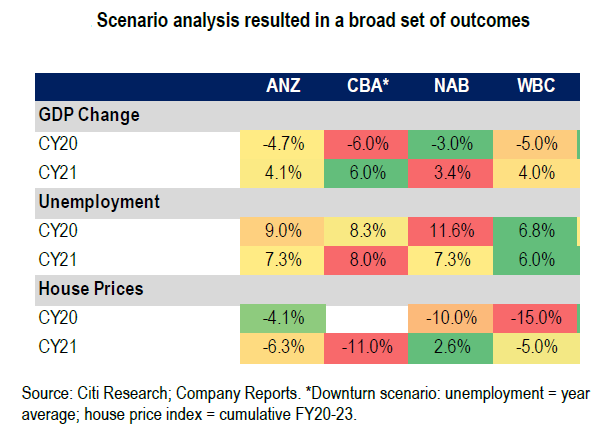
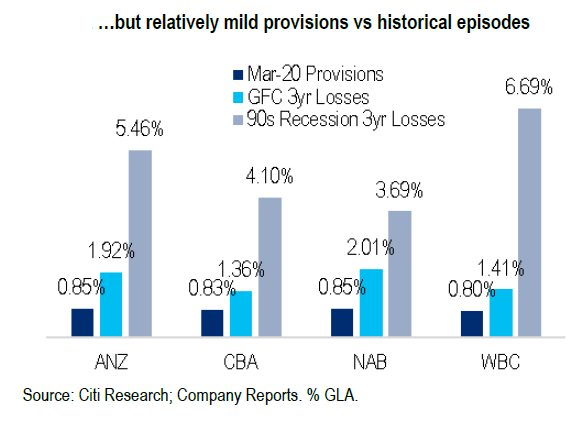
*GLA is gross loans and advances.
2) Hotels for a post-COVID-19 world.
In a report laced with an array of eye catching pictures, Bernstein analysts Richard Clarke, Harry Martin and Pranavi Agarwal take a look at what hotel stays might look like post-COVID-19. In terms of making rooms easier to clean, they suggest several changes are likely, as shown in the picture below. The Bernstein analysts point out much of this is already standard practice in limited service hotels, but implementing such changes in luxury hotels whilst retaining a luxurious feel, could pose some challenges.

They have some interesting things to say on peoples' concerns around potential atmospheric virus transmission.
...[another thing] we think consumers will demand is reduced risk from atmospheric transmission. Up to now we expect few hotels have picked up guests on the message of first-rate ventilation systems or high quality water filtration, but this is perhaps going to change.
One likely innovation is negative pressure rooms, which will mean air from a room (where an infectious person might be staying) cannot get into the corridors.
We would also expect that this aspect means that guests will want to reduce interaction with staff and fewer staff to pass through their rooms. This likely means contactless room service (potentially using robots) and will mean your room is unlikely cleaned every day.
For a more luxurious stays, where daily cleaning is more required, the very technology that enables the guest to control the room's facilities can also be used to track if someone is in the room or not so that cleaning can proceed only if it is vacant.
They also point out the obvious. Buffets are off the menu.
The general manager of the Four Seasons New York has said "I think it's safe to say that breakfast buffets and communal tables and the kind of things that had been traditions at many hotels are going away, for who knows how long". Buffets are likely to be replaced with take away picnic baskets per table or simply become a la carte or set menu. The good news is that this will lead to less food waste.
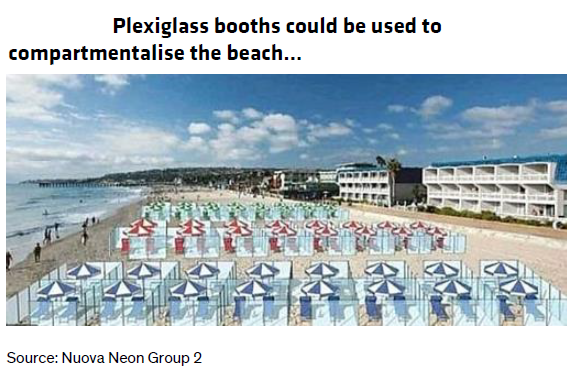
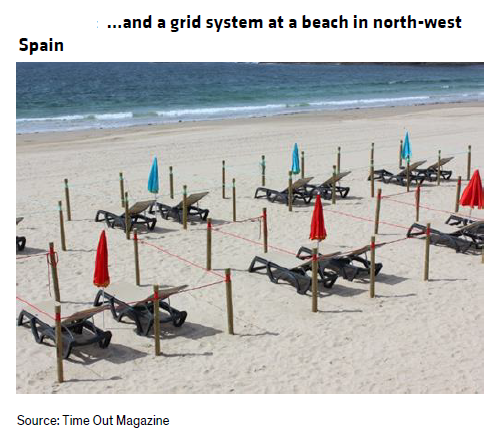
I mentioned eye catching pictures. These include ones of quarantined dining in small glasshouses in Amsterdam where waiters are wearing transparent face shields and gloves, glass dividers between tables in Italian restaurants, and designated standing areas in lifts. And what about those famously crowded European beaches this northern summer? They probably won't be as crowded as normal. But as the pictures below from the Bernstein report show, some including Italian manufacturing company Nuova Neon Group 2, are prepared for virus concerns and the need for social distancing.
3) A business opportunity for criminals.
For most of us COVID-19 has caused a pandemic and a major developing economic downturn. For others it has created opportunity. Some of these seeing opportunity are criminals. According to staff at the Financial Stability Institute (FSI), part of the Bank for International Settlements, criminals are exploiting vulnerabilities created by COVID-19 lockdowns, increasing the risks of cyber attacks, money laundering and terrorist financing.
A third of the world’s population is in coronavirus lockdown. An estimated 300 million office workers globally may be working from home, including up to 90% of banking and insurance workers. Most of these staff log into their firms’ sites remotely, attending meetings using teleworking arrangements, and/or accessing non-public data online – sometimes via home computers and private devices. Since the customers of most financial institutions are also staying at home, doing financial transactions online has become not just a convenience but a necessity.
The lockdown increases the scope for criminals to exploit vulnerabilities and commit financial crime. The increased online presence of virtually everyone has led to new, and in some cases more naïve, targets for online fraudsters. Work-from-home arrangements with remote access to corporate networks have significantly expanded the attack surface for cyber criminals. Money launderers can also take advantage of the increased need for financial institutions to identify and onboard their customers online.
I haven't heard any specifics of New Zealand financial service providers being targeted during our lockdown period. But there's no reason why things would be different here to the rest of the world.
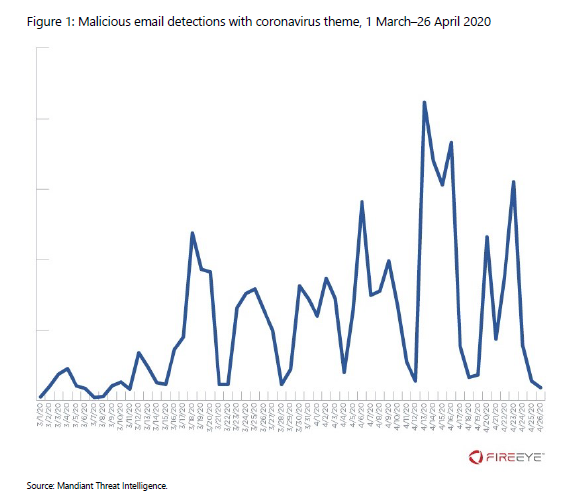
Data show that Covid-19-related cyber threats are increasing. For example, Carbon Black (2020), a cyber security company, noted that ransomware attacks had increased 148% in March 2020 over baseline levels in February 2020. Among the different sectors, the finance sector was the top target, with a 38% increase in cyberattacks against financial institutions. Similarly, the Financial Services Information Sharing and Analysis Center (2020) identified over 1,500 high-risk domains (ie those likely to have been set up by threat actors) created on or after 1 January 2020 containing both a Covid-19 and financial theme. Google (2020), meanwhile, reported 18 million daily malware or phishing emails related to Covid-19 in early April 2020, which was in addition to more than 240 million Covid-19-related daily spam messages. This is consistent with the findings of Mandiant Threat Intelligence that indicate coronavirus-themed malicious emails reached their highest observed volume on 13 April (Figure 1 provides a relative scale of the volume of coronavirus-themed malicious emails).
4) The anti-vaxxer threat to a COVID-19 vaccine.
Amid the uncertainty of the COVID-19 pandemic - how bad will the impact of the virus be and how long will it last for - one thing is sometimes touted as the ultimate silver bullet solution. A vaccine. But as Kevin Roose writes in The New York Times, given how many anti-vaxxers are out there, this is no forgone conclusion.
I’ve been following the anti-vaccine community on and off for years, watching its members operate in private Facebook groups and Instagram accounts, and have found that they are much more organized and strategic than many of their critics believe. They are savvy media manipulators, effective communicators and experienced at exploiting the weaknesses of social media platforms. (Just one example: Shortly after Facebook and YouTube began taking down copies of “Plandemic” [a documentary that went viral on social media] for violating their rules, I saw people in anti-vaccine groups editing it in subtle ways to evade the platforms’ automated enforcement software and reposting it.)
In short, the anti-vaxxers have been practicing for this. And I’m worried that they will be unusually effective in sowing doubts about a Covid-19 vaccine for several reasons.
As Roose notes, anti-vaxxers are often also conspiracy theorists. The United States appears to be the global headquarters of these groups. The Atlantic has a look at this in a series here, suggesting the US owes its existence, at least in part, to conspiracy thinking.
In the colonies, a theory was born that King George III was plotting the enslavement of all Americans. Even without evidence, this theory helped tip the scales toward revolution.
Below, signs that may become more familiar to New Zealanders if we do get an ANZAC travel bubble.
5) The death of neo-liberalism?
Remember Rutger Bregman? He's the Dutch journalist and historian who castigated the super wealthy at Davos last year about not paying enough tax (see below). Now, in the Correspondent, he's calling time on neo-liberalism.
Among other things Bregman discusses the rise of neo-liberalism, the global financial crisis, and the work of economists Thomas Piketty and Mariana Mazzucato, and tax expert Gabriel Zucman. Mazzucato, he notes, probed the state's role in major innovations including the iPhone, medical breakthroughs and the 1960s Space Race. Whether COVID-19 is the death knell for neo-liberalism remains to be seen. But it has certainly ushered in a period of greater government involvement in our lives and in the economy.
Another of Mazzucato’s friends, US economist Stephanie Kelton, adds that governments can print extra money if needed to fund their ambitions – and not to worry about national debts and deficits. (Economists like Mazzucato and Kelton don’t have much patience for old-school politicians, economists, and journalists who liken governments to households. After all, households can’t collect taxes or issue credit in their own currency.)
What we’re talking about here is nothing less than a revolution in economic thinking. Where the 2008 crisis was followed by severe austerity, we’re now living at a time when someone like Kelton (author of a book tellingly titled The Deficit Myth) is hailed by none other than the Financial Times as a modern-day Milton Friedman. And when that same paper wrote in early April that government “must see public services as investments rather than liabilities”, it was echoing precisely what Kelton and Mazzucato have contended for years.
But maybe the most interesting thing about these women is that they’re not satisfied with mere talk. They want results. Kelton for example is an influential political adviser, Perez has served as a consultant to countless companies and institutions, and Mazzucato too is a born networker who knows her way around the world’s institutions.
Bregman certainly wants change.
One thing is certain. There comes a point when pushing on the edges of the Overton Window is no longer enough. There comes a point when it’s time to march through the institutions and bring the ideas that were once so radical to the centres of power.
I think that time is now.
‘It feels like I’m at a firefighters conference and no one’s allowed to speak about water.’ — This historian wasn’t afraid to confront the billionaires at Davos about their greed pic.twitter.com/TiXSJZd89M
— NowThis (@nowthisnews) January 29, 2019
We welcome your comments below. If you are not already registered, please register to comment
Remember we welcome robust, respectful and insightful debate. We don't welcome abusive or defamatory comments and will de-register those repeatedly making such comments. Our current comment policy is here.