
By Girol Karacaoglu*
The 2021 Budget presents an historic opportunity to start implementing a fresh public policy programme, different from what we have pursued over the past 40 years.
This programme would move us forward towards implementing a genuine wellbeing policy, reflecting a social contract grounded in our own history, cultures, and values.
The imperative for this radical change is the fact, clearly documented in the Wellbeing Budget of 2019, that the environmental, social, and economic policies of the last 40 years have failed us abysmally.
At the heart of this new approach must be a commitment to providing individuals and communities with the opportunities and capabilities to live the lives they value – without passing judgement on the variety of lives that people (including future generations) may choose to pursue.
Imagine the policy maker as a gardener, looking after a ‘wellbeing garden’ on behalf of current and future generations. There are five key posts in that garden: the first four represent the environmental, economic, social, and political or legal outcomes that underpin wellbeing. The fifth represents equity and fairness achieved by universal access to these outcomes.
Preliminary evidence suggests the most intense stresses on New Zealand at present are centred on the posts representing equity and environmental quality. If these are not addressed, they will spill over to stresses on social cohesion, political stability, and potential economic growth.
Modelling work, which I published (with ex-colleagues at Victoria University of Wellington and the New Zealand Treasury) on Intergenerational Wellbeing and Public Policy, suggests the way to stop and reverse these stresses would be to combine a ‘leave no one behind’ strategy with one that aims to switch both production and consumption to cleaner (greener) products.
A ‘leave no one behind’ strategy has welfare and wellbeing elements. Welfare policies focus on giving or redistributing what has been produced. Wellbeing policies focus on enabling by making sure all citizens have the opportunities and capabilities (that is, substantial freedoms) to pursue the lives they value.
The strongest welfare policies are those based on the principles of Universal Basic Services. This involves providing everyone with an opportunity to fully participate in our communities and society as whole, consistent with values of justice and compassion. By giving everyone access to education, healthcare, and housing. By making sure everyone can access an adequate income whether they are working or not, whether they are studying or caring for children or other members of their whānau. By making sure everyone has a voice in matters that affect them.
Claims pointing to detrimental effects on employment of providing higher incomes through cash payments to those not able to work, or increases in minimum wages for those who are at work, have been strongly challenged on both theoretical and empirical grounds.
A complementary win-win wellbeing policy aligned with supporting environmental quality would be centred on giving everyone who is capable an employment opportunity – supported by a combination of upskilling and employment creation – in environmentally friendly industries. Both businesses and employees would win, with high wages resulting from upskilling, leading to higher productivity and profitability.
We need good governance arrangements as well as sound policy.
Parliament should develop and effectively communicate a narrative around these policies. The core message should be that leaving no one behind and clean environment strategies are good for sustainable wellbeing for ourselves and future generations.
Process matters too. If ‘the team of five million’ is to be more than a marketing slogan, it would be embodied in inclusive decision-making that brings together the wisdom, expertise and experience of all stakeholders – especially the communities in which individuals and families live.
A specific area that could benefit from better processes is the design of training programmes. Training works best when it’s closely connected to a real job or occupation, and when firms and industries collaborate. Employers and workers are both sources of information about the skills that will be needed.
Emergent ideas in New Zealand, aligned with this strategy, include the film studios planned for Lower Hutt, supported by purpose-built technical schools. Another is the community-based delivery of health services in the Waikato region, again supported by local medical schools.
This is not the time for tactical political manoeuvres targeted at appeasing the median voter with an eye on the next general election. We know that a growing majority of New Zealanders support investments in wellbeing, with seven out of 10 New Zealanders backing increases in income support. A government that does not grab this opportunity to do the right thing for current and future generations may be seriously misreading the changing mood of this nation.
*Professor Girol Karacaoglu is the Head of the School of Government. He came to Te Herenga Waka - Victoria University of Wellington from the New Zealand Treasury, where he was Chief Economist. Before then, he was the Chief Executive of the Co-operative Bank of New Zealand for nine years. His previous roles included General Manager at Westpac NZ, Chief Economist at the National Bank of NZ, and lecturer in Economics at Victoria University of Wellington. His current research interest is in public policy - an integrated approach to economic, environmental and social policies towards improving intergenerational wellbeing.
This article is based on: Love you: public policy for intergenerational wellbeing by Girol Karacaoglu (Tuwhiri, 2021).
162 Comments
Sounds like Robertson early last year saying they would ensure that stimulus $$ would ensure equal outcomes for all while in reality it simply made the rich richer. Yeah nah.
Just wait for the trickle down. It's never failed before.
It won't trickle down but they will certainly make it trickle up with lovely MMT (Magic Money Tree) $$$$.
Warm, yellow trickle.
Preliminary evidence suggests the most intense stresses on New Zealand at present are centred on the posts representing equity and environmental quality. If these are not addressed, they will spill over to stresses on social cohesion, political stability, and potential economic growth.
This, however, is fundamental.
If we continue our present wealth transfer policy from worker to asset holder, young to old, we will face the undesirable consequences of this in our society. We aren't improving society by making it more like a developing country or that of the 1890s.
Exactly.
I cannot help but to dump cold water on any "historic opportunity" to implement any "revolutionary public policies".
NZ's simply does not have any political wisdom and vision to make such policies, letting along any courage and skills to achieve them.
It is unfortunately all about talking big words, blaming the opposition, and print $ to buy votes nowadays.
Just notice the garden metaphor. whoever draft this government waffle must be a fan of movie "Being There". NZ will be doomed if the Labour government really thinks they are the Middle-aged, simple-minded Chance "Gardener".
Quite rare that I agree with you.
I wouldn't agree at all. Look at our COVID response - world class. Look at our 1975 recognition of the Treaty of Waitangi and how that is maturing/becoming imbedded philosophically and ethically over time in relation to indigenous rights/recognition of past injustices. Look at our State Services legislation; our State-owned Enterprises legislation; our Fisheries legislation; our Radio Spectrum legislation from the 1980/90s, all first in the world in many respects. Look at our early adoption of MMP. Look at the early beginnings of social welfare in NZ. Go back further and we were first-in-the-world to give women the vote; first in the world to implement independent overseers (e.g., an Ombudsman) in the public interest and that was expanded to two further independent Officers of Parliament later.
To my mind, New Zealand has always been an extremely innovative Parliamentary democracy.
Look at the response to the housing crisis.
This has struggled because of the conflict between doing what is right and Investor Entitlement Mentality. Especially when government and reserve banking have suffered investor infestation. Thus we've seen the turnaround from the political will of the post-war decades to provide affordable housing for average Kiwis, to a giant wealth transfer scheme for those who got in cheap off the back of all that post-war effort.
Very well said Kate. I hate when people limit what is possible to the status quo. We are capable of better than what our 2 main political parties have shown over the last few decades, and if we don't aim for something "more" then there is zero chance we will ever achieve it.
Thank you - I agree, we can always do better. I recall an essay written by one of my favourite planning theorists, John Friedmann;
http://www-personal.umich.edu/~sdcamp/temp/readers08web/Friedmann,%20Th…
Which pretty much sums up the way I like to think;
Utopian thinking: the capacity to imagine a future that departs significantly from what we know to be a general condition in the present. It is a way of breaking through the barriers of convention into a sphere of the imagination where many things beyond our everyday experience become feasible. All of us have this ability, which is inherent in human nature, because human beings are insufficiently programmed for the future. We need a constructive imagination that we can variously use for creating fictive worlds.
Bridging between dreamy fairy dust imagination and hash reality of getting it done seems to be where the present admin come unstuck however
I do wonder to what degree they (the Executive branch) are coming up against resistance by officialdom - officials are largely responsible for implementation. I think it was revealing that Treasury offered no advice on (saying they hadn't had time to analyze) the Govts recent tax law changes on interest deductibility for property businesses. Was it ideology that stalled them from getting on with the analysis?
We similarly became unstuck on implementation of the RMA in its very early days. Local government was offered virtually no training on developing effects-based policies (the fundamental innovation of the legislations intent).
So, yep, implementation is more critical than conceptualisation in many ways.
And to all those things you mention I would say, has the price of housing gotten better or worse, have the outcomes for Maori improved, are there more or less homeless etc.
Based on the evidence, could it be those very things you mentioned, have contributed to making things worse, not improved them?
None of the things I mentioned specifically addressed NZ's history in relation to housing market issues. As I see it, we were very early innovators with respect to introducing housing as an aspect of our welfare democracy. Summary here;
https://teara.govt.nz/en/housing-and-government
Have outcomes for Māori improved since 1975? If defining those outcomes in terms of participation in the economy, I would say yes but the effects of early colonisation and alienation of Māori from their lands and taonga over the century prior was so destructive that improvement too will take many generations to make a significant difference. Restoration always takes longer than destruction;
https://teara.govt.nz/en/te-maori-i-te-ohanga-maori-in-the-economy
I think homelessness too has improved, say since the Great Depression era. NZ didn't develop into a place with a great deal of illegal dwellings, such as the flavela constructions in Brazil.
But in saying all this - can we do better - much, much better - YES. Which is why I am so concerned about housing/accommodation issues in terms of contemporary policy development.
Kate, that takes some mental gymnastics to compare the depression of the '30s with, 'is homelessness getting better or worse now?' In the last decade and especially in the last 5 years, homelessness has gotten worse.
Maori hardly showed up at all in crime stats. compared to the colonials, after colonization, and very little until the early 1960s, but has followed a similar trend, although not as bad, as has happened with blacks in the USA from that point on, ie a huge blowout in all the negative stats, and a lagging negative trend for all other groups as well. The continuing recent decline for those alive today is more attributable to modern policy settings rather than past ones.
Innovators Yes, even when a quick Google search nowadays would already find similar failures and successes without the need for experimenting on the general public. And at the end of the day, any action has to be more considered than just a roll of the dice for its own sake or the Govt. in powers overriding ideology. After all, for example, how many of the innovation ideas did the Govt. go with on the Productivity Commission report into housing?
For the most part, our 'innovations' over the last 3 to 4 decades have lead us exactly to the worsening mess we find ourselves in.
For the most part, our 'innovations' over the last 3 to 4 decades have lead us exactly to the worsening mess we find ourselves in.
What specific innovations are you referring to between 1980 and today that got us into this mess?
And I didn't find much the Productivity Commission said on housing being what I would call innovative. Again, what specific innovations did you identify from their work?
How about the 'innovation' of allowing the RMA to be used to restrict land supply, and then not being innovative enough to fix it.
And the point about the Productivity Commission, which is par for the course, is to ignore reports and recommendations from those reports because they are more just common sense.
We have the best baseline to be a truly sustainable country, and yet we have just had to import more coal than since 2006 because we have shut down much of our own production.
We used to be innovative, but within Govt. we are not anymore.
I don't understand your point - was the RMA innovative legislation for its time, or not?
The RMA itself doesn't even contain the word "zone" in it. Planners back in 1991 never got any training in writing effects-based policies and rules. Thankfully, this government is innovative/brave/committed enough to finally admit, effects-based planning (build/extract anything, anywhere so long as you don't harm the receiving environment and your neighbours are all happy as well) doesn't work.
What I asked is which recommendations from the PC were innovative, as opposed to common sense, as you say. PureAdvantage, as an example of an NGO in NZ, has been far more innovative in their thinking than the PC, to my mind.
'Innovative' as a word in this context is meaningless, as is 'brave,' 'committed'. What matters is, did it work?
Pure Advantages solutions on housing have to been to treat the symptoms, not the cause, all that talent (on the face of it) and what have they achieved? At least the PC understood where land supply stands in this.
The real solution is not even that 'innovative,' as other jurisdictions are already doing it. Maybe because we can't call it innovative is why we don't want to use it.
While I don't like having to use solutions that are in response to problems that did not need to have existed in the first place, I would call your rent control formula innovative, as long it was used as a short term triage solution so the long term solutions could be enacted.
To use these type of interventions, while maybe necessary, are a sad indictment of how low we have sunk.
Additional rent controls will reduce investment in housing and thus reduce supply, exacerbating the problem. There is nothing innovative about rent controls.
Invest in infrastructure and build more houses.
And in the meantime?
Are you keen to see more families in motels and other temporary accommodation? Are you keen to see increases in the accommodation supplement? Are you keen to see the needs on foodbanks continue to increase incrementally?
And the Government will always continue to invest in public housing given the need, regardless what the private sector is doing.
The Resource Management Act replaced, along with lots of other legislation, the Town and Country Planning Act 1977. That Act restricted land supply explicitly - eg highly productive land. But not the Resource Management Act.
I would argue that all of those things, apart from COVID, were in the past. Has NZ public policy been innovative in the past 20 years? Or have we just seen swings between one vested interest and another with little to show for in improved outcomes?
Our COVID response has been far from world class. The fact we have a 1,000 mile moat played a much larger part.
The jury is still out on the '75 Waitangi recognition.
Our Covid response has been a joke. How hard is it to close the boarders ? Even then it was at least 2 weeks to slow. The lockdowns could have been pretty much avoided if they had got onto it. Over a year to build a quarantine facility and yet we are still using Hotels. We were saved by being at the bottom of the world and one of the last to have it arrive on a plane, its a simple as that. Months now to organise the vaccine rollout, even longer to insure we got some in the first place.
Another armchair epidemiologist who doesn't understand what 'incubation period' is.
Why not allow equity and allow disabled people the minimum wage as well when their performance and work is not affected. Less than $3/hr does not even pay for transport to work and many severely disabled people can access no income support, no housing and no food prep assistance. Hence a cooked meal is a luxury dream for many. Sure it is innovative I don't know any OECD country less innovative in discriminating against disabled people. Denying them access to social supports many able bodied people had during covid-19 crisis. That level of discrimination against disabled people certainly is innovative.
The author of the article states;
The strongest welfare policies are those based on the principles of Universal Basic Services. This involves providing everyone with an opportunity to fully participate in our communities and society as whole, consistent with values of justice and compassion. By giving everyone access to education, healthcare, and housing. By making sure everyone can access an adequate income whether they are working or not, whether they are studying or caring for children or other members of their whānau. By making sure everyone has a voice in matters that affect them.
I support that, do you? My point is New Zealanders and their governments can innovate - they have done it in the past and can do it again.
All it requires is a collective of strong voices in support of good, innovative ideas.
Wouldn't agree too for different reasons, Covid - is border security reasons, not a health at all. Our healthcare systems won't be able to endure the full C19 assault, NZ is lame duck, even for Vaccine? yes, ehem LOL to that of UK,EU,USA & China.. and yet? NZ have to get one from them.. NZ internal health resources just not there to cope let alone overcome it, Border closure of an Islands? not much differ to those in Pasifika.. or that Indonesian Archipelago, more than 16000 islands.. 4th largest population on the planet, yet? due to Island border they not even on big 5-10 of C19 victims number. Long gone about the past innovation you've stated, in front of your eyes right now? there's a sudden influx of imported migrants... third largest ethnicity...but the same to their enslaved forefathers the past 150yrs or so here.. just merely a subject of enslavement, nothing to support them in Healthcare (unlike the specific ethnicity number 2 & 4), yet? - some envisioned here .. that the future of C19 recovery is from Asia...talk about positive collaboration eh? - NZ was miles away compare to OZ in regards to tactical progression.
Covid response, world class? No NZ is isolated with no land borders, only 3 main airports, small population. I would say Singapore is a example of world class...
I agree with you , Kate. My concern is that notwithstanding the many NZ achievements of the past - currently we are failing to address the rising tide of problems
Same concern here - which if why the more people that speak out the better. Great to see someone in academia putting their head above the parapet - and speaking out in such a positive and encouraging manner.
You are entitled to your view, a lot of people do not agree with your Socialistic views
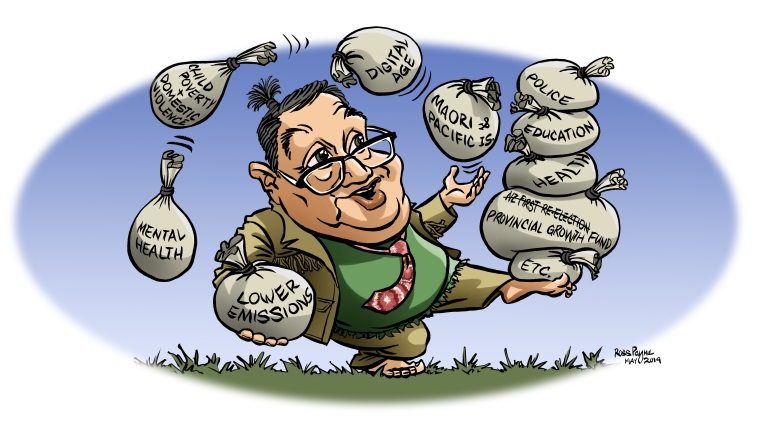
There seems to be one obvious topic missing from the cartoon showing what Grant is juggling?!
Maybe it's been relegated to the "Etc" category.....what a surprise.
Looks like mental health is the first bag to be dropped.
If I recall correctly it was one of the first of Labour's commitments to be dropped in their first term.
That's what black sharpie pens are for
totally - Flagship 1.9 bill over 4 years much fanfare huge enquiry -- but Virtually no new services yet -and failure all over teh place - so bad that the report after censorship is unreadable! -- yet we will spend more than that in the first 6 months of the year on emergency accommodation - much of it paying $280 a night for a motel room that normally sells at $100 - Epic Fail
The 'team of five million' is there to be milked for political and financial gain. Past that, it does not exist. See: Labour ruling out supporting the basic concept of not taxing people on the inflation-component on their earnings as floated by National. The same inflation that the Government mandates the RBNZ ensure happens in our economy through a formal agreement.
Justify that to people struggling with a drop in real, actual incomes after Covid lockdowns.
Of course most people want to see benefits increased, the real question is who wants to pay for it. I am sure if a stand alone survey was who wants to pay higher taxes it would get very little support. Wellness, equity, unicorns and rainbows are all nice until the bill turns up.
Anything is possible now that we can 'leverage the balance sheet of the Reserve Bank'. It's just one infinite slush fund. Full monetary debasement - here we come!!
I would say it debases the value of work, when you stop valuing people on their contribution to society and start valuing people based on ethnicity etc.
Yip, the genie is out of the bottle. Whenever the government talks about debt and budgets, you have to laugh. Why we still believe in a fiat currency is the biggest joke.
I'm not so much about increasing benefits, much more about getting the living costs down - especially for those in need. I hope the government continues to put the farce of KiwiBuild behind it and crank up social housing developments. They also really need to push forward on food costs, as NZ is ridiculously expensive in that regard.
Then think about some sort of mandatory training schemes, which aren't wishy-washy "how to find a job" types of things.
I agree that getting the cost-of-living down should be the major focus. It is to my mind far more stimulatory than either pushing wages up and/or subsidising the cost-of-living for much of the general population via the welfare system.
The government has so much more influence on cost-of-living than many appreciate.
The cost of rent/mortgages underpins every aspect of the cost of living. Every person providing a service - nurse, police, takeaway, even the mailman needs a place to rest and sleep. They are all being crushed under rent/mortgage obligation, which in turn pressures employers for higher wages. This builds to runaway inflation as businesses choose to not go bankrupt. AKA it is passed on...and on.
Without really addressing the elephant of "stupid debt fueled housing prices", how do you propose getting the cost of living under control?
Only an asset reset can do it. Yes it will be messy. The alternative of every increasing inflation through higher wages that just fuels the speculators equity leverage spiral. This has been our economy for the last 20 years, with a side bonus of tax avoidance.
Without really addressing the elephant of "stupid debt fueled housing prices", how do you propose getting the cost of living under control?
That's why I'm supporting rent controls - not a rent price freeze - as far too many rentals are already unaffordable (i.e., costs being greater than 30% of the rentier's household income). But controls that bring the cost of rented accommodation down (and yes, many landlords will find themselves in the position of negative yield but a still positive ROI, depending on what year they purchased and how leveraged they are).
House prices will fall as a consequence.
Could you expand how that's could happen pls ?
I'd apply a universal formula to the setting of weekly rents (a rent price maximum): [(RV/1000)] +/- x%
The variable 'x' would be set (on a district-wide basis to align to the valuation/revaluation of RVs) to a number that would bring the rent price for the properties in the bottom third of RVs to equate to 30% of the average household income in the district. That variable would then be applied to not only the bottom third but all rental properties in the district. The variable is reviewed and re-set every three years with revaluations by QV - and in each of the interim years, rent price increases would be pegged to the CPI.
Tenancy Services already use the categorisation by areas into the three categories: lower median and upper for their Market Rent data. This data would instead display rent maximums set for lower, middle and upper - as well as the formula and variable, so that any renter can publicly access the RV of a property they are looking to rent, in order to check that the asking rent is in line with the government regulation.
Sounds fine in theory, but not in practice. Someone somewhere will have to take the hit. Where are you going to start???
When you talk about keeping the living costs down rather than increasing benefits are you thinking remove the tax on cigarettes?
I'm not saying bring cost-of-living down as an alternate to increasing benefits. Clearly core income benefits (as opposed to subsidies, such as accommodation supplement) must be increased but in doing so we want people to be better off not simply treading water so that they can meet these irrational and unaffordable increasing costs.
So, benefit increases AND cost-of-living decreases are desperately needed.
And yes, the evidence that the cumulative tax on cigarettes overwhelmingly disadvantages those on lower incomes is unequivocal. The taxes are punitive (well beyond cost recovery for the cost-of-illness/treatment for smoking related disease) and opportunistic (government income is substantially and discriminatorily increased).
A real blot on our tax record of targeting the disadvantaged.
How about we grow the Nations economic pie, before we try are-distribution of wealth. Jobs before benefits!!!
*duplicate post*
Now that we've gone full MMT without any public debate or democratic process whatsoever, I guess every green socialist idealist is enamoured of the possibilities of utopian wish-fulfillment. Government profligacy invariably leads to massive corruption, but we don't even discuss the slippery slope we are heading down. From the enlargement of the 'election' from a day to a seemingly never-ending window, to the ongoing renaming of all our government agencies (for example: 'Waka Kotahi' and 'Oranga Tamariki'), to the unchallenged proposition that importing any less that 100,000 people every year would mean we are a nation of xenophobes - democracy is a myth in New Zealand. The most powerful person here is an unelected central banker who implements the plans of The Federal Reserve in this local vassal state.
Yes. Renaming these agencies to names that nobody understands is bloody stupid.
But this is a bloody stupid country.
I understand them and I'm sure I'm not the only one. In fact given that many were renamed to reflect poor outcomes in certain sectors for Māori, I would say they are very appropriate. Kāinga Ora and Oranga Tamariki for example.
Even if they weren't, in a bicultural country there's no justification not to rename them (or to leave them as they are for that matter).
I've only been here a few years but have picked up enough Maori to understand those names. Are you not a fan of learning?
It's good to see a language which was routinely beaten out of children just a few decades ago being restored.
Nothing to do with 'not a fan of learning'. The point was: where was the discussion around these name changes, where was the discourse, where was the public education campaign advising that 'Oranga Tamariki' is an agency encompassing all NZers whatever their race, colour, or creed - and not an organisation tasked specifically with the well-being of Maori children? Right now there is significant confusion and the high dudgeon and indignance of those who love this 'change by stealth' is not going to change that one iota.
Waka Kotahi doesn’t make sense. Maybe appropriate for a maritime authority, but land transport!?
And getting stupider by the minute
NZs monetary system has been operating just as MMT describes since 1984 when our currency was taken off of a fixed exchange rate. MMT is not a regime that needs to be voted on it is simply a description of the operation of our monetary system with a fiat currency.
You need not worry too much though as no one from orthodox economists and politicians to the general public understand it and we are told constantly that taxation and borrowing finance the government and that budget surpluses are good for us.
There is very little understanding of banking either and how that creates money.
That's not really true. A central tenant of MMT is that it is the moral imperative of the government to borrow and spend, to increase employment and economic activity. And to create credit that allows us to create wealth. Somehow.
But wealth comes from savings not from borrowing.
Then when inflation rears it's ugly head, the government increases taxes to mop up the extra money sloshing around supposedly capping inflation. "Debt doesn't matter because you can print your way out". "A government is not like a person they don't need to balance their books". Of course, aside from the fact that it is nonsense generally and has been shown to be such, repeatedly in history, the idea that you can print your way out of debt problems only applies to the reserve currency. If New Zealand cranks up the printing presses, we still have to convert to dollars to buy almost anything form overseas. If people lose faith in our currency and bail out of it, it drops like a stone. Then what?
MMT is simply another representation of the cycle of societal forgetfulness that humanity is cursed with. It's been so long since any major western economy has experienced hyper inflation that most of the people who would remember it are dead. So charlatans come along with "a new paridigm" to explain how we can defy the laws of nature and have our cake and eat it to. We don't need to save, government NEEDS to be profligate, and deficits don't matter.
This is all true. Until it's not.
Ask Zimbabwe how MMT went for them. Or Venezuela. Argentina try it every 10 years or so. They all end up in hyper inflation and societal discord.
The MMT pseudo intellects forget that ultimately debt is a promise that someone will pay you back. Printing money to pay someone back, is just default by slight of hand. And currency (in the absence of gold) is based on faith. It is the belief that you can exchange your labour for something you can then use to exchange for other things. There needs to be balance in that for it to work. And trust among all the people using it. There is no intrinsic value in fiat, the value comes from belief. It's a shaky house to be sure.
Print a crap load of money and people lose faith. They lose faith in promises. Then they don't trust their currency. Then they don't trust each other.
Things can then turn very bad very quickly.
But apparently we couldn't have house prices allowed to go down. Welfare dependency is bad, you see, except when those in dependency are investors.
However, we seem to have been protected somewhat from becoming Zimbabwe or Venezuela (so far) by the fact our money printers were spinning up after and somewhat more slowly than US dollars, those we have to convert to in order to purchase from overseas.
I think it's more to do with the deflationary hang over of the GFC.
Real wages have stagnated for years, all "wealth" is coming from asset price inflation.
Even the stimmies have been invested into stocks, via Robinhood call options largely. Doesn't sound very speculative to me.
And the S and P PE moves into the 40s. There was a time when we thought north of 30 was getting into bubble territory.
But yeah printing money is great and the government will be able to fix it all by raising taxes. Well Biden is trying so we will see.
Everything that you have said here just goes to prove that you have no understanding of MMT and have never bothered to study it.
No I've studied it. Enough to understand it's bollicks.
It pretends to be clever and insightful. But it's smoke and mirrors.
It's similar to critical race theory. Or epidemiological modelling. Or efficient markets.
Pretty ideas but they fall flat on their face in the real world.
Wealth is not, nor has it ever been, created by government printing press. Wealth comes from productivity the excess of which (savings) can be re-invested to generate further wealth. Or not if it's a crappy investment.
Explain to me how New Zealand could simply print money to repay debts in US dollars without destabilising the currency and causing huge inflation at least in US dollar terms, which matters seeing as most international commodities are measured in US dollars?
Why did the Weimar republic not get higher and higher levels of employment from all it's money printing? Why was it not able to stop the hyper inflation simply by raising taxes?
And what about Paul Voelcker? How come he was able to crush inflation by massively raising interest rates? Why didn't the US government just raise taxes to get rid of the inflation?
Because MMT is bollicks that's why.
You comments are all highly prejudicial and display a complete lack of understanding of where money comes from. If you wish to know where our savings come from then I suggest you study the work of economist Wynne Godley and 'Sectoral Balances and Stock Flow Consistent Modelling'. Godley worked for The British Treasury by the way so he knew what he was talking about. Some homework here for you,
https://en.wikipedia.org/wiki/Wynne_Godley
https://en.wikipedia.org/wiki/Sectoral_balances
https://www.economicsjunkie.com/sectoral-balances-and-private-saving/
https://gimms.org.uk/fact-sheets/sectoral-balances/
https://www.bankofengland.co.uk/quarterly-bulletin/2014/q1/money-creati…
https://www.rbnz.govt.nz/research-and-publications/videos/money-creatio…
Economist Warren Mosler also has this to say on government borrowing,
I would cease all issuance of Treasury securities. Instead any deficit spending would accumulate as excess reserve balances at the Fed. No public purpose is served by the issuance of Treasury securities with a non convertible currency and floating exchange rate policy. Issuing Treasury securities only serves to support the term structure of interest rates at higher levels than would be the case. And, as longer term rates are the realm of investment, higher term rates only serve to adversely distort the price structure of all goods and services.
I would not allow the Treasury to purchase financial assets. This should be done only by the Fed as has traditionally been the case. When the Treasury buys financial assets instead of the Fed all that changes is the reaction of the President, the Congress, the economists, and the media, as they misread the Treasury purchases of financial assets as federal ‘deficit spending’ that limits other fiscal options.
https://www.huffpost.com/entry/proposals-for-the-banking_b_432105
Those last few questions show that you have no idea of what MMT is; what actually happened at Weimar (the repatriation of debts in foreign currencies to hostile powers); or even the basics of the oil-price driven inflation of the 70s (and how it was actually brought back down by energy policy changes and the end of the embargo). Study harder.
It certainly is tedious to read your misrepresentation of, and fantasies about, Modern Monetary Theory.
The world is being mugged by a speculative and dominant financial, insurance and real estate sector that have almost completely displaced the productive economy. The big corporates sponsor the rampant exploitation of environmental and human resources - hoovering up the proceeds and funneling it (sans tax) to the share and asset-owning classes. Govts have forgotten they are elected to lead - seduced by the suited lobbyists. BUT NO!!! It is those damn green socialists and the re-namers of Ministries that should be the target of our fury. Jeez.
'Green Socialists embrace MMT', that is my point which you have conveniently side-stepped. I mentioned a faustian pact & there obviously is one, otherwise we would not be heading down this road. Both Trump (representing the people you loathe) and Biden (representing the people you adore) have been operating the same 'debt & deficits / monetary debasement for benefit of elites' system, with the Federal Reserve having their hands on the tiller.
I didn't side-step that comment - I ignored it because it doesn't make any sense at all. But, since you asked....
You are clearly confusing MMT (an explanatory macroeconomic framework that recognises the role of money and banks and is based on how Govt finance actually works) with Quantitative Easing (an asset swap between reserve banks and commercial banks that increases the liquidity of financial assets in the economy). QE does not cause monetary debasement - if you don't understand why not, go and do some reading.
Your Faustian Pact comment is too 'down the rabbit hole' for me to entertain.
On Trump and Biden. Firstly, don't presume to know my views on either. Secondly, you are making the common mistake of assuming the villain in the story is the character you like the least. The reserve bank is a bystander.
Sounds like nothing really, some pseudo scientific waffle which we seem to be constantly saturated in nowadays.
It would be difficult to comment on his modelling "evidence" as his link leads to a review of his book and an opportunity to buy it at nearly 100 euros!!!
GDP is unequivocally a rubbish measure of society and we need better measures and more focus on human needs such as mental health. The environment is obviously a critical part of the formula. Long term planning is also a no brainer but it would seem unlikely in our three year election cycle.
The data on minimum wages is mixed. I would simply make this point. The weekly expenditure of the poor is disproportionately dominated by food costs compared to wealthier individuals. If the minimum wage increases and supermarkets and many parts of their supply chain, use minimum wage labour, are we really to believe that supermarkets will shrug their shoulders and absorb those wage costs, as lower profits, for the good of society?
I am sceptical on that to say the least.
If supermarkets pass the cost on, that will disproportionately hurt the poor the most. As the poor are likely on minimum wage, what has been achieved, aside from some inflation?
This would be just one unintended consequence. There will no doubt be many others. Interventions seldom (if ever) give just the intended result.
The government cannot magic wealth through policy. It has to come from savings and productivity.
Of course this does not really help the poor. But to me increased wages have to come from the poor themselves. If they cannot exist on what they are paid they should not do the work. Easy for me to say and of course that is also not an option if you have hungry mouths to feed.
In which case wage increase probably comes from where it has often come from at the margins, self organisation group bargaining and strikes (like what happened with care workers). Of course that requires the poor to be educated enough to understand that. Which is itself a challenge.
No easy answers to difficult questions unfortunately. But waving the wage wand by government seems too easy a solution to be effective.
Precisely.
It's not what you get paid, but what that pay will buy you.
And the lower down the food-chain you are, the more important that is.
Food, Shelter and Clothing are the necessities none of us can do without.
The cost of the most pay consuming item amongst that lot - shelter - has the most profound effect on the well-being of our society, from the bottom, up.
Agree, what is important is what that pay will buy you and have noticed that in last few months everything has gone up by 20% to 30%.
Just went to my barber who use to charge $20 is now charging $25 .........a friend is looking for a rental and houses that he was seeing earlier for $550 to $580 is now asking between $620 to $650.00 and a house that was earliest listed for $620 went for $680.
Of the three basic necessity food, clothing and shelter - have turned shelter in casino chip ....
$25.....that is a very cheap haircut these days!
Where I do is still cheaper $18 and it used to be $15 and another place where I did use to to $28 which now is $35.
So what is moral of the story Tom Valen.
Not to forget a colleague of mine bought a house for 2.6 million and said is cheap ....so.....
I am paying $10 for my haircut in Rotorua, it has been that price for years.
There are a couple in Central Auckland charging $25. Better results than Alcatraz too.
$25.....that is a very cheap haircut these days!
In Japan, about JPY1,000 ($13) at a chain barber. Very good.
Buy some clippers, I'm now getting mine cut for free. When your over 50 you really don't care what it looks like, your just glad to have loads of hair to cut in the first place :) Whack a number 6 in for the sides and a 20 on top, done in under 10 minutes. You too can look like Gonzo on MAFS in an instant.
At least it's consistent right? Lol Doesn't hurt to learn how to fade and layer etc. Just don't tell everyone about your skills or you'll be in high demand.
I'm early 30's and have clippered my own hair using a cheap Warehouse set for years. I don't even bother getting the wife to tidy it up any more.
As much as I do enjoy a good hair cut, it's not high on my list of priorities.
A man of my own heart. I take this approach and use $15 Tina on Botany Rd every 2nd cut. Spend less, save more. Compounding interest, play the long game and retire early.
I used to get my wife to do the same. Then she said I am prepared to pay someone to cut the lawn so I can pay someone to cut my hair.
If your cut is fairly simple, an option is to have a relative help with a trimmer and scissors. I learned to do this for a relative and it takes me all of 10 minutes. Not everyone has an eye for it and you do have to learn a few tricks, but it saves them a lot of money through the year and the quality is consistent, which they always complained about from barbers. The equipment easily pays for itself. Haircuts for females have always been pretty expensive and trickier, but some styles can be quite easy to do, particularly for long layered hair: https://youtu.be/ykkLUsJPdtk The money I've saved from doing this myself is worth the time spent learning.
Pretty lucky to live in NZ if our most intense stresses are equity and environment. I would file those stresses as a mental health issue, a normal person is too busy living life, to worry about trivialities.
The fact that many consider the environment a triviality or a 'nice to have' rather than the foundation and source of all life is something of a problem.
I bet you have a lot of problems...
This is the most left wing government we’ve had since Norm Kirk. Maybe longer.
There’s going to be a lot of damage to be repaired before this is over.
Jacinda did a nice job with COVID though. Now if she and her government would just go away all would be fine and we’d have nice memories of her.
It's a left wing government operating in a world where there has been a statist takeover due to a faustian pact between the mega-wealthy elites and the utopian socialist dreamers. Now the state is to provide bank funding and hammer interest rates at any sign they are increasing, and one arm of the state (the central bank) is directly funding the activities of another arm of the state (the government). Savers can go boil their heads, malinvestment is everywhere, corruption is rife, zombie companies are endemic, and markets are artificial and running on endless stimulus. Price discovery is dead, creative destruction is dead, and capitalism is having the last rites read over it.
David Harvey describes it thus;
https://en.wikipedia.org/wiki/Accumulation_by_dispossession
If you want a word for this post-capitalism era, he goes for 'The New Imperialism' era.
Lol what!? What alternate reality do you inhabit?! This government is centre-left at best.
Given it started life (i.e., got elected largely on) its 'Budget Responsibility Rules' - you could say it was right of centre on initial formation.
What they got elected on has no relation to what they do ( Kiwibuild .. Light Rail.. etc. etc .) - so "what they got elected on" does not really describe them at all .
Fresh restart should not be extra dole but opportunity and level playing field for own.
In NZ, no government can afford to change status quo though may tweak a little bit here and their for sound bytes to media and public without any meaningfull change.
Best example has been the new housing policy though good but will it help in controlling future speculation funded through interest only loan.
Wage increase is good, can take up to $100 per hour but what is the point if no attention and investment on productivity. Small and medium businesses have realized that instead of paying rent and wages, better to flip house as also more safe than business as Jacinda and Orr has bigger stake than person speculating, so will go all out to support by action or by their inaction...like IO loan.
Maybe we should quit with importing workers for largely unskilled work so the labour market can find its equilibrium?
A bunch of meaningless waffle.
Oh come on. Which part of imagining the policy maker as gardener wasn't specific enough for you?
Comment of the day sir! Definitely laugh out loud on that one, thanks for that.
Budget presents a historic opportunity to start...they may but than will either pass it on to another agency, committee or person or will come up with an announcement date for future announcement.
Did Housing announcement not presented a historic opportunity...started but than passed it on to RBNZ with a date for future announcement.
Jacinda Arden Government is famous not for announcement but for announcing date for future announcement and it keeps continue as tomorrow never comes.
Waffle waffle waffle, vague vague vague, blah blah blah.
And to top it off, the "do the right thing" statement, as if his opinion on what the government should do is the only right way.
Over the past 70 years I have witnessed so many increasing social and economic issues such as growing inequality, increasing poverty, social disconnect, poorer wages, homelessness, housing affordability, failing infrastructure . . . as well as many environmental and sustainability issues. Many of these issues have emerged in the past 40 years with the then Rogernomics "economic reset" largely based on competition. While that reset at the time was much needed we are now in a similar state where we have got to ask "Is the New Zealand we really want?"
Despite Robertson alluding to that need and mooting an economic reset, and Jacinda referring to a transformational government, I have not seen discussions around neither. Although hopeful of Labour over the past four years, Government action has been reactive. Yes, Covid required the Government to be reactive. However the majority of their current actions - such as over the past month - continue to be reactive including their announcements regarding housing late last month, raising the minimum wage, stopping flights from India.
Raising the minimum wage for example is just both simplistic and tinkering . . . . it is not addressing underlying causes of poverty and low wages.
In the same vein, if rents continue to rise I am not going to be surprised to see some sort of attempt at legislated rent control . . . again reactive and tinkering and not addressing the underlying causes.
We are at a time where there needs to be big discussions and that is not happening . . . and focusing on Covid - while has been effective - it is simply a distraction.
Promises of economic reset, transformational Government . . . I'm not seeing it. Simply solving immediate crisis issues by reactive legislation is neither of these.
NZ runs fairly large and consistent current account deficits which drain income from the economy and lowers our standard of living. We suffer from a lack of business investment to remedy this while putting too much money into the housing market instead.
We also have a tendency to sell off our profitable businesses to foreign owners instead of holding on to them. There has also been a lack of investment in our infrastructure which now all needs upgrading.
If our profitable businesses are consistently going overseas does that not imply that we aren’t doing enough to retain them?
Additionally if our businesses are going overseas as soon as they become successful then it would imply that we will never have enough investment in business locally. Invest > success > leave (NZ does not reap the rewards), Invest > fail > stay. Money going into housing is irrelevant.
Business owners often look for the quick profit or it may come down to the choices that large shareholders such as ACC and The Superfund make.
Very true. It was for this very reason I voted for John Key twice, before giving up in disappointment that he never got around to addressing the housing crisis and productivity, two major campaign planks.
We need Robertson and Ardern to step up and address these two issues. Not another John Key show up, look around, and leave.
It is promising that they have asked investors to contribute a little more of their fair share to NZ, but there is plenty more to be done and requiring serious change.
A long winded way of saying: we will fleece you and through our witholding or granting of public funding we will decide for you what is of value and what is not.
Given that increasing the minimum wage has no down sides according to this report, why not just set the minimum wage at $50 or $100 an hour?
Why not allow equity and allow disabled people the minimum wage as well when their performance and work is not affected.
How about an adjustment to the $390 per week threshold before student loan repayments at 12% kick in? (edit: went fron 380 per week up to 390 per week from 1 April 2020, a saving of $1.20 per week...)
This threshold has never been adjusted for inflation since inception.
A min wage earner pays $50 a week in student loan repayments - Surely this is too high a proportion of disposable income (likely next to zero disposable after living costs).
It needs lifting significantly.
Balance by adding a higher rate (over 12%) for salaries over 100k who should have the disposable income to absorb the increase in repayments.
Logic 101 - unlikely seen under this lot.
Why does it need to be over 12%? The Australian rate scales with income and maxes out below 12% once you hit $135K. Their minimum repayment threshold is also 2x ours. Our tax system is out of whack with how much it costs people to actually get by in this country.
Yup agree, I haven't looked what they do overseas.
Lift the threshold to 40k - anyone making under that doesn't have disposable income in this country.
I don't understand why Labour had their stupid first-year free policy for tertiary education.
Far more sensible policy would be to cut repayments to 6% and have the government match them to 6% (a la Kiwisaver employer contribution) for earnings up to the average (or median, whichever) wage. You know, a policy that actual voters could vote for, unlike the first-year-free policy that mostly affects people who aren't eligible to vote.
That would effectively be a 6% tax cut aimed at a large swathe of the country with student loan debt, not a small number of whom never actually finished their studies or have particularly benefited from what they did achieve.
Good idea to connect contributions from the earner and the taxpayer. Suggest if we make this for people working in NZ that this is a good way to gain a return on the investment that the country makes in education. I.e. rewarding people for working in NZ rather than educating a workforce for other countries.
(Of course, we'd still need to address housing policy to ensure that 6% contribution isn't massively less benefit than the opposing incentives to leave NZ.)
First year never made any sense.
Basically a free party year.
Should have been at min free second year after passing first year, with extension to first and second with it refundable via student loan if drop out after year 1.
Simon, My son is at University, doing first year engineering. First year course fee free is an absolute blessing, would not be there without it, still about 18k in hall of residence fees on top of all other incidentals. At home now for Uni holidays, first week 40hrs employment, next week 30 hrs and last week similar. Working hard studying hard and some responsible socialising for balance, hardly "Basically a free party year"
First year never made any sense.
Basically a free party year.
Should have been at min free second year after passing first year, with extension to first and second with it refundable via student loan if drop out after year 1.
They should have made the last year free not the first. Create an incentive to finish the course.
'Imagine the policy maker as a gardener, looking after a ‘wellbeing garden’ on behalf of current and future generations.
As policy makers are politicians, who are gardeners and NZ is the garden. Will look after flowers representated by so called investors, rich....and average Kiwi and FHB are weeds to be used as needed and killed.
As per the article :
The fifth represents equity and fairness achieved by universal access to these outcomes.
Really....
Maybe the Govt should just focus on the broad economic and social framework settings and allow citizens and community groups to organise their own well-being.
Same with workplaces that seek to add a layer of ‘well-being’ after overriding employee autonomy and reasonable workloads.
Do we need the Govt meddling and authorising every aspect of life?
Good economic settings would allow home ownership for most as an example.
Oh vomit. All this wellbeing stuff is social engineering.
Govt: Please abolish the central bank so money can price itself, punish polluters (plugging the massive gap in capitalism), maintain a basic safety net, and apart from that leave us alone and try to make yourself less important.
PS. We have an English word for whānau so using it here is just virtue signaling. Write the whole thing in Maori if you like, but the odd noun is woke bullshit.
We had an English name for Mt Taranaki too once. Now, seeing someone write or refer to Mt Egmont is becoming more and more rare. Language develops - I like that ours is moving toward a sort of English/Māori hybrid and I don't see that as 'virtue signaling' but rather the on-going and maturing unique NZ identity.
Interesting musings.
New Zealand is certainly a land of political opportunity, unfortunately I suspect it always will be.
NZ is screwed. It wants to have the fall back of a lovely social welfare system for health, education, unemployed, sick and the old. All free with largesse to abound. Alas, we are not a rich country and expenditure for the above isn't meeting demand. Add to this the increasing number of vermin in NZ and things will only worsen.
Definition of Vermin: People having kids they can't afford to feed, clothe, house whilst not instilling any values conducive to interaction in a modern society. Frequently the products of long term social welfare beneficiaries with gang/drug affiliations.
Not wealthy? We are all as rich as can be - just look at sky-high house prices & the Billions that Robertson has to throw around. There is no limit on what we can spend, we'll just 'leverage the balance sheet of the Reserve Bank'. It's the ultimate cheat code in the game: if you run out of money you just 'leverage the balance sheet of the Reserve Bank'. MMT to infinity!!
"Definition of Vermin: People having kids they can't afford to feed, clothe, house whilst not instilling any values conducive to interaction in a modern society. Frequently the products of long term social welfare beneficiaries with gang/drug affiliations."
What about property investors buying houses they can't afford to pay for but expect somebody else to (usually those you mention above) - are they also vermin?
No. Most property investors operate both within the law, and adhere to current tax legislation. Often vilified and seldom loved. But I'd rather a Mum and Dad property investor as a neighbour (est. 70% own only 1 x rental) than a LONG term social welfare beneficiary who continues to have children whilst sucking off the public tit.
IO-I guess anyone who sells a product or provides a service to those who are destitute needs to be tar and feathered. Imagine the irony of owning a liquor store in a low decile area, or selling cigarettes at extortionate prices. I guess the latter dairy owners deserved to be robbed.
Major issue with pension payments in NZ. Instead of bitching, the Gov should increase mandatory payments and underwrite. Consider allowing folks to be involved in the NZ Super Fund. Sweet Jesus, I envy their returns.
Too may whiners on here, and in society in general. Don't see too many Chinese at the dole office. Work ethic and pride. Too easy to sit around and bleat poverty while sitting in a state house. FFS, try working 60hrs/week and see how your position changes.
Over 50% of our social welfare budget is given to old folks regardless of how rich they are. Then we give billions in subsidies to property investors who can then turn around and evade tax by pretending to have never bought for capital gains.
Meanwhile, our welfare for actual poor people seems harder to get or stay on than in the days when - for example - John Key grew up in a secure state house, or Paula Bennett got her first house with a housing corp loan and a solo mum benefit. At the same time, we have politicians using 'private superannuation schemes' to work around the law that you cannot claim a benefit to rent your own house, another extraction from our poor exploited working taxpayers.
Good points. We have a lovely friend who turned 65 before my husband did. He's what I term as very comfortably off. Top 10% salary bracket for years and years. Enjoyed stable employment throughout his life and has a partner who has also worked full time once the children were at school. Neither have a uni education. Own their own architecturally-designed home outright, plus a number of investments including other properties. Wise with money all his life.
I found it funny, when he advised my husband to ensure that he applied for Super well before his 65th birthday - because if you waited until after your birthday, there was no back-pay :-).
Did you vote for Helen Clark and/or Winston Peters who did away with Jim Bolger's surtax on national super, which addressed the issue
many of you are complaining about?
I think you've got your history wrong;
Labour tried to fund it by cutting the cost of superannuation through a surcharge - essentially a form of means- testing the universal benefit.
National won the 1993 election, at least partially, based on Jim Bolger's definitive promise - "no ifs, not buts, no maybes" - to abolish it.
Sounds to me like Bolger axed the idea of means-testing - and largely won the election based on that promise - then reneged (brought it in anyway).
https://www.stuff.co.nz/the-press/opinion/2462237/Super-genie-out-again
A good reason that Super. is means tested and eligibility moved to 68 (announced 5 years in advance to give seniors time to prepare).
Vermin.. wow. You mentioned your belief in social darwinism before, so what do you think we should we do? Exterminate them? There a plenty of people who can afford to have kids, that make zero effort to instill any values conducive to a decent society. It's certainly far easier for them to have the time and resources for it. As long as they operate under a thin veneer of civility and their conduct is legal, it doesn't matter how detrimental these peoples actions are for the good of society, right? You seem to think everyone that is down in the mud is there by choice and reveling in it. Has nothing to do with boots on faces.
You misread. If you are taking a Government handout because your situation is dire, then you should not be bringing children into this world and asking the state to support them. Its rude, lazy and plain ignorant.
Social Darwinism would advocate sterilizing these people. As I'm not a Nazi, I have a great solution-pay them extra for not having more kids eg $1000 payout if they DON'T get pregnant.
After reading the authors CV he must have had a Damascenian moment to come up with this.
Isn't it time for Maori to stop blaming non Maori for there wows?
Delete this
I will add some clarity. All of Maoris woes are because of colonization. 100%. Any alternate view is RACIST. How dare you point the finger. Actually, the biggest impediment to Maori advancement is Maori themselves. Jews dont blame Nazis for their current situation. They just get on moving ahead
But do not use any negative reference to Maori, you will be vilified. Disclaimer I have white privilege, boomer etc.....yawn
Thats because the Jews are some of the smartest people on the planet. Ultimately they were targeted because they were so successful but they learned and now protect themselves.
that's right - if it is tricky to argue with - delete it .
I don’t understand what this means. The only thing policy proposal I can see here is that we should fund vocational training. Is that what “well-being” is?
I didn’t understand the head of the Productivity Commission either. Do I just have exceptionally poor reading comprehension? Help.
Given that you couldn't think up an original pen-name, I suspect you do indeed have poor comprehensive skills.
Or an agenda.
Or both
It's one of the best articles on interest.co.nz in a long time - and from an economist.
He's so right that the big issues of the day are equity and environment. And yes, this budget is this Labour Government's chance to be bold. Nothing short of a re-set. It is a 'time' in history not unlike the 'time' when the Lange Government did a 're-set' - which moved us from a protectionist state to an open market.
Now we need to be moved from a neoliberal state to a wellbeing state and the foundational work by Treasury regarding that framework is good. Now the hard part - implementation.
https://www.treasury.govt.nz/information-and-services/nz-economy/higher…
The professor is right - we can design a governance system such that no one is left behind.
People like the author and you are overlooking the disastrous outcomes of socialism in the former Soviet Bloc,
not to mention the UK before Thatcher and NZ before Roger Douglas.
Not at all ignoring history - but what we had before Lange/Douglas was not socialism, but protectionism. We've been a welfare state for years and years, that is not to be confused with a socialist state, as many of the dictatorships of today (and from the former Soviet Bloc) call themselves. They're not socialists, they are dictators.
Where the market reforms of the 80s are concerned, opening up our economy was absolutely necessary. That implementation in both NZ under Lange/Douglas and in the UK under Thatcher was what was poor (too hard, too fast). Reagan did a much better job of it - and Australia probably made the transition better than all of them.
Socialism is a state in which the workers own the means of production. I don't think it has been implemented anywhere in the world.
Wellbeing is a completely different concept altogether.
If interested in the application of the concept further - here is a US survey and subsequent ranking of well being by state;
https://wellbeingindex.sharecare.com/wp-content/uploads/2018/02/Gallup-…
Implement a fresh policy programme?
How much of the old policy programme did Labour actually deliver on??
Lack of execution intelligence is exactly that..
Tax and spend. Tax and spend. Tax and spend. Tax and spend. Tax and spend. Tax and spend. Tax and spend. Tax and spend. Tax and spend. Tax and spend. Tax and spend. Tax and spend. Tax and spend. Tax and spend. Tax and spend. Tax and spend. Tax and spend. Tax and spend. Tax and spend. Tax and spend. Tax and spend. Tax and spend. Tax and spend. Tax and spend. Tax and spend. Tax and spend. Tax and spend.
Gst at 15%, incone tax on the high performing hard working is up again. The only untaxed area is the sacred cow of property.
Every year is a historical opportunity- so is the next.
Love the Green shills flooding the comment section.
Printing Money socialissed as QE/FLP.. Stimulus, subsidy, grant, deferral.. you can rename all you wants for any natural distortions/interventions...in Med. they call it most of the times to save patients..but there's always consequences.. sadly, not all portrayed to be good.
The issue of Chief and Senior Executive salaries and a formula to assist reasonable levels of reimbursement is also required as part of a reset. This area despite significant overseas research saying they are "out of control and not justified," remains a cone of silence . Current levels are like housing , out of control. A fit for purpose salary, and doing away with bonus or share allocation performance measure's is the way to go. This is part of the equity issue, and needs to be addressed.
We welcome your comments below. If you are not already registered, please register to comment
Remember we welcome robust, respectful and insightful debate. We don't welcome abusive or defamatory comments and will de-register those repeatedly making such comments. Our current comment policy is here.