
Two thousand Covid-19 cases a day, thousands in hospital, hundreds in intensive care. Welcome to springtime in New South Wales.
When the history of Australia’s Covid-19 pandemic is eventually written, what happens in NSW over the next ten weeks will be a crucial chapter.
Like the rest of the country, NSW adopted a ‘zero-covid’ strategy for the first eighteen months of the pandemic. Now, in the face of a major outbreak of the highly transmissible Delta variant, the state has been forced to abandon that strategy.
There is no shortage of parties blamed for the state’s current predicament – the unmasked, unvaccinated limo driver who introduced the virus into the community, Prime Minister Scott Morrison who was responsible for the slow start to the nation’s vaccine rollout, NSW Premier Gladys Berejiklian who instigated Sydney’s initial ‘too late and too light’ lockdown, or the many Sydney residents who have breached the lockdown rules.
Take your pick. It’s all academic now. The bottom line is that eliminating Delta in NSW is no longer possible. In the Premier’s words, “We have to accept that living with covid is a reality not an option”.
The new strategy is vaccinate, vaccinate, vaccinate. And make sure the hospital system is prepared for the inevitable onslaught.
To be fair to the Premier, her strategy is much more optimistic than that. In a remarkable case of making a virtue out of necessity, the Premier has turned her loss of control of the virus into a positive plan to reopen the state and return some kind of normality to the lives of its eight million citizens sooner rather than later.
Reopening, and the freedoms that come with it, are contingent on rising vaccination rates. There will be no single ‘Freedom Day’ of the kind experienced in the United Kingdom. Rather, this is an incremental process.
The two major milestones for reopening NSW are 70% and 80% of eligible people being fully vaccinated. Under current projections, those milestones will be reached by mid-October and early November respectively.
The details of what will happen then will be set out in a road map to be released by the Premier this week. To date, she has only made general comments about what to expect, such as the ability to go to the pub again at 70%.
Transparency is obviously important so that businesses and institutions can start planning now for reopening.
The elephant in the room is the coming divide between the vaccinated and the unvaccinated. Many of the freedoms returning in October and November will only be available to people who have been fully vaccinated. For example, the policy in pubs will be ‘no jab, no pint’.
Limiting freedoms to the fully vaccinated serves two purposes. First, it assists in controlling the spread of Covid-19 because the virus is less transmissible among vaccinated people. Secondly, and perhaps more importantly, it acts as an incentive for the unvaccinated to get vaccinated. As the Premier said last week “Don’t be left behind … When we start opening up at 70% double dose, it will only be for those who are vaccinated”.
Whether it is this message, the fear of illness, a sense of community obligation, or some combination of these, vaccination rates have taken off in NSW in recent weeks. The change is especially acute in the Western Sydney hotpots where linguistic, cultural, and religious issues were seen as barriers to vaccination. From a slow start, first dose rates in many of these areas have quickly climbed above 80%.
The NSW Premier’s fundamental shift from a zero-covid strategy to one of living with covid rests entirely on a rapid vaccine rollout. She has been lucky that the Prime Minister has been able to deliver the necessary Pfizer vaccines. In just the last month he has rustled up an additional one million doses from Poland, half a million from Singapore, and four million from the UK.
The success or failure of the Premier’s new strategy may ultimately be determined by the choice of 70% and 80% full vaccination as the key milestones for reopening. Like all sensible politicians struggling with this pandemic, she asserts that the choice is based on ‘the medical advice’. According to the expert modelling, the levels chosen will enable the provision of greater freedoms without the number of Covid-19 cases blowing out and the hospital system being overwhelmed.
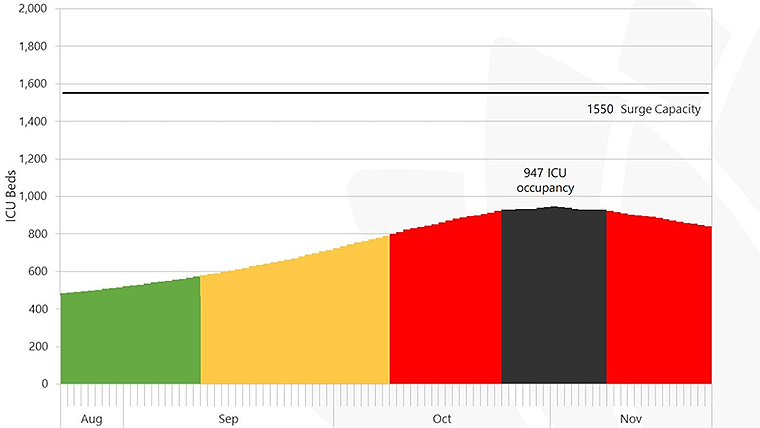
The daily number of new Covid-19 cases should peak in the next two weeks. Hospitalisations are expected to peak in later October. As of 8 September, NSW has approximately 1,200 Covid-19 patients in hospital of whom about 190 are in intensive care. Hospitalisations are projected to peak somewhere between 2,200 and 3,900 with those in ICU approaching 1,000. The latter would comprise the usual ICU population of about 400 plus an additional 500-600 attributable to Covid-19.
Fortunately, NSW has used the last eighteen months to significantly increase its ICU capacity from about 600 to 1,550. The NSW Health graph below shows projections for ICU occupancy in the coming months. It indicates that the new ‘surge capacity’ should cope with the peak demand.
Source - NSW Health
The death toll so far from the current NSW outbreak is around 130. Projections suggest there will be hundreds more, rather than thousands. Covid-19 is primarily a killer of the unvaccinated. The rising rate of vaccination, together with rapidly improving methods for treating Covid-19, will limit deaths.
Perhaps in an attempt to lessen the shock, the Premier has pointed out that before the pandemic NSW’s average annual death toll from the flu was 600-800 people. She says that “it is a scary time, but it is also a time for us to look to the future with optimism and hope”.
The Premier’s task of selling her plan is aided by ‘lockdown fatigue’ and frustration at restrictions on travel, both within Australia and internationally. There is a growing recognition of the social, health, and economic costs of NSW being ‘closed’.
Tourism, entertainment, and educating foreign students are all significant contributors to the NSW economy that are suffering under Covid-19 restrictions, particularly the closed border. Last week, Netflix announced that it is moving production of the latest Chris Hemsworth movie Extraction 2 from NSW to the Czech Republic. This is rumoured to be attributable to the uncertainties in Australia created by Covid-19.
No doubt the Premier is alert to the economic benefits for NSW if it becomes the first Australian state to reopen and start ‘living with covid’. First mover advantage will give it a competitive edge over Victoria in welcoming back foreign students and over Queensland in attracting foreign tourists and TV producers.
Prime Minister Scott Morrison is an ardent cheerleader for NSW’s new strategy. Like the NSW Premier, he is keen to reopen the country’s borders. In his words, “whether it's the tourists, the students, the skilled workers, the connection with the rest of the world, the trade that comes from that - all of that is essential to Australia's future prosperity”.
In a sign of support for NSW’s strategy, Qantas has announced plans to recommence flights from mid-December to the UK, the US, Singapore, Canada, and Japan. It will be strange indeed if Sydneysiders are able to fly, without hotel quarantine at either end, to London and New York, but not to Perth and Auckland.
Time will tell if NSW’s new strategy is a success. The stakes are high for the Premier and for her state.
Achieving ‘covid-resilience’ was never going to be easy for Australia. The Economist expressed it well last week – “Throughout the pandemic the zero-covid countries have been the envy of the world. The final stretch, however, will be their toughest.”
Ross Stitt is a freelance writer and tax lawyer with a PhD in political science. He is a New Zealander based in Sydney. His articles are part of a new 'Understanding Australia' series.
We welcome your comments below. If you are not already registered, please register to comment
Remember we welcome robust, respectful and insightful debate. We don't welcome abusive or defamatory comments and will de-register those repeatedly making such comments. Our current comment policy is here.