
Bernard Hickey details in this third of our Top 10 charts for 2010 how the Reserve Bank's view of short term interest rates has changed markedly over the year.
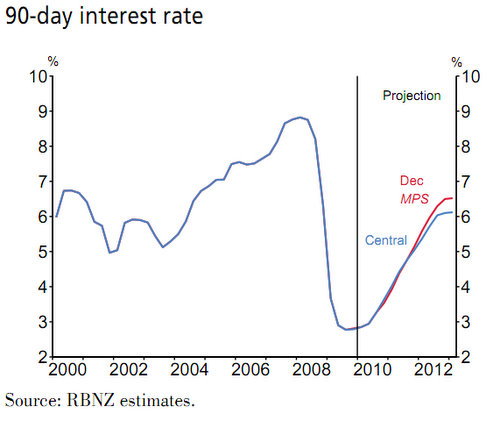
Back in in its December 2009 monetary policy statement, the Reserve Bank forecast that the 90 day bank bill rate would rise by 370 basis points from the 2.8% then to a peak of 6.5% by the March quarter of 2013.
Seeing the need to tighten loose monetary policy to control inflation, the Reserve Bank hiked the Official Cash Rate by a total of 50 basis points to 3% in the middle of 2010.
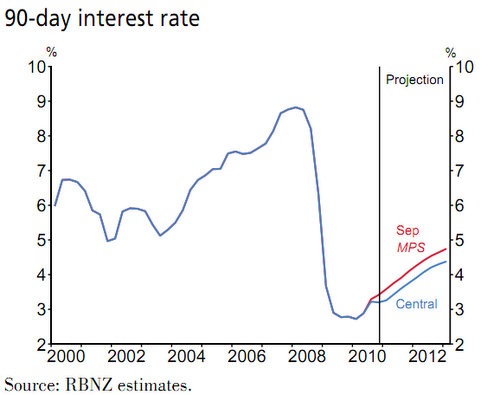
But by the end of the year the Reserve Bank was forecasting 90 day bill rates would only rise 120 basis points to a peak of 4.4% by the March quarter of 2013.
What caused the Reserve Bank to radically lower its forecast for interest rates?
The recovery that was supposed to be in full swing by the end of 2010 had dried up and gone away.
GDP grew just 0.1% in the June quarter and actually fell 0.2% in the September, meaning the New Zealand economy barely avoided a double dip recession.
Consumers were reluctant to take on more debt and the September earthquake in Christchurch gave the economy a jolt in the quarter. The housing market slowed again.
Growth in America and Europe was slower than expected, although China and Australia continued growing faster than the rest of the global economy.
The Reserve Bank also saw inflationary pressures seeping away, despite the expected one-off boost from the GST increase to 15% from 12.5% on October 1.
Here is the bank's December 2010 forecast track for the 90 day bill rate below. The bank doesn't publish its Official Cash Rate forecast track, but it is unlikely to be too much different, given the 90 day bill rate is usually 30 to 40 basis points below the 90 day rate.
Here was the Reserve Bank's forecast track from its March 2009 Monetary Policy Statement, which included the December track (in red) below.
It shows how much the Reserve Bank has lowered its forecast track for rates through the year as the economy has slowed down.
32 Comments
I bags going first!
I don't know why we even care anymore these days as to what the Reserve Bank is doing with interest rates?
no-one takes much notice nowadays as to their effect on the sad ole housing market and any movement has about a one day affect on the export dollar and then global forces kick back in.
we're at the mercy of those global markets as we get buffetted around ( sorry, Warren) and Bollard and his levers on interest are about as important a bonnet ornament on a Jaguar !
But wait!..do i hear the sounds of the Euro crashing into oblivion in 2011?...all hands to the pump as Al Boll put's on his sou-wester, grabs his Fishermans Lozenges and primes those interest rates....what?....nothings happening?
Wet up your way is it Rob?...got a bit windy down here...I think Bolly is on holiday....Key sure is...English has popped off to polish his spin...I hear the US housing mart is in trouble again and the consumers put away their pennies...bit like us...Kiwi climbing back v the au now that the aussie housing market is facing a cliff edge...wonder how many rich Beijingers will drop down to have a splurge on merino sox and possum jumpers...now a few million Party members in town would be a boost for sure.
what's your new years resolution , Wolly?
To be resolute Rob...and to try not to giggle every time I hear English or Key speak of a fiscal surplus in our time.
Love the comment above about inflation "seeping away"....harhaaaaaaahahaha oh that is a great new years bit of spin....wonder what the peasants think of that when their rates demands turn up and the insurance bills and food bills and fuel bills........de dum de dum.
The biggest inflationary pressure is the Bernanke's ZIRP for interest rates.
Lots of new, imagineered, very low cost dollars looking for a home.
that's why i love all my thousands of gold equities..i tuck them in every night and thank helicopter ben for helping them grow into a small but well- fed fortune...don't own any real gold, just buy into the place that makes the stuff!
How do you "make the stuff" Rob?
With a particle accelerator?
Well, it goes like this young Wolly...you gather around with a hot cup of cocoa whilst Uncle Rob of the North tells you a tale that goes right back to the gold rush days in Gabriels gully.
firstly, young laddie....they dig in the ferkin' ground and haul this yellow metal out by the tonne and then they....now, buggar off and help your mother with the dishes !
Good try Rob....'extract' was the term you should have used....unlike Bernanke poo, you can't 'make' gold.
that's the trouble with you old people..you take everything literally!
All part of your education Rob....the only "making" going on involves those scamming the HongKong buyers who bought cheap stuff and discovered ingots of alloy....oh and the Fed of course who have a mountain of gold plated Tungsten ingots in Fort Knox vaults.
I suggest you go to the Whare-house and buy the" Best of Roy Orbison" and play it loudly !
"the New Zealand economy barely avoided a double dip recession" perhaps wishful thinking? I wouldn't bet against an H2 2010 recession.
Here is a question not asked and therefore not answered to date:
What would have happened in 08 had the govt opted to allow the bubbles to collapse as they have in Ireland?
How many "bubbles" do you see? Any one in particular?
Or , what would have happened in '08 if Winsome Peters got 15000 extra votes ?
The Clark & Cullen government would still be running the show , downhill . How could Cullen deal with the GFC , as he was obessed with spending an ever greater share of the country's GDP . Government spending rose by 50 % in his 9 years as Finance Monster . How much would that have increased to , after 12 years !
As badly as we feel JK and Wild Bill are , how atrocious the alternative could have been .
Indeed. Can we pinpoint where the 50% went....what can be chopped off on Jan first?
Wait, what?
Wasn't there an article recently doing the rounds explaining why old gen Cullen was focused upon saving like a granny, while young Turk Key from the spendthrift generation was "not afraid" to borrow and spend?
Ah...of course...GBH and Wolly are looking for yet another excuse to bash "socialists"...any excuse...even if it's not based upon any facts whatsoever. Gotcha.
Who needs an excuse , to bash the socialists ?
I wake up on a beach in SE Asia each morning , and depending upon the trade winds ( from NthKorea / Venezeula / NewZealand ) , I get the stale stench of " socialism " into my Gummy nostrils , .............. and I see red ! .............
GBH - re Clark and Cullen's spending - it's called training and conditioning and grooming the powerless to ensure the next wave of dependents and thus keep themselves in power.
Exactly ! ............ To keep a growing and enfeebled underclass , too dependent to cope without Nanny State , so that they'll vote for their benefactors ( Labour ) in perpetuity .
Westpac's O'Donovan in today's Herald picks a "Ripsnorter" of a 2011 for the NZ economy, and sees the start of a "golden decade".
Ripsnorter in my books is 3.5 to 4% growth.
Yeah Right. O'Donovan has once again lined himself up to look like a moron.
In the same article ANZ's Bagrie is correctly much more circumspect, forecasting a slightly better 2011 (I'm guessing 2% growth), but noting the risks on the downside.
Remember that one - a ripsnorter 2011
http://www.nzherald.co.nz/business/news/article.cfm?c_id=3&objectid=10697019
The property bubble was built out of hype and hot air and "thinking positively!".
Poor O'Donovan really misses the bubble. It was Good Times for shallow and worthless yuppies.
Guys like him are convinced that all they have to do to get another bubble going is to shanghai the media and be as positive as they can.
An economy built on hype: what could possibly go wrong?
C'mon Matt-in-Akld : O'Donovan , our little hurdy gurdy man of finance , is singing songs of love . A ripsnorter of a year . On the cusp of a golden era . Don'tcha want to grab some cusps , Matt ?
Lookie , he even gave you a mention : " I know that is extemely unfashionable , we only seem to be happy when we are miserable " ............. Ah that's sweet , Brendan knows you !
UK Homeowners cut mortgage debt by the most in over a year
....encouraged by record low interest rates.
Found a nearly equivalent chart for NZ somewhere... then lost it.
Did they indeed....and who was it that did the paying I wonder when I look at the deposit rates paid to savers and prudent Poms!
Are you suggesting that maybe we're at the bottom of the pyramid?
Three things in life are certain....death...taxes and having your savings stolen by the planned debasement of the currency!
The first you can delay by various lifestyle choices....the second you can reduce to a minimum by following the pollies through their loopholes...the last is avoidable if you bother to shift your capital at speed into other currencies, also an escape route known to pollies.
My thought was more that NZ govt/taxpayer seems to be directly borrowing debased currencies already - presumably at better rates than in bubble growth time.
Residential borrowing is from Australia, who in turn borrow from.... and charge to lend on. Does govt have mechanisms to directly pass the cheaper borrowing onto the taxpayer (to pay down the more expensive Australian owned debt) e.g. cheaply funded tax cuts, kiwibank etc. All debt of course, but maybe some sort of strategy? We do seem to be paying over the odds at the moment, slightly reliant on overly cocky Australian self -belief maybe, or helping to fund their belated realisation that they've overspent too. They must look like a soft target for the old moneys, a late domino to be pushed - are we obliged to be the last domino?
Hi all
New poster - have watched and followed you for a while but thought i would join the fun for the new year!
As much as i agree or disagree with many of the sentiments here - i cant help but think that the interest rates will have only a miniscule impact on the economy and daily life for the vast majority of us in 2011.
I am far more concerned with the exchange rate and the price of oil - both of which seem to make much more immediate and direct impacts on my, and i guess every othere kiwi! Ifg we see an expected 10-15% rise in oil, couplled with a 15% drop in the dollar, wew are looking at $2.40 a litre which will effect the price of absolutly everything.
the only bubbles i forsee in 2011 are the ones you see inthe bath!
cheers
But aren't soaps and shampoos a by-product of....oil? So no bubbles at all then. Not even in the bath. Just the remnants of previous ones...Oh, I see! You see...deflation.....
We welcome your comments below. If you are not already registered, please register to comment
Remember we welcome robust, respectful and insightful debate. We don't welcome abusive or defamatory comments and will de-register those repeatedly making such comments. Our current comment policy is here.