

Here's my Top 10 links from around the Internet at 5 pm in association with NZ Mint.
I welcome your additions in the comments below or via email to bernard.hickey@interest.co.nz.
I'll pop the extras into the comment stream. See all previous Top 10s here.
My must read today is #8. It's long and detailed. But well worth it.

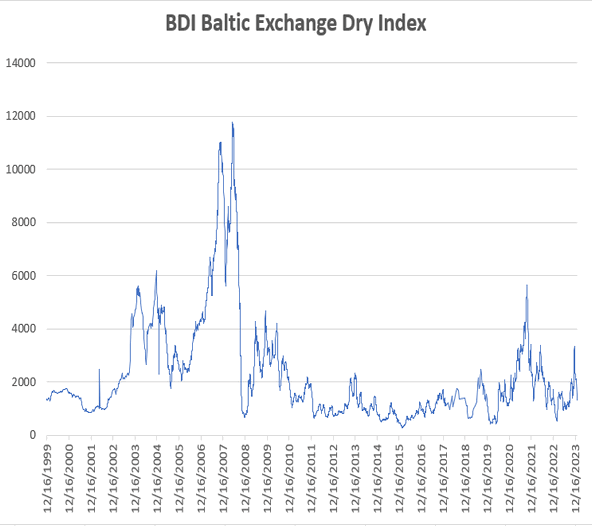
1. Watch the Baltic Dry - Many believe this index of the price of bulk shipping is a good early indicator of what's happening with global trade and, in particular, what's happening with demand from China for bulk imports such as iron ore, coal, soy etc.
It crashed in late 2008 and early 2009 just before global trade slumped more than a third and the global economy dived into recession.
HT to Roger Witherspon for pointing out the sharp drop in recent weeks, which contrasts with the rise in stock markets.
There has been a lot of new ships built, which might explain some of the drop as new supply of ships came onto the market.
HT AndrewJ for this link to a nice Joe Weisenthal explainer on this extra shipping supply. Joe says: 'Chill'.
But still...
2. Money is too tight to mention - Satyajit Das, the former options trader and author of Traders Guns and Money, has written another cracking piece at Naked Capitalism questioning the complacency in Australia about China's ability to dig (literally) Australia (and therefore New Zealand) out of trouble.
Das points to the problems many resources projects and businesses in Asia and Australia will have this year as European and US banks pull out of the region. He sees a tightening of credit and subsequent slowing of growth. HT Doug via email.
Here's the details:
The reduced participation reflects losses on sovereign bond holdings, pressures on bank capital and increases in US$ funding costs. European banks are actively looking to sell all or a portion of their Australian loan portfolios to alleviate the pressures. They are also cutting back on new lending to Australia clients, focusing on their home markets in Europe.
Given that Australian companies will need to re-finance around A$80 billion of maturing loans in 2012, these pressures are not welcome. The problems of European banks, active in commodity financing, may reduce the supply of credit to the sector by about 25-30%, which would impact Australia’s resources businesses.
The contraction of credit will also affect Australia indirectly. The withdrawal of European banks from Asia and other emerging markets is affecting the ability of companies to finance trade and investment projects. This affects Australian exports.
In 2007, European banks and US banks accounted for 30% and 10% of loan in Asia-Pacific. This has fallen by around half to 15-16% for European banks and 5-6% for US banks. The level of participation is likely to shrink further as a result of the problems of these banks. Troubled French banks account for about 11% of maturing loans in Asia Pacific. It is unlikely that these banks will maintain their level of commitment. Asia-Pacific banks have taken up the slack but are not sizeable enough to fill the gap completely.

3. France's growing far right - National Front leader Marine Le Pen wants to see France pull out of the Eurozone and the EU. She has 19% support going into the Presidential elections in April and May, polls recorded on Wikipedia show.
Here's Le Monde with a backgrounder.
Le Pen's pitch is this: that in order to go back to the idea of a strong, interventionist state, France must leave the EU.
"We will have to strike down the European treaties, the treaties of the mainstream parties, which are holding us back and condemning us to isolation. This anything-goes politics has become totally anachronistic throughout the world," she said earlier this month.
Le Pen is not scared of outspoken, even contradictory utterances on this issue. She is perfectly capable of dubbing the EU "the Trojan horse of ultraliberal globalisation" at the same time as comparing it to the USSR and referring to "a European Soviet Union".
4. The Christchurch Showdown - The Press' John McCone has an excellent backgrounder here on the revolt in Christchurch against the 'Bob (Parker) and Tony (Maryatt) show'.
He cites Peter Lynch, the local landowner who sparked a revolt via talkback radio:
Lynch has also kept up to date with the previous Bob and Tony controversies - the Henderson properties, the Ellerslie Flower Show, the rent rise debacle, the music school row. He has even felt exercised enough to pen the occasional letter and make requests for official correspondence. But you know how things are. His protests had not gone beyond that. Now, however, the energy around town is different, Lynch says.
"This whole earthquake thing has changed people's outlook on life. Before people were still apathetic. It was like, 'Aw, yeah, I know, but what can we do?' The difference today is that it's not 'What can we do about it', but 'What are we going to do about it?' "
Like many, he experienced an instinctive outrage on hearing Marryatt had been handed a 14 per cent performance pay rise - a six- month, back-dated increase that took his chief executive's salary from $470,400 to $538,529 a year.

5. Quick! Rent something! Anything! - Remember the rental panic story in the NZ Herald last year. Well it's back. Some editor must have marked it on his calendar.
"Must do this one next year."
It's the usual collection of slightly febrile anecdotes without any serious statistics to back it up. Yes Auckland has a property shortage and rents are rising faster in Auckland than anywhere.
But really?
Some areas have seen rents rise by up to 28 per cent and more increases are on their way as the first tax bills disallowing depreciation claims hit property owners from April.
Here's the Department of Building and Housing statistics showing median rents for 3 bedroom properties in Auckland were up 4% at NZ$500/week in December from December 2010. Rents for 3 bedroom properties are up 11% in the last two years and are up 9% for two bedroom properties. The CPI rose 6% over that period.
It's worse than inflation and the rest of the country, but it's not time to panic. It's not 28% rental growth.
We do however need a lot more housing in Auckland, which Len Brown seems to ignore completely whenever talking about Auckland's future. I watched coverage of his little speech on the 1.5 million population milestone yesterday and there was a lot of talk of trains and infrastructure, but not a single mention of housing.
Why not?

6. Fricken Fannie Mae - ProPublica and NPR have done a great job exposing how US government-owned mortgage giant Fannie Mae made profits betting that home owners would not be able to get loans.
Public documents show that in 2010 and 2011, Freddie Mac set out to make gains for its own investment portfolio by using complex mortgage securities that brought in more money for Freddie Mac when homeowners in higher interest-rate loans were unable to qualify for a refinancing.
"We were actually shocked they did this," says Scott Simon, who heads the mortgage-backed securities team at the giant bond trading and investment firm called PIMCO. "It seemed so out of line with their mission, out of line with what Congress wanted them to do."
Those trades "put them squarely against the homeowner," PIMCO's Simon says.

7. Chinese capital flight - Gordon Chang at Fortune has a look at the sharp rise in demand for gold in China and concludes it's probably not central bank buying.
There are an awful of newly (and often dodgily) rich people in China who want to salt there money away somewhere the Chinese government cannot get it or repossess it. New Zealand land perhaps?
But the first option is gold.
Here's Chang:
Although indicators showed the Chinese economy faltered only at the end of September, there had been a growing sense of pessimism inside the country for months before then. Beijing, after all, could build only so many “ghost cities” before citizens began to notice. As Joseph Sternberg of the Wall Street Journal Asia said on the John Batchelor Show last Wednesday, “people inside China seem to be losing faith in the Chinese growth story that we’ve been hearing so much about for the past few years.” Estimates of capital flight are sketchy, but it appears there was $34 billion of it in the third quarter of last year and a $100 billion in the fourth.
Not every Chinese citizen is in the position to export cash, so the next best tactic for the nervous is to buy gold, a refuge from plunging property prices and declining stock markets as well as an anticipated depreciation of their currency. “Within China,” notes Michael Pettis of Peking University, “many are going to argue that the rapid decline in the trade surplus, coupled with unmistakable evidence of flight capital, means that the PBOC should devalue the RMB.” And the fact that China’s leaders in public are talking about the adverse impact of the European crisis on China weighs heavily on sentiment.
The worst thing about capital flight and gold purchases is that they drain liquidity out of the Chinese economy just when it is needed most. Beijing can continue to work its magic as long as strict capital controls keep money inside the country. Once they fail to do so, however, all bets are off. The purchasing of gold, of course, results in the exporting of cash.
Chinese asset values have not yet crashed across the board, but the buying of gold—a leading indicator of panic—is an especially troubling sign that they will.

8. Modern American manufacturing - This detailed Atlantic investigation of the nature of jobs in American manufacturing plants is fascinating. It looks at the type of work available and the types of wages American factory workers can earn.
The issue turns on the point of automation. The story focuses on a 'Level 1' worker, Luke, who is a highly trained technician running robots, and Maddie, who is a 'Level 2' manual worker running a laser cutting device. Maddie is replaceable. Luke is not. The story helps explain the demise of America's post-war manufacturing-employed middle class and its replacement with a increasingly divided society where a few do very well and the rest are stuck in an impoverished underclass.
It shows the issue is a bit more nuanced than labour being cheaper than China. HT Koz via Twitter.
A Level 1 worker makes about $13 an hour, which is a little more than the average wage in this part of the country. The next category, Level 2, is defined by Standard as a worker who knows the machines well enough to set up the equipment and adjust it when things go wrong. The skilled machinists like Luke are Level 2s, and make about 50 percent more than Maddie does.
For Maddie to achieve her dreams—to own her own home, to take her family on vacation to the coast, to have enough saved up so her children can go to college—she’d need to become one of the advanced Level 2s. A decade ago, a smart, hard-working Level 1 might have persuaded management to provide on-the-job training in Level-2 skills. But these days, the gap between a Level 1 and a 2 is so wide that it doesn’t make financial sense for Standard to spend years training someone who might not be able to pick up the skills or might take that training to a competing factory.
Standard invests only in machinery that will earn back its cost within two years. For Tony, it’s simple: Maddie makes less in two years than the machine would cost, so her job is safe—for now. If the robotic machines become a little cheaper, or if demand for fuel injectors goes up and Standard starts running three shifts, then investing in those robots might make sense.
“What worries people in factories is electronics, robots,” she tells me. “If you don’t know jack about computers and electronics, then you don’t have anything in this life anymore. One day, they’re not going to need people; the machines will take over. People like me, we’re not going to be around forever.”
And here's the summary graph:
Throughout much of the 20th century, simultaneous technological improvements in both agriculture and industry happened to create conditions that were favorable for people with less skill. The development of mass production allowed low-skilled farmers to move to the city, get a job in a factory, and produce remarkably high output. Typically, these workers made more money than they ever had on the farm, and eventually, some of their children were able to get enough education to find less-dreary work. In that period of dramatic change, it was the highly skilled craftsperson who was more likely to suffer a permanent loss of wealth. Economists speak of the middle part of the 20th century as the “Great Compression,” the time when the income of the unskilled came closest to the income of the skilled.
The double shock we’re experiencing now—globalization and computer-aided industrial productivity—happens to have the opposite impact: income inequality is growing, as the rewards for being skilled grow and the opportunities for unskilled Americans diminish.
To solve all the problems that keep people from acquiring skills would require tackling the toughest issues our country faces: a broken educational system, teen pregnancy, drug use, racial discrimination, a fractured political culture.
This may be the worst impact of the disappearance of manufacturing work. In older factories and, before them, on the farm, there were opportunities for almost everybody: the bright and the slow, the sociable and the awkward, the people with children and those without. All came to work unskilled, at first, and then slowly learned things, on the job, that made them more valuable. Especially in the mid-20th century, as manufacturing employment was rocketing toward its zenith, mistakes and disadvantages in childhood and adolescence did not foreclose adult opportunity.
9. There is no poverty in America - Here's the New Yorker with some sobering black and white photos. HT MOD via Twitter.
10. Totally irrelevant Jon Stewart piece on The US Supreme Court's arbitary and archaic views on people who don't wear many clothes. It's definitely NSFW.
We welcome your comments below. If you are not already registered, please register to comment
Remember we welcome robust, respectful and insightful debate. We don't welcome abusive or defamatory comments and will de-register those repeatedly making such comments. Our current comment policy is here.