

Here's my Top 10 links from around the Internet at 10:00 am today in association with NZ Mint.
Bernard Hickey is on vacation and won't be back until early May.
I welcome your additions in the comments below or via email to david.chaston@interest.co.nz.
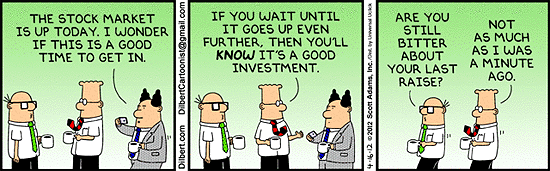
I am still keen to get your suggestions for suitable cartoons. If you notice a really good one, please email me. HT Adrian for today's one.
See all previous Top 10s here.
1. "It's a monstrosity"
If you think the new US FATCA law is tough for us, spare a thought for US citizens who live abroad. They are facing killer penalties if they make any mistake in their US tax returns.
Their law is now assuming that every US citizen living overseas is a tax cheat and that must prove otherwise. Extraordinary. It looks like it will take a tax professional a whole day just to complete one of the required forms. Here is a link to the story in the NY Times:
“It’s a monstrosity,” Steven R. Horton, whose tax practice in Paris advises American expatriates, said of the new demand from the U.S. Internal Revenue Service: Form 8938, the Statement of Specified Foreign Financial Assets. “It compels every taxpayer to try to find a way that they’re guilty of some kind of omission.”
The new requirement comes courtesy of the Foreign Account Tax Compliance Act, or Fatca, an effort to crack down on offshore tax evasion by U.S. citizens. The impetus for Fatca was the revelation that the Swiss bank UBS had been helping thousands of Americans - many of them U.S. residents - to cheat the Internal Revenue Service, an offence for which it paid a $780 million penalty and handed over details on thousands of clients to end prosecution.
The new form requires taxpayers to provide detailed information on their overseas financial accounts, including income derived from them. The penalties for failing to file start at $10,000. Significantly, tax experts warn, filers are subject to major penalties for underreporting - and even where innocent errors are made, they say, it will be up to the taxpayer to convince the IRS examiner of their innocence. The statute of limitations does not expire until after a corrected form is filed.
Proponents say Fatca will bring the U.S. Treasury huge sums each year once the IRS is able to compare individual tax data with reports from foreign financial institutions.
“Offshore tax evasion costs the U.S. jobs and billions of dollars each year, and it puts an unfair burden on the average American taxpayer to make up the difference,” Senator Max Baucus, the Montana Democrat who is chairman of the Senate Finance Committee and a sponsor of the legislation, wrote in an e-mail. “In an era when budgets are tight, it’s critical for the IRS to have the resources it needs to root out tax cheats.”
2. A grim fairy tale - Chinese stats
People are always suspicious of Chinese statistics - the expectation is that they have been sanitised up. So it was a bit of a surprise that Q1 2012 GDP data came in at +8.1% below most analysts estimates of +8.9%. However, now there has been some time to consider the latest data, suspicions are rising that there has in fact been some sanitisation 'up'. That is because the main components mostly seem to be suggesting only a +5% growth. And that's a huge difference that could reverberate around the world.
Here is Forbes analysis » and here are some key elements:
So how fast did GDP grow in Q1? By far, the best indicator of Chinese economic activity is the generation of electricity. In the January-February period electric output grew by 7.1% year-on-year according to official statistics. In March, output increased 7.2%, the slowest increase for a non-holiday month in a year. Because the growth in electricity outpaces the growth of the economy, it’s evident that China cannot be growing faster than 6%.
Actually, a 5% pace is more realistic because other signs point toward flattening growth. Home and commercial property sales dropped 14.6% in Q1 from the same period last year, for example. Bellwether passenger car sales for the quarter were down 1.8% year-on-year, and sales of commercial vehicles were off a stunning 10.8%. The latter figure, usually neglected by the China-watching community, is particularly important as it suggests general business activity will slow in coming months.
3. Is materialism a mental disorder?
If the desire for ever-more material goods is not itself a mental disorder, it is associated with higher rates of depression, anxiety and anti-social behaviour - or so suggests a new study. If you frame questions from a 'consumer' point of view, the responders are wary and cynical. The same questions framed from a 'citizen' point of view reveals a much more balanced response. ScienceDaily reports:
The findings have both social and personal implications, says psychologist and author of the study, Galen V. Bodenhausen. "It's become commonplace to use consumer as a generic term for people," in the news or discussions of taxes, politics, or health care. If we use term such as Americans or citizens instead, he says, "that subtle difference activates different psychological concerns."
We can also take personal initiative to reduce the depressive, isolating effects of a materialist mindset by avoiding its stimulants - most obviously, advertising. One method: "Watch less TV."
4. It may be Germany that leaves the euro first, rather than the PIIGS
The impacts of a two-speed Europe - one going flat out, the other going backwards - are now getting quite severe. It's basically an unnatural and unsustainable concoction where no country has sovereignty over its own monetary conditions. There's deflation and there is inflation both going on at the same time in different countries, and it is the inflationary effects in Germany that might be the tipping point. The WSJ explores the growing tensions:
Now the boot’s on the other foot. Loose credit conditions have been put in place to help peripheral Europe, and these are leading to wage and housing price pressures in Germany. If sustained, the inflationary forces will only exacerbate the already deep rift between the miserly instincts of the Bundesbank and the desire for easy policy within the rest of the ECB.
It’s hard to see a way out of this conflict. While peripheral Europe flounders under austerity and giant debt loads, Germany flourishes. Unemployment has fallen to 5.8%, creating a scarcity of workers that has attracted large-scale net migration under the EU’s freedom of movement rules.
The result: surging demand for housing, especially in the urban areas. The rate of price increase as calculated by BulwienGesa AG for 125 towns and cities was 5.5% last year, considerably higher than in 2010, which showed a significant 2.5% gain over the prior year. That’s not much by the standards of the pre-crisis U.S., but blazing for Germany.
Meanwhile, wages and salaries per employee rose more sharply in 2011 than at any time since 1993, according to the Bundesbank report. Add to that a recent deal giving Germany’s two million public sector workers a 6.3% wage increase for the next two years and you get fuel being added to a slow-burning fire.
Professor Joseph Stiglitz’s thesis may hold true: The cost for Germany will be so high that it is Germany that will leave the euro first.

5. 'Daddy, you are more evil than I thought'
A hedge fund manager who specialises in short selling explains his business to his son.
So, perceptively my son asked whether it was in my interest to dob scammers into regulators – he asked whether the reason we did not do it much was because of the reasons stated above or because we liked the scammers to be free and profitable. Alas – and I had to confess it – at least part of it was that being a successful short-seller required that regulators were inadequate to the task of policing fraud.
6. Interest rate crime
Various LIBOR investigations are throwing more light on the murky way this benchmark rate has been set. The Economist has dug into where these investigations are up to. The results for the offending banks at the center of this scandal could be very expensive indeed.
If the case is upheld, damages could be big. The American cases are being pursued under “class action” litigation. This means that if Baltimore’s case is upheld other cities sold the same products will also be able to claim damages. Across America 40 states allow municipalities to enter into swap agreements. The total estimated amount in 2010 was $250 billion-500 billion, according to an IMF paper.
What’s more, cases are being brought under the Sherman Act, America’s antitrust law, which allows for triple damages. Assume the worst and damages for American cities alone could go as high as $40 billion.
7. Satellite data II
Hard on the heels of our report of a satellite census that showed there were almost twice as many Antarctic emperor penguins than thought, 3D altitude maps captured by satellites show glaciers in part of the greater Himalaya range are bucking the global trend of continued ice loss - in fact they are growing. The UK Guardian has the story »
8. The Camorra never sleeps
This story had me riveted. It has nothing to do with the economy or interest rates, so I hope you don't mind if I link to it. Its a fairly long read, but gripping. We should really value the rule of law and an open society. This is what happens when democratic institutions get weak.
It's a crime story, about Naples. For years before they caught him, the Italian police had no idea that Paolo Di Lauro was one of Naples’s most powerful crime bosses, running a drug and counterfeit-goods empire - and responsible for a peace his turf had rarely known. Now authorities may long for the days when he was in charge. The full essay is in Vanity Fair.
“We have no choice. The Camorra has created an anti-state whose very existence threatens the legitimacy of the Italian state. If the courts did not act, they would not be real. If the courts are not real, Italy will not endure. Our role is not to prevail over the Camorra but to go through the motions of trying.”
9. Links between fracking and earthquakes
Scientists from the United States Geological Survey have cautiously weighed in on a subject that has sparked public concern in some parts of their country: spates of small and not-so-small earthquakes in oil- and gas-producing areas. It's a short and somewhat dense scientific note, but it does conclude ...
The acceleration in activity that began in 2009 appears to involve a combination of source regions of oil and gas production ...
The New York Times has an easier-to-read summary of the issue here » The issue is relevant for New Zealand given our drive to produce more oil and gas locally. And then there's this »
10. The last laugh
Someone made very complimentary comments a couple of days ago about this version of Top10. This one's for you, from the archives.
We welcome your comments below. If you are not already registered, please register to comment
Remember we welcome robust, respectful and insightful debate. We don't welcome abusive or defamatory comments and will de-register those repeatedly making such comments. Our current comment policy is here.