
By Bernard Hickey
Put down your coffee and croissant and pick up a pen. Now, put a note in your diary to ring your banker to ask for a better deal on your mortgage.
Seriously.
Banks are now desperate to keep your business and are frantically doing deals with customers behind the scenes to stop them defecting to rivals.
That means you shouldn't be paying the advertised rate for your floating rate or fixed rate mortgage. Expect your bank to match the best rate on the market and threaten to leave if they don't. See all the bank advertised rates here.
It hasn't always been like this.
Back in the olden days before the freeing up of New Zealand's banking system, it was much harder to get a loan. Those with grey or no hair will remember all the hoops that had to be jumped through and often the need to resort to borrowing via a soliticitor. Your bank manager was someone who had to be feared and genuflected to, not the other way around.
There was also a time in late 2008 and through 2009 when banks retreated into their shells in the worst of the financial crisis. Lending standards were toughened up and margins for some of the riskier types of lending were increased.
Those days are long gone.
The Reserve Bank's half-yearly Financial Stability Report released this week showed the banks are sitting on a cash pile worth NZ$49 billion that they're desperate to lend out. That's more than double their cash pile in late 2008.
The report also reports the banks can afford to give you a better deal. Bank net interest margins, which are the profits they make between the cost of their borrowing and their returns from lending, have rebounded from 1.87% in September 2009 to 2.32% in March. That's largely because most customers have switched from fixed rates, which are less profitable for the banks, to floating rates. There is plenty of fat there for the banks to burn through to keep your business.
Banks now know that to keep growing profits they have to either poach business from their rivals or reduce their operating costs. That's because they can no longer just sit there and watch their profits rise with the tide of a fast-growing mortgage market. Mortgage lending growth has collapsed from around 14% in 2007 to barely above 2% in 2012.
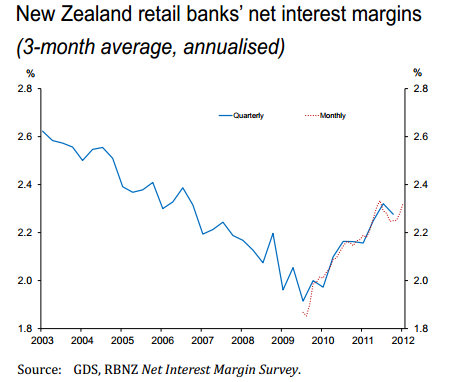
Retaining business is now even more important than growing business because there is so little growth.
The Reserve Bank is already seeing signs of this more intense competition in the form of a relaxation of lending standards. There's two ways a bank can win a mortgage: cutting the price with a lower interest rate or offering to lend more to a riskier customer by relaxing credit standards. Many are now doing both.
The central bank's quarterly survey of lending standards showed the biggest easing of standards in the March quarter since the onset of the Global Financial Crisis. It also showed lending officers expected an even bigger easing in the June quarter. That means it is now much easier to get a 90% plus home loan or to borrow an even larger multiple of your income.
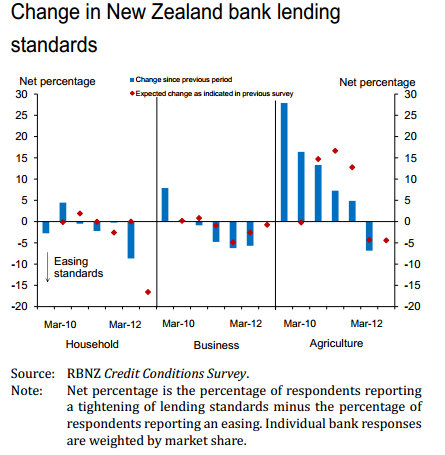
But for most people who already have a floating mortgage and don't want to borrow more, the best way to take advantage of these easier conditions and more competitive banks is to simply go to your bank manager and ask for lower rate.
The biggest opportunity is for those with floating mortgages. They are often put into 'set and forget' mode because they don't have a natural trigger for renegotiation when the term of a fixed mortgage expires. That means many borrowers are paying the advertised floating rate, which is around 5.7% for most banks. Don't pay that rate. Go straight to your banker and demand a rate of less than 5.4%. That's what most banks will agree to when pushed by a broker. If they don't move, then move to another bank.
Just like the L'Oreal ad says, do it because you're worth it. And the bank can afford it.
And as Rachel Hunter also famously said, it won't happen overnight, but it will happen.
We welcome your comments below. If you are not already registered, please register to comment
Remember we welcome robust, respectful and insightful debate. We don't welcome abusive or defamatory comments and will de-register those repeatedly making such comments. Our current comment policy is here.