

Here's my Top 10 links from around the Internet at 10:00 am today in association with NZ Mint.
Bernard will be back with his version tomorrow.
As always, we welcome your additions in the comments below or via email to bernard.hickey@interest.co.nz.
See all previous Top 10s here.
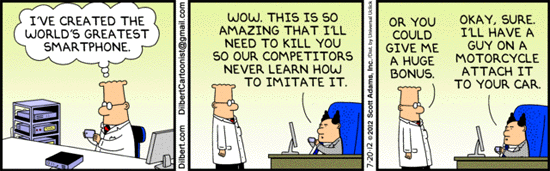
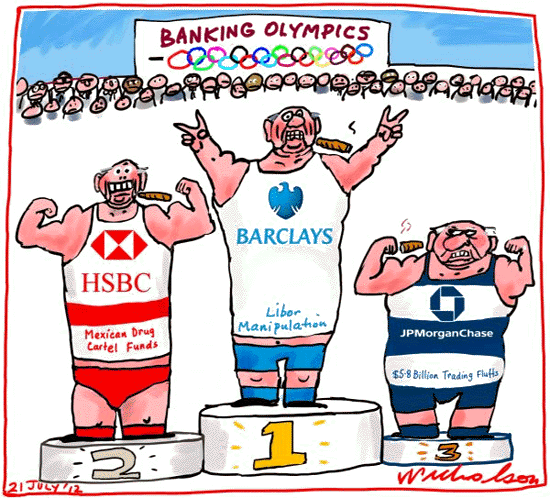
1. 'Crime of the century III'
Remember the New Zealand finance companies of 2005-2008? Many of these were risky endeavours, but among other reasons (supply and demand) they set their term deposit offer rates at a level benchmarked against banks. They did not wish to appear risky to investors.
Well, it turns out some of the world's largest investment banks used exactly the same strategy in 2008, as the Libor scandal is revealing.
The FT has more »
Regulators are focusing on at least four of Europe’s biggest banks as they investigate the attempted manipulation of the region’s benchmark interest rate, suspecting that Barclays’ traders were the ringleaders of a circle that included Crédit Agricole, HSBC, Deutsche Bank and Société Générale.
It has been clear for some time that about 20 institutions have been drawn into regulators’ sights over the affair. But until now, the details of how individual banks could be implicated has remained murky.
There had been a broad assumption that most banks under investigation were suspected of manipulating Libor submissions in the financial crisis period running from 2007-9 to appear healthier than they really were, sometimes allegedly with the implicit nod from policy makers.
However, the alleged involvement of traders at Crédit Agricole, HSBC, Deutsche and SocGen, predates the financial crisis by several years. Barclays’ settlement with regulators made it clear that there were two distinct periods of attempted manipulation – the first for trading gain, the second for broader reasons of financial stability.
Satyajit Das has been also looking at how these rates have been 'fixed'. He says the Libor fix may be a simple example of "beezle".
Coined by economist John Kenneth Galbraith, the term describes the fraud or embezzlement that occurs in booms as sharp people take advantage of the favourable conditions and abundance of money.
2. The EU needs a real central bank
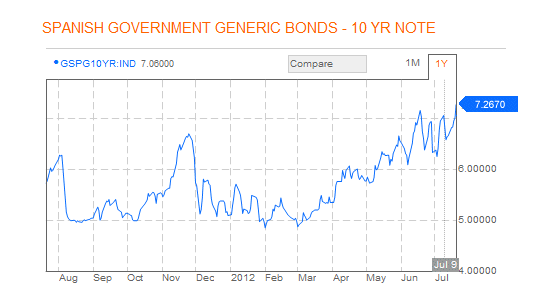
All major sovereign countries have crushing debt burdens. But investors are flocking to US Treasuries, UK Gilts, Japanese bonds, and Swiss government issues - but not to the euro. Just a very few years ago, the euro was considered a serious alternative to the US dollar as a reserve currency, but not any more. Why is this? It looks like it has a lot to do with the willingness and freedom to print money in a crisis - that is, do serious 'quantitative easing'. The EU/ECB won't, so the euro is being trashed. Is it too late to save it? Looks like that to me. Here is Anatole Kaletsky at reuters.com:
The ability to print money, officially known as quantitative easing (QE), has allowed the U.S., British and Japanese governments to run whatever deficits they wanted and to offer their banks unlimited support without suffering the sky-high interest rates that are now driving the Club Med countries toward bankruptcy. Instead of raising money from private investors, these governments finance their public spending and deficits by borrowing from their own central banks. This means that the U.S., British and Japanese governments are actually much more solvent than their huge deficits suggest, because much of their debt does not really exist. They are an accounting fiction – an IOU from one branch of government, the treasury, to another, the central bank. The Bank of England, for example, is lending £375 billion to the British government in 2009-12, out of a total planned deficit of around £450 billion. The Fed’s $3 trillion balance sheet effectively reduces the U.S. government’s total debt by 20 percent, from $16 trillion to $13 trillion.
Of course using printed money to finance government deficits cannot permanently solve structural economic problems such as poor education, crumbling transport infrastructure or unaffordable pension commitments – and in some circumstances financing of deficits by central banks can be extremely dangerous, generating rapid inflation. But the world today is not threatened by inflation and overspending, as it was in the 1970s and 1980s. Instead the danger is generally thought to be deflation caused by inadequate investment, weak consumer spending and falling wages, as in the 1930s.
3. The right must learn to love the state again
The 'right', especially the American right, has a serious blind spot when it comes to advancing ideas on how to address or solve the GFC issues and get beyond the them. They think excessively large government and government programs have caused the problem - and they might well be right. But the solution will not be as simple as 'shrinking government' - what is probably needed is a smaller but more nimble government, one organisationally transformed from the 1950's model (or even the 1930's model) which seems to have survived. Francis Fukuyama has a useful opinion piece in the FT on this, here »
If contemporary conservatives could get over their ideological aversion to the state, they would recognise that ... government is both necessary and in great need of reform rather than abolition. Private sector companies have undergone huge changes in recent decades, flattening managerial hierarchies, upgrading workforce skills and experimenting ceaselessly with new organisational forms.
[Government] needs to be smaller but also stronger and more effective. And this will not happen unless people see public service as a calling, rather than a despised occupation for people unable to make it in the private sector.
4. Waiting for the rain
There has been a noticeable and worrying shortfall in the amount of rain falling in this years Indian monsoon season. Last year things were normal to heavy, but this year the subdued season has India on edge. Or so Chandrahas Choudhury reports:
For about a month, Indian foreheads have been creasing at growing fears that the rains brought by the annual southwestern monsoon -- the climatic feature that most strongly distinguishes the subcontinent -- are going to be less than normal this year.
As of this week, the rain shortfall in India was about 22 percent, compared with the 50-year average, and the shortfall in several critical regions was worse. A rain map of India in 2011, a year in which the monsoon was close to normal, is here, revealing the enormous variations seen across a landmass as large and yet local as India.
Monsoon rains are crucial to India's agriculture and economy, because they provide about four-fifths of the country's annual rainfall, because much of the arable land is still mainly rain-fed, and because about two-thirds of the population still depends directly or indirectly on agriculture (even if agricultural output comprises a much lower percentage of gross domestic product than in decades past).

In Australia, by contrast, things are normal to wetter this year, a far cry from the droughts of a few years ago - which some reckoned pointed to a sign of things to come - well, they didn't. What came was normal variation.
5. One year on
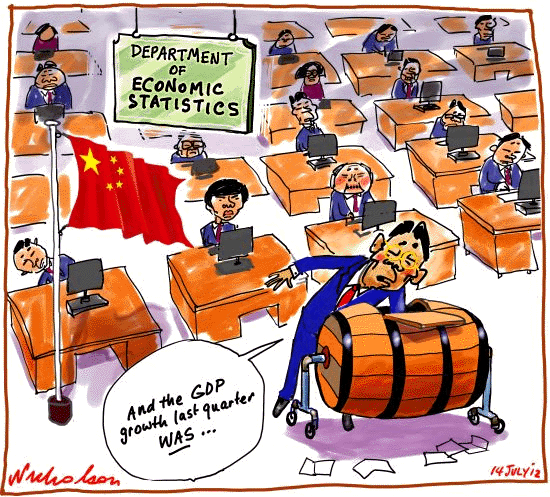
The markets have ignored S&P's ratings downgrade of the US and it seems to me they are ignoring the coming 'fiscal cliff'. BusinessWeek reports:
When Standard & Poor’s stripped the US government of its top AAA credit rating last August, predictions of doom followed. Mitt Romney called it a “meltdown” and warned of high long-term interest rates and damage to foreign investors’ confidence in the U.S. Republican Representative Paul Ryan of Wisconsin, who chairs the House Budget Committee, said the cost of mortgages and car loans would rise. Mohamed El-Erian, chief executive officer of Pimco, the world’s largest bond fund, forecast erosion in the standing of the dollar and U.S. financial markets.
They were wrong.
Almost a year later, mortgage rates have dropped to record lows, and the government’s borrowing costs have eased. Yields on 10-year Treasury notes - in effect, the interest rate the bond market charges the government on long-term credit—have plummeted from 2.56 percent just before the downgrade to 1.51 percent on July 17. The dollar is up 11 percent against an index of major currencies, and the Dow Jones industrial average has risen 12 percent. International investors’ enthusiasm for the US has strengthened, with 46 percent of respondents in May’s Bloomberg Global Poll calling it the market with the most potential.
Warren Buffett turned out to be prescient. “The US is still triple-A,” he said in 2011 amid the uproar. “In fact, if there were a quadruple-A rating, I’d give the US that.”
Buffett owns 13% of Moody's of course - and you might even say Buffett is his own credit ratings agency, given the power of his opinion.
6. 450 year old debt. Trillions owed
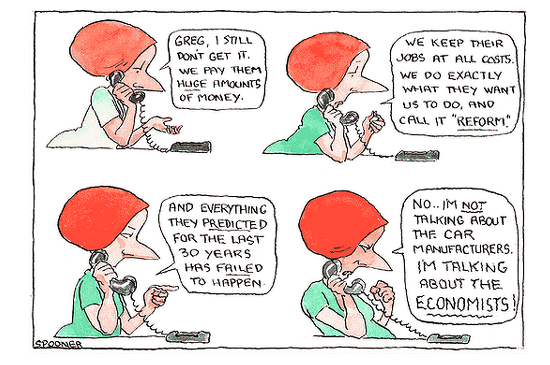
It is not a good idea to let a debt go unpaid for a long time - or maybe it is. CSMonitor.com has the tale:
The sleepy hamlet of Mittenwalde in eastern Germany could become one of the richest towns in the world if Berlin were to repay it an outstanding debt that dates back to 1562.
A certificate of debt, found in a regional archive, attests that Mittenwalde lent Berlin 400 guilders on May 28 1562, to be repaid with six percent interest per year.
According to Radio Berlin Brandenburg (RBB), the debt would amount to 11,200 guilders today, which is roughly equivalent to 112 million euros ($136.79 million).
Adjusting for compound interest and inflation, the total debt now lies in the trillions, by RBB's estimates.
7. Adopting a great idea
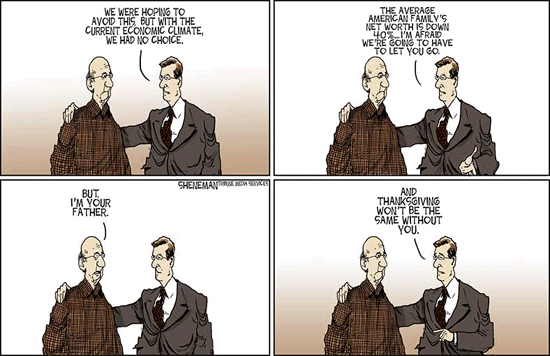
Russian Prime Minister Dmitry Medvedev (Vladimir Putin's alternate) is calling for the introduction of a common currency for the Eurasian Union of former Soviet countries as a hedge against growing volatility. They want to use the good bits from the euro experiment.
The first thing to do when creating a single-currency union is establish a common central authority overseeing the fiscal policy in each of the bloc's countries, something eurozone countries don't have, said Alexei Devyatov, chief economist at UralSib Capital.
I don't think the obvious colonising implications will go down that well outside Russia, however.
8. Windows that generate electricity
UCLA researchers have developed a new transparent solar cell that is an advance toward giving windows in homes and other buildings the ability to generate electricity while still allowing people to see outside. Their study appears in the journal ACS Nano.
"These results open the potential for visibly transparent polymer solar cells as add-on components of portable electronics, smart windows and building-integrated photovoltaics and in other applications," said study leader Yang Yang, a UCLA professor of materials science and engineering, who also is director of the Nano Renewable Energy Center at California NanoSystems Institute (CNSI).
Yang added that there has been intense world-wide interest in so-called polymer solar cells. "Our new PSCs are made from plastic-like materials and are lightweight and flexible," he said. "More importantly, they can be produced in high volume at low cost."
9. Toward a cashless society
Money is an abstraction. ASB has recently put it on Facebook. It's on mobile phones around the world. Whatever it looks like or whatever it’s backed by, what matters is that people believe in it. James Surowiecki has penned a brief history of money to put it in perspective.
Today, many people long for simpler times. It’s a natural reaction to a world in which money is becoming not just more abstract but more digital and virtual as well, in which sophisticated computer algorithms execute microsecond market transactions with no human intervention at all, in which below-the-radar economies are springing up around their own alternative currencies, and in which global financial crises are brought on for reasons difficult to parse without a PhD. Back in the day, the thinking goes, money stood for something: Gold doubloons and cowrie shells had real value, and so they didn’t need a government to stand behind them.
In fact, though, money has never been that simple. And while its uses and meanings have shifted and evolved throughout history, the fact that it is no longer anchored to any one substance is actually a good thing.
10. Where the hell is Matt?
Talk about not knowing what you’ll be when you grow up! This from the NY Times: (love that seal!)
Matt Harding was a video-game designer in his early 20s, traveling the world. On a whim, he put together the now-immortal video, “Where the Hell Is Matt?” It consisted entirely of short clips of Matt, a non-dancer, doing his “stupid dance” in one famous world location after another, edited to a great, soaring song. The result had a power, a universality, a happiness, that drove it to become one of YouTube’s most popular videos.
And now Matt released his 2012 video. It’s a big departure - and it’s a masterpiece.
This time, it’s not Matt just swinging his arms, stepping in place. This time, he actually learned to dance, often in the style of the country he was visiting. As a result, there’s a feeling of collaboration, of immersion, that wasn’t in the earlier video.
We welcome your comments below. If you are not already registered, please register to comment
Remember we welcome robust, respectful and insightful debate. We don't welcome abusive or defamatory comments and will de-register those repeatedly making such comments. Our current comment policy is here.